


Cash-strapped Merafong City Local Municipality has spent almost half its R2.6 billion annual budget on professional services while failing to service its water and electricity bills, senior sources at the local government say.
To meet its salary obligations, the municipality allegedly used conditional grants intended for service delivery to pay the salaries of councillors and staff.
This comes as the municipality fails to pay its Eskom and Rand Water accounts, leaving residents without water for months.
According to documents the Mail & Guardian has seen, excluding bulk utility payments to Eskom and Rand Water, Merafong City Local Municipality paid R821.6 million to 19 primary professional, technical and operational service providers between June 2023 and May 2026.
The municipality spent R97.5 million on attorneys between February 2023 and May 2026.
The budget for Merafong Municipality was about R2.6 billion for the 2023/24 financial year.
This means the municipality spent more on professional services than it would have paid for water and electricity services for the community.
A whistle-blower at the municipality told the M&G that in one instance, the municipality was seeking a company to provide a financial management system and opted for a company that was more expensive than others.
The M&G is aware of the companies involved.
“The company most municipalities use was going to cost the municipality about R39 million but the company that was preferred was costing the municipality R69 million,” the source told the publication.
“The bid evaluation committee had recommended the R39 million company based on pricing and experience but eventually they irregularly selected the R69m company.”
The source said that between Eskom and Rand Water, the municipality owed about R2.5 billion.

Regarding water-related issues, the source said the municipality was not billing residents, meaning that much of the water being used was non-revenue water. Non-revenue water refers to water lost through leaks, theft or meter tampering.
“If you go to those taps, you will see that there are no meters there. This means that the water is essentially free and that should not be the case because the municipality still needs to pay Rand Water for the water residents are using.”
Driving through the mining town of Carletonville, the deterioration of infrastructure is clearly visible.
A few kilometres away lies the township of Khutsong.
As you drive into the township, ANC posters can be seen attached to almost every street pole. The area has long been an ANC stronghold and the party governs the municipality outright. Some residents said that despite their dissatisfaction, they would continue to vote for the ANC, while others said they would rather abstain from voting than support another political party.
Driving around the community, one is greeted by the sight of women pushing wheelbarrows loaded with water containers, women and children carrying water on their heads and community members queuing at communal taps to fill their containers.
A group of residents who spoke to the M&G at a public tap in the Batswana section said they relied on taps built during the apartheid era because the municipality was failing to provide basic services such as water.
The residents said they had been without running water in their homes for the past eight months and the communal taps had become their only source of water.
Residents said the taps had been installed before democracy as communal water points for township residents.
A chicken-dust businessman who was at the tap said he had used the tap four times since opening his business at around 9am. The visit took place at about 1pm.
“I’ve come here four times already and you can see I’m carrying four 20-litre containers. There was even an elderly woman walking with a stick and limping. I offered to carry her water home because I couldn’t stand by and watch her struggle with such a heavy load.”
The businessman said he understood that the municipality had failed to pay water tanker contractors, resulting in the suspension of water deliveries.
“The people operating the water tankers told us they had stopped because they were not being paid by the municipality and could no longer afford diesel, vehicle maintenance or employee salaries. That is why they stopped delivering water to us.”
One woman, who had four five-litre buckets lined up at the tap, said smaller containers were easier for her to carry but that also mean she had to return several times each day.
“It’s better now because the children are still at school but from 3pm the queues become very long. You can wait for hours.
“Some people arrive with four 20-litre containers and bring children carrying additional buckets. The water also comes out very slowly.”
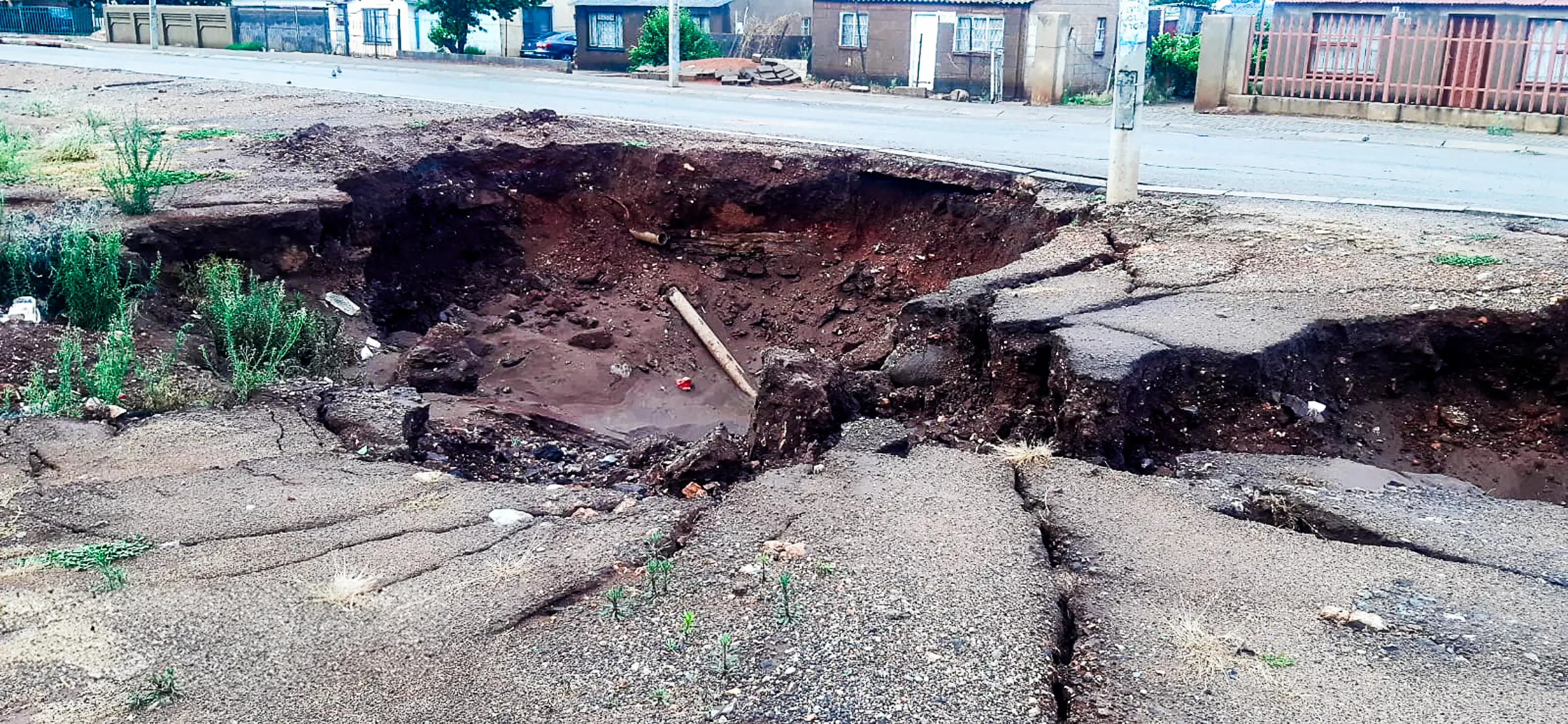
The Khutsong area has long been known to be an area affected by huge sinkholes. The sinkholes started forming in the township in 2021, forcing families to abandon their homes as they were deemed unsafe. This did not only affect households. A relatively new clinic, Khutsong West Clinic and Relebogile Secondary School also closed.
The Khutsong West Clinic was closed indefinitely, effective from May 1, 2025, Relebogile Secondary School was closed in 2023, forcing pupils to study under makeshift classrooms.
Tirisano Preschool, which had served the community for more that 40 years, closed last year and was eventually demolished because it had collapsed into a sinkhole.
Elizier Digwamhje, a resident who was forced to leave her home in 2021 after it was damaged by a sinkhole, said the municipality relocated her on 25 November 2021 after informing her that the property was no longer safe.
Digwamhje said municipal officials instructed residents to move at around 9pm but did not provide alternative accommodation. She said that the next day, the mayor had told them that they would be accommodated in RDP houses.
“The RDP houses were 45m2, while my house was 295m2. We had furniture and belongings — just think about the difference. It’s painful because we worked hard for those homes and then suddenly we were told to move into an RDP house.”
“The municipality told us the move would be temporary but when we asked for written assurance on how long we would be there, they refused to provide it.”
“I have had to stay with relatives and they don’t seem to care where we are. There have been sinkholes in town but if I took you there today, you wouldn’t even know they had existed. The houses in the township, however, have been neglected.”
She said she was forced to rely on family members for accommodation while waiting for the municipality to address the sinkhole damage.