


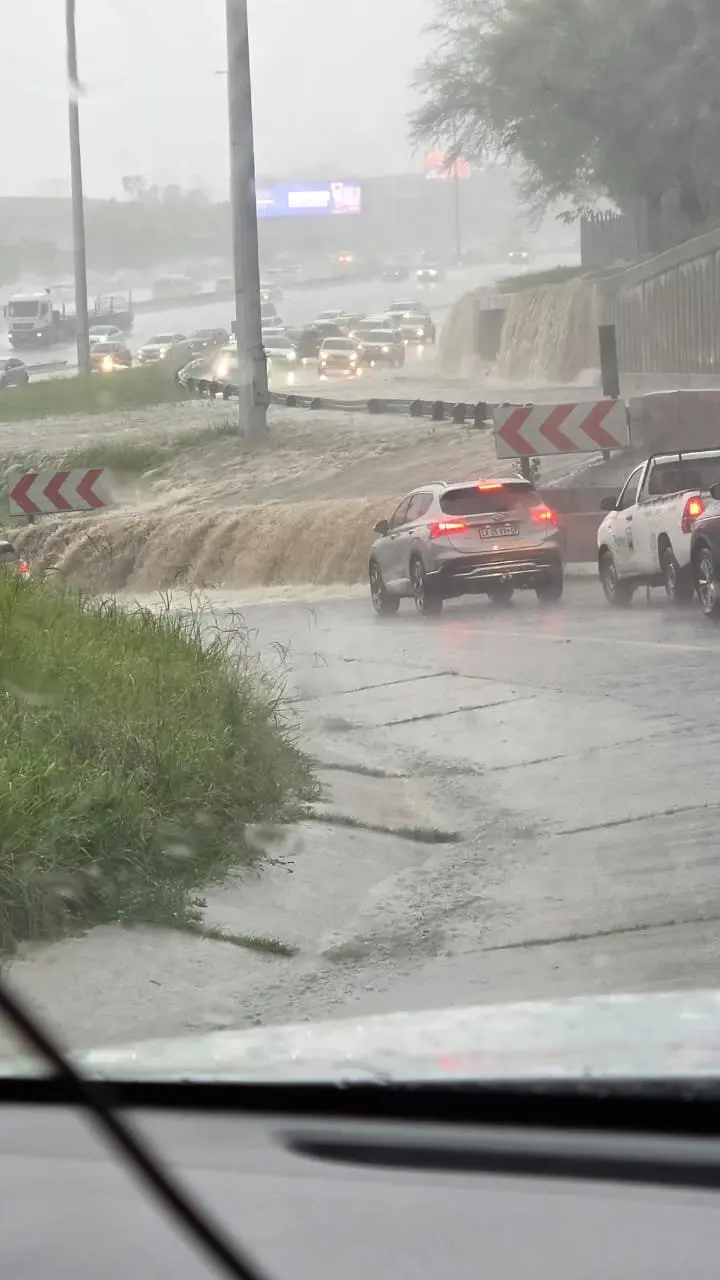
Floodwaters swept through homes, informal settlements and roads across Gauteng on Wednesday, leaving communities stranded, damaging infrastructure and prompting emergency rescues as severe thunderstorms battered Johannesburg, Ekurhuleni and Tshwane.
In Alexandra, floodwaters inundated homes and streets, submerging vehicles and leaving residents scrambling to escape rising water. Some residents were forced to climb through their roofs to get out of flooded homes.
The Jukskei River also rose sharply in Alexandra, spilling into surrounding areas near Cheetah Street, as floodwaters inundated parts of the township.
In Ekurhuleni, Gugulethu informal settlement was among the worst affected, with most of its informal structures reportedly washed away. Homes in Skomplaas informal settlement near Springs were also flooded, with some roofs torn off.
The city’s disaster and emergency services recorded 20 storm-related incidents, including 15 water-rescue incidents and five involving fallen trees.
Johannesburg Emergency Management Services (EMS) spokesperson Robert Mulaudzi said the service had received a high volume of emergency calls, mainly relating to flooding in residential areas and damage to roads and bridges in Soweto, Alexandra, Midrand and Fourways.
Trees had also fallen, while the EMS aquatic rescue team rescued a motorist in Witkoppen whose vehicle had been swept away.
One of the worst incidents was the collapse of road infrastructure on Nasrec Road in Riverlea, which was closed between Main Reef Road and Dunlin Drive.
But the extent of flooding could not be explained by rainfall alone. The way cities are built also influences how much water runs off into stormwater systems.
Dr Ione Loots, from the University of Pretoria’s department of civil engineering, said rainfall measurements at one of the university’s monitoring sites in Tshwane showed a peak intensity of approximately a one-in-10-year event.
Although official data from the South African Weather Service (SAWS) was not yet available, this meant rainfall of that intensity had a 10% probability of being equalled or exceeded in any given year, she said.
“Built-up areas have large impermeable surfaces, which reduce infiltration and increase the amount of runoff that needs to be managed,” Loots said. “This can place additional pressure on local drainage systems.”
Densification and the expansion of paved surfaces reduce the space available for rainwater to soak into the ground, potentially contributing to localised drainage problems and flooding.
However, stormwater systems are not designed to prevent all flooding. Their capacity is based on an assessment of risk, with infrastructure designed to manage more frequent rainfall events rather than every possible storm.
“Stormwater management systems in South Africa and internationally generally cater for smaller, more frequent events (typically up to the 1:2 to 1:5-year return period) through the minor drainage system, which includes kerb inlets and stormwater pipes,” she said.
During more severe rainfall, these systems can be overwhelmed. Roads then form part of the larger drainage network, carrying excess runoff.
“During severe rainfall, some temporary flooding of roads is expected, as roads form part of the major drainage system and convey excess runoff,” Loots said.
She said it was not economically feasible to build drainage systems capable of accommodating every possible rainfall event. Whether existing municipal systems were adequate also depended on their condition, maintenance and capacity, as well as changes in surrounding urban areas.
“We therefore cannot assume that all flooding is due to inadequate infrastructure, or that all infrastructure is necessarily performing as intended,” she said.
Mulaudzi said many of the emergency calls involved blocked stormwater drains and flooding in residential areas, particularly in Soweto and Alexandra.
“Especially in our townships, most of our townships, they're blocked,” he said. “In Soweto, [there are] blocked stormwater drainage systems, like in Alexandra, it's the same issue.”
He said residents needed to be better educated about the importance of keeping stormwater drains clear, particularly when it was not raining.
“When people clean up, they normally throw things in there. They don't know what's going to happen when it rains and there’s a flash flood,” he said. “The importance of those drainage systems, I think we need to educate our communities about.”
EMS teams rescued a motorist whose vehicle was swept away in Witkoppen. The motorist managed to cling to a tree until emergency responders reached him.
Motorists also continued to put themselves at risk by attempting to drive through flooded roads, sometimes removing barriers put in place to prevent them from crossing.
“We still have issues like motorists trying to cross. On most of the roads, motorists take a chance. They will even remove those barricades and try to cross those areas,” Mulaudzi said.
“People underestimate the current of the water. They say, ‘My car is much bigger, I can pass here.’ Then, when they're in the middle of the road, they get stuck.”
He urged residents to take weather warnings seriously and avoid crossing flooded roads and bridges.
He said emergency management teams had been deployed to Alexandra to assess residents' needs and determine what assistance was required from municipal departments, including the JRA and City Parks.
The Johannesburg Roads Agency (JRA) said the closure was necessary to ensure public safety while engineers assessed the damage and arranged repairs.
The JRA deployed rapid-response teams to clear debris from stormwater drains and assess affected roads and bridges.
It reported flooding in several parts of the city, including Alexandra, Soweto and Bramfischerville. In Slovo Park, river flooding overtopped Cavendish and Stockwell roads, while a local culvert was overwhelmed by stormwater runoff.
The SAWS recorded 44mm of rain in Johannesburg on Wednesday, 36mm in Pretoria and 18mm at OR Tambo International Airport in Ekurhuleni.
SAWS senior forecaster, Tokelo Chiloane, said the storms developed under conditions favourable for deep convection, with sufficient atmospheric moisture, strong daytime surface heating and atmospheric instability supporting thunderstorm development.
Strong updrafts contributed to hail formation, while downdrafts and heavy precipitation resulted in damaging winds and localised flooding, particularly where storms persisted or repeatedly developed over the same areas.
Chiloane said El Niño may have contributed indirectly through warmer-than-normal temperatures, which could promote stronger surface heating and support thermal convection.
However, it could not be directly blamed for the storms or their intensity, as sufficient moisture and atmospheric instability were also necessary for severe thunderstorms to develop, she said.
Mulaudzi said he believed changing weather patterns and climate change were contributing to increasingly disruptive rainfall. “Ten years ago, it was just a talk ... we thought it was something far away, but now it's a reality,” he said.
He pointed to the damage caused by rainfall lasting only an hour or two, questioning what the consequences would be if heavy rain persisted for five or six hours. “When it rains, it doesn't rain for long, like an hour or two, rainfall causes chaos,” he said.
The JMPD said most major roads and crossings had reopened by Thursday morning after water levels receded, and traffic was flowing across the city. But it urged motorists to remain cautious, warning that mud, rocks, fallen branches and other debris remained on some roads, while some traffic signals were still out of order.
Further showers and thundershowers were forecast for Johannesburg on Thursday, raising the risk of renewed localised flooding because the ground was already saturated.
Motorists were urged to avoid low-lying bridges and overflowing streams if water levels rose again, and not to remove road closure barriers or attempt to drive through floodwater.