


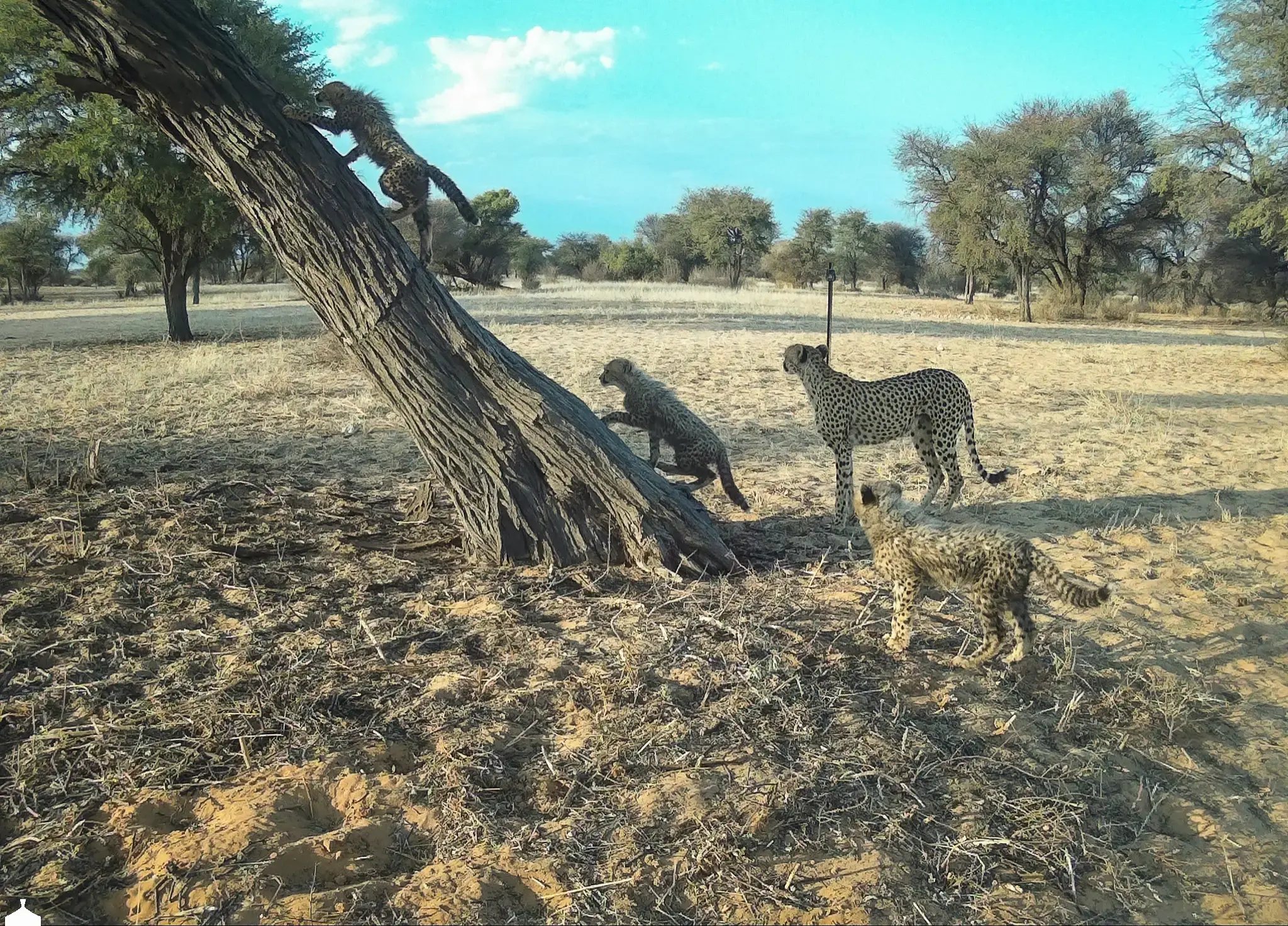
South Africa’s last free-roaming cheetahs are hanging on by a thread.
A landmark four-year census has found that only 119 free-roaming cheetahs — 83 mature adults and 36 cubs — remain outside the country’s national parks and private game reserves, with researchers warning that previous estimates overstated the population by about 70%.
The findings, released by the Free-Roaming Cheetah Census, provide what researchers describe as the first robust scientific baseline for the country’s remaining wild cheetahs roaming across parts of the Northern Cape, North West and Limpopo.
The census paints a sobering picture of a population increasingly hemmed in by fences, development and habitat fragmentation, leaving the last free-roaming cheetahs isolated in shrinking pockets of habitat.
The census focuses on South Africa’s last free-roaming cheetahs living outside fenced reserves and national parks, not the country’s managed cheetah populations.
“The long-term survival of South Africa’s free-roaming cheetah relies significantly on coexistence and effective wilderness corridors provided by farmers and landowners of protected wildlife areas,” said Marna Smit, the project coordinator at Ashia Cheetah Conservation and a contributing author to the census, in a statement.
The study found that the species’ range is split into two distinct regions. In the west, spanning the Northern Cape and western North West, cheetahs move relatively freely across commercial livestock farms and the Botswana border where fencing is more permeable.
In contrast, the bushveld landscapes of eastern North West and Limpopo are increasingly dominated by intensive game farming, hunting estates and protected ecotourism landscapes with more predator-friendly fences.
While the region features a higher tolerance for predators and abundant wild game, “natural wildlife corridors are increasingly constrained by impermeable game fencing, often trapping cheetah within fencelines”.
The high density of fences, coupled with human development along the Mahikeng-to-Gaborone corridor, has physically bisected the range. According to the research, it is no longer ecologically accurate to view South Africa’s free-roaming cheetahs as a single, fully connected population.
For now, genetic results are indicative of a relatively connected population.
“At this stage, biological fragmentation between the two regions does not appear to be strong yet, suggesting that until now or at least recently the gene flow has occurred and the two regions have been genetically connected,” the study said.
But without intervention, the future of the charismatic big cats is fragile.
“However the ecological evidence does point to increasing restriction of movement between the regions, particularly where human population density and impermeable fencing create barriers,” it said.
Genetic differentiation in long-lived mammal populations, like the cheetah, often becomes detectable only after several generations, typically in the order of five to 15 generations, known as multigenerational “genetic lag”.
“Given a cheetah generation time of four to six years, this suggests that measurable genetic structuring may lag behind landscape fragmentation and disturbance by several decades.
“Thus, although full genetic separation has not yet occurred, the conditions are in place for this process to continue if connectivity declines further and population numbers remain below 100.”
That provided an important conservation opportunity, the authors said.
If connectivity can be maintained by protecting and restoring open wildlife corridors across private land while expanding conflict mitigation programmes that help farmers coexist with predators, genetic exchange may support population resilience and reduce long-term isolation risk.
The census, conducted between October 2022 and 2026, covered an area about 2.4 times the size of the Netherlands.
Researchers travelled more than 400 000km, deployed 389 camera traps that captured 5.2 million images, conducted 299 interviews with farmers and landowners, collected biological samples and analysed GPS tracking data.
The project was undertaken by Ashia Cheetah Conservation, the Cheetah Outreach Trust and the University of Groningen, with support from farmers, landowners and local communities.
Smit added that the long-term survival of free-roaming cheetah relied significantly on coexistence and effective wilderness corridors provided by farmers and landowners of protected wildlife areas.
“With 83 wild adults identified in these vast northern borderlands, cooperative conservancies and permeable fencelines are highly valuable management tools.
“This data shows that we have a clear window to reinforce habitat corridors, bridging the management of South Africa’s free-roaming cheetahs with national parks and private metapopulations to support the species across this last natural range.”