


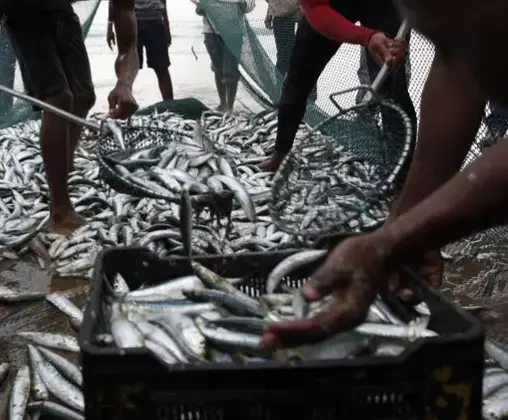
The investigation into the mass death of sardines along South Africa’s West Coast is increasingly pointing to pilchard herpesvirus (PHV) as the cause, although scientists have yet to conclusively establish that the virus is responsible.
No new mass mortality incidents have been reported since 16 August, suggesting the acute phase of the event may have eased, according to the department of forestry, fisheries and the environment, which said that monitoring and testing were continuing.
While the investigation has focused on what is killing the sardines and what the mortality could mean for the marine ecosystem, the event has now had a more immediate operational consequence.
On Friday, Eskom said it had to reduce Koeberg Unit 1 to 50% power as a routine safety precaution after a cooling-water pump automatically shut down because of a buildup of marine material in the station’s seawater intake area.
“There is currently an increase in sardine mortality along the Southwestern and West Coast that is under inter-agency investigation,” Eskom stated. “Nuclear and operational safety at the station was never at risk. Emergency response teams were activated to clear the intake area and operations on Unit 1 will return to normal after the cooling water intake is fully restored.”
On Friday, the City of Cape Town said its urban waste management’s cleansing department was busy with the clean-up and removal of the large numbers of dead sardines that had washed ashore between Silwerstroomstrand and Milnerton.
“Over the last few weeks, dead and dying sardines have been observed washed ashore at various locations covering an extensive area as far afield as Saldanha Bay on the West Coast to Cape Agulhas on the Cape south coast, as well as some Cape Town locations,” it said.
It noted that the cleanup was slightly delayed as the city’s disposal department was required to request an exemption to allow for the disposal of the dead fish at Vissershok Landfill due to the designation of the fish as possibly infected.
“This exemption request is in process and has been escalated to Minister of Forestry, Fisheries and the Environment David Maynier due to its urgency.”
The city said the environment department had released the results of the diagnostic testing that was done on the affected fish, which were collected off various beaches along the affected area, confirming that PHV genetic material was present in sampled sardines. “Its role in the recent sardine mortality remains under investigation.”
The environment department said about 75 sardines have been included in the PHV testing programme. Initial testing by the South African Institute for Aquatic Biodiversity and Rhodes University found PHV genetic material in all 15 fish examined.
Importantly, the 10 fish collected during the mortality event consistently showed high viral levels. Viral levels varied among five sardines that were caught alive and appeared healthy when collected.
The viral sequence was also found to be a 99.7% match to an Australian PHV gene sequence.
The department has since processed about 60 additional samples for PHV screening. Preliminary results from roughly half of these indicate high levels of the virus, although confirmatory testing is under way.
Scientists are also examining a further 40 samples for pathological evidence of disease. They are looking for the characteristic inflammation and damage to the gills associated with active PHV disease.
This distinction is important because detecting a virus in a fish does not by itself establish that it caused the fish’s death. The pathological examinations could provide stronger evidence of whether PHV was actively causing disease in the sardines.
PHV is a virus that infects sardines, which are also known as pilchards. Major PHV-associated mass mortality events occurred in Australia and New Zealand in the 1990s. In Australia, the 1995 and 1998–99 events resulted in substantial sardine mortalities.
The department says that in the Australian case, the virus caused inflammation and thickening of the gills, interfering with oxygen uptake and leading to respiratory distress and death.
For the West Coast, the department said investigations into other possible causes had provided little evidence that harmful algae were responsible for the mortality.
Paralytic shellfish toxins were not detected, while domoic acid and yessotoxin were found at low levels. The highest concentrations were recorded in an apparently healthy comparison sample. Examination of stomach contents and material rinsed from the gills also found no harmful algae at densities considered capable of causing the mortality.
Unusually cold water and low-oxygen conditions were recorded along parts of the West Coast, but the conditions were broadly similar to those observed during a recent pelagic recruitment survey before the mortality event, when no dead or dying sardines were seen.
Low oxygen also occurs periodically along the West Coast without previously resulting in sardine deaths on this scale.
The fact that the mortality appeared to be restricted to sardines made a broad environmental cause less likely, the department said, although environmental conditions could yet be ruled out as contributing stressors.
“Taken together, the evidence increasingly points to PHV as the leading explanation,” the department said, adding that its causal role would be confirmed once the pathological examinations and wider surveillance results were available.
The findings do not pose a known human-health risk. PHV is a fish virus and there is no evidence that it can infect or cause disease in people.
The detection of PHV therefore does not, on its own, mean that healthy sardines caught commercially or canned sardine products are unsafe to eat.
A high-level task team involving the department, affected municipalities, management authorities, the fishing industry and other stakeholders has also held its first meeting and agreed on a coordinated response.
The plan includes expanded surveillance and testing, clearer guidance on the disposal of dead fish, public-health communication and an assessment of the potential impact on the sardine resource.
The public is being urged not to collect, eat or feed dead or dying sardines to pets. The department would provide further updates as confirmed results become available.