


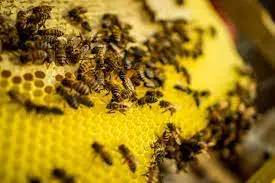
They may be tiny but honey bees could help tackle a big environmental problem: the lack of monitoring for pesticide pollution in sub-Saharan Africa’s water.
The insects naturally collect water from their surroundings and carry it back to their hives.
Researchers at the University of Pretoria suggest that by catching returning water-foraging bees and analysing the water stored in their crops, scientists could detect pesticide contamination in nearby surface water.
The proposal, outlined in a new research article published in the July/August edition of the South African Journal of Science, could offer a relatively simple and low-cost way to monitor pollution, particularly in remote areas where conventional sampling equipment is difficult or expensive to maintain.
The idea is significant because the researchers found that water-quality data for four widely used pesticides — atrazine, glyphosate, metolachlor and imidacloprid — are available for only 17 of 49 sub-Saharan African countries.
The researchers, from the social insects research group in the University of Pretoria’s Department of Zoology and Entomology, say this represents a major gap in understanding pesticide contamination across the region.
Agriculture is a major source of pressure on freshwater quality in sub-Saharan Africa, with pesticides applied to crops able to reach surface water through spray drift and runoff.
More than 40 million hectares of land in the region are used for maize production while the researchers expect production to increase sharply as demand grows.
Their review of scientific literature and reports found usable records on the presence of the four pesticides in water, soil or sediment for just 17 countries. They found no records covering the four pesticides in water bodies in Central Africa.
South Africa had by far the most monitoring data and some of the highest reported concentrations. The maximum recorded atrazine concentration in a South African water body was 298.2 micrograms per litre (µg/L), almost 150 times the European Union’s environmental quality standard of 2 µg/L.
Reported imidacloprid concentrations reached 390 µg/L and metolachlor 120 µg/L, while glyphosate concentrations ranged from 0.42 to 3.19 µg/L.
The researchers caution that these figures should not be taken as representative of water quality across South Africa or the continent. Most countries had only one to four monitoring records, providing only a limited snapshot of contamination.
“This figure illustrates a significant and concerning gap in water monitoring data in sub-Saharan Africa,” they write.
Some of the pesticides also face restrictions elsewhere. Atrazine was banned in the European Union in 2004 because of concerns about its persistence in groundwater, while S-metolachlor has not been approved for use in the EU since 2024 because of groundwater contamination concerns.
Outdoor agricultural uses of imidacloprid were effectively banned in the EU in 2018 because of concerns about its effects on honey bees and other pollinators.
How the bee monitoring could work
Honey bees need water for several purposes, including cooling the hive and feeding young bees. A returning water-foraging bee can carry roughly 30 to 58 microlitres of water in its crop.
Researchers could potentially catch these bees at the hive entrance and analyse the water they are carrying for pesticide residues. Detecting pesticides could provide an “early warning sign” of possible surface-water contamination in the area around the hive, the researchers suggest.
Because honey bees generally forage within about a 3km radius, the insects and hive products such as honey, pollen and beeswax could provide information about contamination within a defined area.
The approach is not entirely new. Honey bees have already been used to monitor environmental contaminants elsewhere in the world. Airports in countries including Germany, Italy, Malta, Sweden and the Czech Republic have used hives for environmental monitoring, while Italy has used bees to monitor agricultural chemicals since the 1980s.
The researchers say the approach could be particularly useful in remote and rural parts of sub-Saharan Africa, where conventional water-monitoring equipment and long-term sampling stations can be difficult or expensive to maintain.
But bees are also exposed to the pesticides they could help detect. The researchers say honey bees encounter pesticides through contaminated water, plants, pollen and nectar, as well as dust and hive products such as beeswax.
Exposure does not necessarily kill them outright: low doses can have “sublethal” effects on behaviour, learning, navigation, immunity and other functions.
Imidacloprid has received particular attention, with studies linking low doses to effects on foraging, navigation, learning and memory, temperature regulation and immunity.
Yet relatively little is known about how these pesticides affect African honey bees under local conditions. Only seven studies from five sub-Saharan African countries have examined the effects of imidacloprid or glyphosate on honey bees under local conditions.
At the same time, residues of one or more of the four pesticides have been detected in honey or pollen sampled in countries including South Africa, Kenya, Mozambique, Tanzania, Uganda and Côte d’Ivoire.
Importantly, the researchers calculated that a single load of contaminated water would generally contain pesticide doses well below the lethal doses for the four pesticides studied. The value of the bees therefore lies less in measuring immediate toxicity and more in their ability to act as living samplers of their surroundings.
The authors describe honey bees and beehive products as “excellent indicators of environmental contamination” and suggest managed hives could provide both qualitative and quantitative information on pollution.