


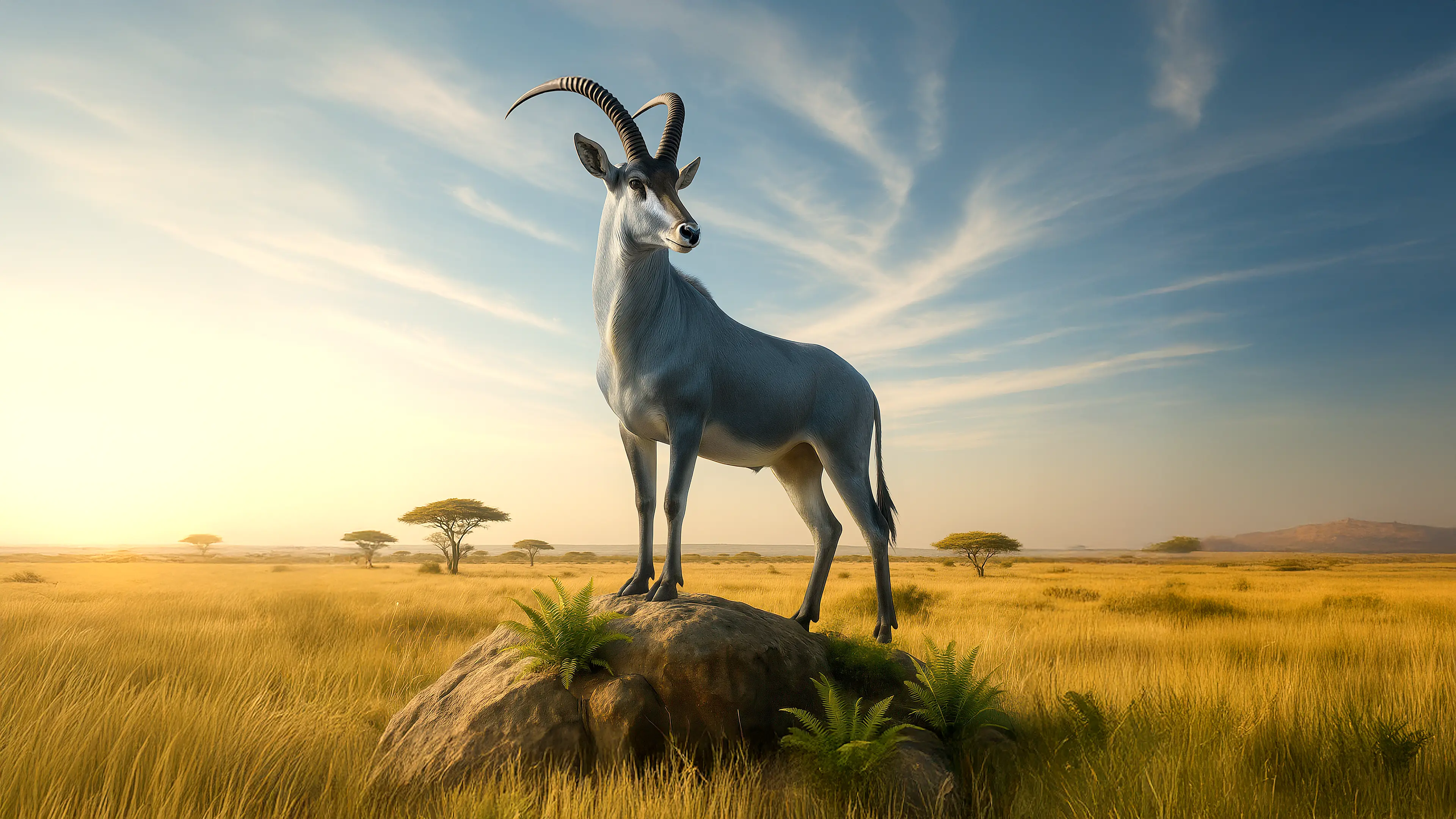
Hundreds of years ago, the silvery-blue bluebuck roamed the coastal grasslands of the Western Cape. But by about 1800, it had vanished forever. Research suggests that its small, isolated population was vulnerable to extinction before hunting by European settlers delivered the final blow.
Now, more than two centuries after the last bluebuck disappeared, Texas biotech company Colossal Biosciences is attempting something that sounds like science fiction: bringing the extinct antelope back.
Colossal, the billion-dollar company behind controversial "de-extinction" projects involving the woolly mammoth, dire wolf, thylacine, dodo and moa, is working to reconstruct the bluebuck genome and create an animal carrying the genetic and physical characteristics of the extinct species.
Colossal, which describes itself as the "world's first de-extinction company", has attracted criticism over whether genetically modifying a living relative can be described as resurrecting an extinct species. Critics say genes alone cannot reproduce everything lost when a species disappears, including its genetic diversity, behaviour, ecological relationships and evolutionary history.
The debate intensified after Colossal announced in 2025 the birth of three animals it says are dire wolves. The International Union for Conservation of Nature's Species Survival Commission's Canid Specialist Group said they were not dire wolves "nor are they proxies of the dire wolf based on IUCN SSC guiding principles of extinct species for conservation benefit".
The group said creating grey wolf pups with edited genomes "may demonstrate technical capabilities but it does not contribute to conservation", warning that such proxies could threaten living species.
But Colossal argues that its aim is not to produce perfect genetic copies but to reconstruct the genomes and defining biological characteristics of extinct species.
For its bluebuck work, the company is using the roan antelope, its closest living relative, as the genetic reference species and eventual surrogate. Researchers sequenced DNA from a bluebuck museum specimen held by the Swedish Museum of Natural History. Comparing the bluebuck and roan genomes revealed about 18 million genetic differences, Colossal says.
They have narrowed them to about 20 000 candidate variants in coding or regulatory regions that could be associated with characteristics such as coat colour and horn shape.

Matt James, Colossal's chief animal officer, said the project was in the genome-editing and cell-engineering phase rather than the embryo stage. The company has created induced pluripotent stem cells (iPSCs) from roan antelope, which James said was a world-first for the species. The cells provide a platform to test candidate genetic edits before they are introduced into an embryo. The genome-editing work is running alongside embryology and assisted-reproduction research.
"We've had to build entirely new procedures for a taxonomic group that has had little to no reproductive research completed before," he said.
Colossal has developed what James described as world-first ovum pick-up procedures in roan antelope and scimitar-horned oryx. "The ART [assisted reproductive technology] work is the piece with the most immediate conservation payoff." The technique could be used to help genetically rescue small, fragmented antelope populations losing genetic diversity, James said.
The reproductive work includes developing techniques to retrieve and mature viable eggs, with the aim of using somatic cell nuclear transfer to produce embryos for implantation in a surrogate, which is an "incredibly difficult challenge".
Producing gene-edited embryos would be the next stage, once candidate edits had been finalised and validated in the roan iPSC lines, he said.
The first bluebuck birth was "years away". "Any number I gave you today would be provisional at best and probably wrong," James said when asked how many genetic edits would be made. "We're not editing everything that's different. We're editing what's phenotypically load bearing."
He said Colossal was not merely creating a genetically modified antelope. "We're building a genomic reconstruction of the bluebuck, not copying an existing genome."
The company is working from the museum-derived genome to reconstruct what he called the defining bluebuck traits, including its coat, horn shape and body proportions.
"That's a different and, in some ways, more impressive scientific achievement than cloning would be. We're resurrecting a genome that hasn't existed on this planet in over two centuries and putting it back into a living, breathing animal."
But Dr Carel Oosthuizen, of the University of Pretoria's department of zoology and entomology, said it would be more scientifically accurate to call the resulting animal a "genetically reconstructed proxy" or a "synthetic hybrid" rather than a true resurrection of the species.
Oosthuizen said that because DNA degraded over time, Colossal could not perfectly reconstruct the original bluebuck genome. Instead, he said, it must use the genome of the living roan antelope as a "scaffold" and edit it to match recovered bluebuck DNA.
"That means the resulting animal is essentially a modified roan antelope with bluebuck-like traits inserted into its DNA. It is not a true Hippotragus leucophaeus but a novel, human-made organism, a rewrite of the genome of a surrogate species, effectively a proxy designed to fill a similar ecological role."
The company ultimately intends to rewild the animals, although James stressed that rewilding would be the final stage of a much longer process.
The bluebuck's historical range was in the grassland ecosystems of the south-western Cape, within what is now the Cape Floristic Region. This habitat has been degraded by land conversion, invasive species and agricultural expansion. "None of that gets undone by producing a genetically accurate bluebuck," he said.
Habitat restoration and addressing the drivers that made the region unsuitable would have to happen well before any reintroduction.
James said Colossal has not publicly identified a reintroduction site; that was being worked through with the Endangered Wildlife Trust (EWT) and other conservation partners. Colossal has engaged Advanced Conservation Strategies to evaluate potential sites and the South African regulatory pathway.
But Oosthuizen said the scientific case for reintroduction faced another problem: the little that is known about the extinct animal, which "makes a responsible reintroduction nearly impossible to model". "Most records were written by hunters or early naturalists who noted superficial traits (colour, horns) but rarely detailed behaviour or diet."
Scientists could infer some characteristics from related species, he said, but "we lack critical data on its specific diet." Without a reliable ecological baseline, he said, "scientists cannot accurately assess how the animal would interact with modern flora and fauna or whether the current environment can support it".
Oosthuizen said a reconstructed animal would not necessarily behave like the extinct bluebuck.
"We also have to acknowledge that in social mammals such as antelopes, behaviour is largely learnt rather than instinctive … A proxy born to a surrogate of a different species would likely learn the behaviours of its foster mother rather than those of the extinct species."
He said factors beyond DNA, including the gut microbiome and epigenetic effects shaped by maternal and environmental conditions, could influence how a reconstructed animal developed, digested food and responded to stress.
Yolan Friedmann, the EWT chief executive, said the organisation had agreed to assist, "at this preliminary stage, with identifying, preparing and protecting suitable protected area sites that could support the prospective future release of bluebuck".
"Any further involvement will depend on the outcome of the conservation value and risk assessment (CVRA), which the Colossal Foundation has contracted Applied Conservation Solutions to develop."
The EWT would proceed beyond the initial stage only if the CVRA indicates that the rewilding of de-extinct bluebuck presented a suitably low level of risk and offered a clear, significant conservation benefit for biodiversity, she said.
The department of forestry, fisheries and the environment said Colossal and its partners had not approached it to discuss the project.
Any genetically engineered bluebuck would face South Africa's biosafety and environmental regulatory framework. The department said the Genetically Modified Organisms Act covered genetically engineered organisms, with a 2021 notice confirming that genome-editing tools fell within the framework.
While the department said genome editing could offer solutions to environmental challenges, it warned that "such innovative solutions come with uncertainties and risks".
"All activities involving GMO activities are subject to a rigorous scientific risk assessment process, conducted … case by case … to evaluate potential risks to human health, biodiversity and the environment, with the hindsight of the precautionary approach principle where needed.
Oosthuizen was more pessimistic about the modern landscape, noting that it has changed "drastically and irreversibly" since 1800. He questioned whether enough contiguous habitat remained for a self-sustaining population.
"Releasing a herd today could see animals entering farmland, where they may be viewed as pests or starve for lack of native forage," he said.