


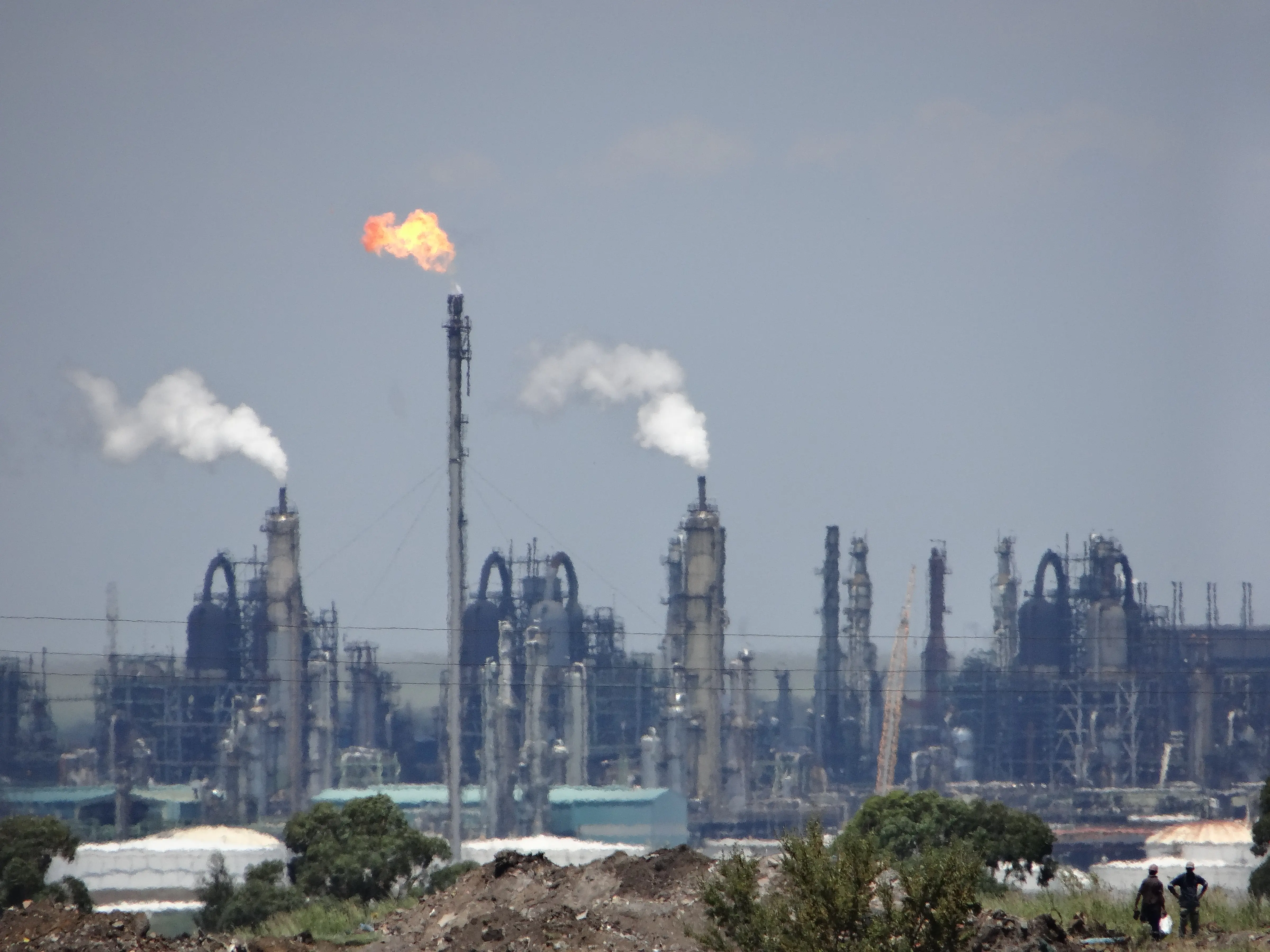
Air pollution from Sasol's Secunda operations is estimated to contribute to about 1 000 deaths every year and cost the economy about R19 billion annually, according to a new health impact assessment by the Centre for Research on Energy and Clean Air (Crea).
For the 2024/25 financial year, Crea estimates that emissions from the coal-to-liquids complex contributed to about 1 100 preterm births, 820 low birthweight births and 2 030 asthma emergency room visits, including about 930 involving children aged between zero and 17.
The assessment also estimates 260 new cases of childhood asthma and about 23 800 years of life lost across the exposed population as a result of premature deaths associated with the facility's emissions.
The figures are statistical estimates of the additional health burden associated with pollution from the facility, rather than a tally of identifiable individuals whose deaths or illnesses were directly caused by the plant.
Crea used emissions reported by Sasol in an atmospheric dispersion model to estimate the facility's contribution to pollution and associated health impacts. The assessment covers emissions from stacks in the facility, rather than associated activities such as transport.
"We use source-specific air pollution modelling," said Jamie Kelly, an air quality analyst at Crea. "The Highveld has many pollution sources but our analysis isolates the emissions from Sasol Secunda and models how those emissions disperse and undergo chemical transformation in the atmosphere.
"We then estimate the health impacts associated specifically with that additional pollution, rather than attributing the Highveld's overall pollution burden to Sasol."
Daniel Nesan, the report's lead author and an air quality analyst at Crea, said the study sought to answer a straightforward question: "When this facility releases pollution, where does it go? What does that mean for people's health and who is bearing the cost of this pollution?"
The report estimates that Sasol emitted 112 000 tonnes of sulphur dioxide (SO2) in 2024, along with significant quantities of hydrogen sulphide (H2S), particulate matter and other pollutants.
Nesan said the scale of the SO2 emissions illustrated the significance of the facility. He said Secunda emitted almost a third more SO2 than the UK as a whole in 2024.
"Releasing pollution through a stack doesn't make it just disappear; it just changes where the pollution goes," he said.
The modelling found that pollution from the facility contributes to higher concentrations close to Secunda, while fine particles can travel considerably further.
The estimated mortality burden reflects exposure to PM2.5 and NO2, including secondary particulate matter formed in the atmosphere from SO2, H2S and nitrogen oxides.
The assessment showed that the health burden "start early in life and continue as they reach adulthood", Nesan said.
Crea estimates that the pollution resulted in about 23 800 years of life lost and 468 000 work absence days during the financial year.
The associated health burden is estimated at $1bn (R19bn). The figure includes the economic value of premature deaths, illness, disability, healthcare use, adverse birth outcomes and productivity losses.
"The cost is real even though the company responsible for these emissions doesn't pay the cost directly," Nesan said.
The findings come as Sasol operates under alternative SO2 emission limits that are less stringent than South Africa's minimum emission standards (MES). Crea said the generally applicable standard for the relevant boilers is 1 000mg/Nm³, while Sasol's approved alternative limits are 1 700mg/Nm³ for the west stack and 1 400mg/Nm³ for the east stack. The alternative limits apply until March 2030.
Crea is calling for the alternative limits to be reviewed, arguing that stronger emission reductions would deliver substantial health benefits to communities in and around the Highveld Priority Area, a designated air pollution hotspot.
The report also highlights a separate regulatory problem involving H₂S, the gas associated with recurring "rotten-egg" odours reported around Secunda and, at times, across parts of Gauteng.
Strong sulphurous odours were reported in Johannesburg and elsewhere in Gauteng in January and March this year, "continuing a pattern of recurring episodes reported since at least 2021".
In March, the department of forestry, fisheries and the environment said the odour was probably caused by H₂S. It acknowledged that although Sasol was operating within its legal emission limits, investigations had found the limits "were not enough to properly protect public health, particularly for communities around Secunda".
Last year, the government proposed reducing the H₂S emission standard for coal-gasification processes from 3 500mg/Nm³ for existing facilities to 600mg/Nm³ for new and existing facilities.
However, the department subsequently said revised amendments would undergo another round of public consultation.
Crea said the odour episodes and their health impacts were additional to the PM₂.₅ and NO₂ impacts quantified in its assessment.
Nesan said the rotten egg smell represented only part of the problem. "We can't use it to judge the full extent of people's exposure and we cannot assume that when the smell is absent, there is no pollution."
The report recommends that the environment minister review Sasol's alternative SO₂ limits and introduce binding annual emissions reductions across the Secunda complex covering SO₂, nitrogen oxides, particulate matter and H₂S.
It also calls for stronger emissions reporting and independent monitoring, with data made publicly available, as well as greater involvement of affected communities in air quality planning and enforcement.
Robyn Hugo, the director of climate change engagement at Just Share, said the alternative limits raised questions about whether communities were receiving adequate protection.
"South Africa's emission standards are weaker than those in other developing countries, yet Sasol Secunda has been allowed to operate under limits that are even more lenient.
"This raises fundamental questions about whether the regulatory system is providing the level of protection that communities should expect and that is legally required to protect constitutional rights, and whether the environmental and social risks of these operations are being adequately accounted for."
Sasol said it was studying the report and it would be premature to comment on the conclusions before completing a detailed review.
It said it had not independently verified Crea's estimates and could therefore not endorse the specific figures.
"Any attempt to attribute health outcomes to a single emission source should be approached with caution given the complexity of air quality in the Highveld Priority Area, which is influenced by multiple industrial, domestic, transport and regional sources," Sasol said.
The company said its application for alternative SO₂ limits was not an attempt to obtain general leniency but sought to have emissions from its Secunda steam-plant boilers regulated on a load basis rather than solely through concentration limits.
Sasol said the approach was expected to deliver greater overall reductions in SO₂ emissions than an equivalent mass reduction under the concentration-based limit, while reducing particulate matter and nitrogen oxides.
It said its application was supported by atmospheric impact and health risk assessments. Ambient SO₂ concentrations in Secunda and surrounding areas were below national ambient air quality standards.
The company said it had invested more than R9.5bn in emission-abatement initiatives since 2015 and expected its roadmap to reduce SO₂ emissions from its steam plants by about 30% by 2030 from the 2019 baseline, while also reducing NOx, particulate matter and greenhouse gas emissions.
Sasol is challenging provisions of the Highveld Priority Area air quality management plan and implementation regulations requiring emissions reductions of 40% by 2030.
It said the legal proceedings were primarily aimed at clarifying whether the 40% target was an industry-wide objective to which regulated emitters would collectively contribute or a binding requirement applicable to individual facilities. It had submitted its emission reduction and management plan and was awaiting feedback from the relevant licensing authority.
The report's findings come against the backdrop of the landmark "Deadly Air" litigation. In 2022, the high court found that poor air quality in the Highveld breached residents' constitutional right to an environment not harmful to their health and wellbeing.
That finding was upheld on appeal, with the Supreme Court of Appeal confirming the government's legal duty to implement and enforce the Highveld Priority Area air quality management plan.
The department of forestry, fisheries and the environment said it had taken note of Crea’s findings, but did not endorse its estimate of about 1 000 premature deaths and R19 billion in annual health and economic costs.
“The department notes the Crea’s report, like all scientific reports that seek to provide scientific evidence on the impact of pollution to human health and the environment,” it said.
The department said it was unlikely to review Sasol’s alternative SO₂ emission limits because the former environment minister’s decision was functus officio, meaning the decision was final and could only be reviewed by a court.
However, the department has published a draft proposal to amend the National Environmental Management: Air Quality Act’s Section 21 notice, which would curtail the provision allowing alternative emission limits until March 2030.
The proposal was published for public comment in Government Notice 12039 in the Government Gazette 55255 on 28 August.
The department said Sasol’s Secunda operations fell within the Highveld Priority Area, where the Highveld air quality management plan, promulgated in 2025, sets an emissions-reduction target of 40% by 2030.
These targets are supported by priority-area regulations promulgated in 2024, which apply to all polluters in the area.
It said Sasol’s court challenge to the 40% reduction requirement was sub judice and that the department had yet to file its responding affidavit.
The department confirmed that it had not conducted a Sasol-specific health-impact assessment. On compliance, it said that, according to records submitted by Sasol, the facility had not exceeded its current alternative SO₂ emission limits since April 2025.