


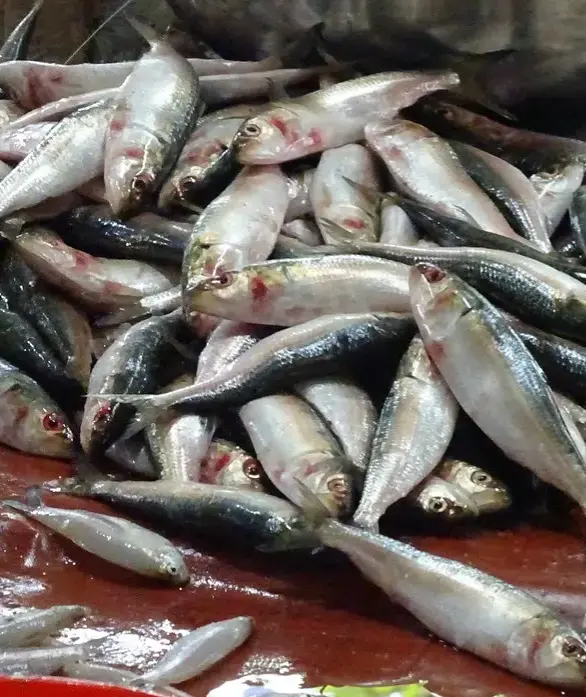
South Africa’s sardine fishery could face precautionary restrictions as the government grapples with the uncertain scale of a mortality event that has now been reported across about 2 600km of coastline, from Henties Bay in Namibia to the northern Wild Coast.
The department of forestry, fisheries and the environment said in an update on Thursday that it is “considering possible precautionary, time-limited management of the fishery” as pilchard herpesvirus (PHV) remains the leading explanation for the deaths.
The possible intervention comes as the department acknowledges that it does not know how many sardines have died or how much of the stock may have been lost.
In an updated frequently-asked-questions document, the department said the total allowable catch could “potentially” be reduced, “if scientific assessment indicates that the mortality has materially affected stock status, recruitment or the assumptions underlying the applicable management procedure.
“The detection of PHV itself does not automatically require a TAC reduction. Any change would be considered through the established scientific and management process.”
It said that no comprehensive assessment of the seabed has been conducted. An unknown proportion of fish may have sunk, washed ashore or remained undetected.
The 2 600km span represents the geographical extent of reported strandings and sightings, rather than the number of fish affected.
The department said the available evidence did not indicate that the mortality represented a large proportion of the overall sardine stock, but cautioned that it should not be interpreted as meaning the stock was unaffected or that the uncertainty had been resolved.

A hydroacoustic survey planned for October and November is expected to provide the first reliable fisheries-independent estimate of sardine biomass and distribution after the mortality event.
The timing is significant because South Africa’s sardine total allowable catch (TAC) was increased in July, based on information available at the time. The department said the subsequent detection of PHV is new information that is now being incorporated into the management process.
“Short-term availability and socio-economic considerations were also taken into account. The subsequent PHV detection is new information and is being incorporated into ongoing scientific monitoring and management.”
It said that depending on the evidence, measures could include intensified monitoring and reporting, increased sampling, temporary catch controls, changes to catch limits or fishing-season duration, spatial measures or broader temporary restrictions.
“The appropriate response would depend on the magnitude and distribution of the risk and would be reviewed as new information becomes available.”
Last week, the South African Pelagic Fishing Industry Association (Sapfia) told the Mail & Guardian that the hydroacoustic survey was imperative and acknowledged that a significant reduction in sardine biomass would have implications for the directed sardine TAC.
The industry has opposed calls for an immediate moratorium on small-pelagic fishing, saying this would effectively close the entire sector. It has called for an evidence-based approach to assessing the mortality.
The new departmental document also provides greater clarity on a disputed figure of 1% that entered public discussion after the mortality event began. The department said it did not produce or approve an estimate that the mortality represented 1% of the sardine population.
But it acknowledged that an illustrative calculation discussed during preliminary scientific deliberations produced a quantity “of the order of 1%” of the biomass measured earlier in the year.
The calculation was based on applying the density of dead sardines recorded near Dyer Island across a much larger area, the department said, and was subject to major assumptions and uncertainties. It was not an estimate of total mortality.
The distinction is important because much of the mortality may never have been observed at the surface.
PHV signal
PHV was associated with two large-scale sardine mortality events in Australia and New Zealand during the 1990s, although the virus was later detected in apparently healthy Australian sardine populations without causing continuous mortality.
The historical events are relevant but cannot simply be used to predict what is happening in South African waters, the department said. It said differences in fish distribution, oceanography, coastline, surveillance and stock conditions mean the Australian experience cannot be directly transferred to South Africa.
The virus has not previously been reported in South African sardines. In the current event, genetic material from PHV has been detected in both dead fish and apparently healthy sardines, although viral levels have generally been higher in fish associated with mortality.
The department said that strengthens the association between PHV and the deaths but the presence of viral genetic material alone did not establish that the virus caused the mortality.
Scientists are looking for the characteristic gill inflammation and tissue damage associated with PHV, which can interfere with oxygen uptake and cause respiratory distress. Some of the earliest Western Cape specimens had deteriorated too rapidly for reliable pathological assessment.
Other possible contributing factors remain under investigation, including unusually cold water, strong upwelling, low oxygen, harmful algal blooms, toxins, water quality and other infectious agents.

How did PHV get here?
The question of how PHV came to be present in South African sardines remains unclear.
The department said it was considering several possible biosecurity pathways, including infected fish or biological material, imported sardines or bait and other routes. It was testing samples of imported sardines supplied by industry and said imported bait might also be considered for screening.
The department said there was no evidence that imported frozen sardines, ballast water or any particular country, company, fishery or shipping route introduced the virus.
The possibility is nevertheless significant because contaminated frozen sardines used as feed in Australian bluefin tuna farming were implicated in the investigation of a major PHV-associated mortality event there.
Last week, WWF-SA conservation scientist Craig Smith told the M&G that South Africa should investigate whether similar pathways existed locally, including imported sardines used by processors and sardines imported as bait.
Finding PHV in an imported sardine would not, on its own, establish that imports introduced the virus into South African waters. The department said wider testing, including of sardines caught before the current mortality event, would be needed to determine whether the virus was recently introduced or had been circulating undetected.
The department has also clarified that the 99.7% genetic match between the South African virus and an Australian PHV sequence does not establish that the virus came from Australia.
It indicates that the detected viral genetic material was closely related to the Australian sequence used for comparison but did not identify its geographic origin or route of introduction.
PHV has been confirmed in sardines associated with mortality in Gqeberha, strengthening the evidence that the event there may be linked to the earlier Western Cape mortality.
The virus remains the leading explanation, but the department said the presence of viral genetic material did not by itself establish causation.
Pathology is being used to look for the characteristic gill inflammation and tissue damage associated with PHV. Some of the earliest Western Cape specimens had deteriorated too rapidly for reliable pathological assessment.
Other possible contributing factors remain under investigation, including unusually cold water, strong upwelling, low oxygen, harmful algal blooms, toxins, water quality and other infectious agents.
The potential consequences extend beyond the fishery. Sardines are a major food source for African penguins and other marine predators,and last week BirdLife South Africa warned that a substantial reduction in the sardine stock could have serious consequences for the endangered seabirds.
The department said it was monitoring predator responses as part of its assessment of the event. It said the mortality estimates remained “highly uncertain” and that the event might not yet have run its course.