



Nearly a year ago, Ermelo came perilously close to running out of water. Now the Mpumalanga town is again facing the prospect of empty taps, with severe pollution, rampant water leaks and an El Niño likely to reduce rainfall in the next few months.
Water and Sanitation Deputy Minister Jack Bloom, who visited the area last week, said a senior official in his department told a stakeholders' meeting that an acute drinking water shortage was likely in Ermelo within two to three months.
The warning comes as the town heads into a period of heightened rainfall uncertainty from El Niño, which is expected to bring hotter and drier conditions to southern Africa. One of its key water sources, the Willem Brummer dam, is severely contaminated and another, Douglas Dam, is also running low.
At the recent meeting, ward councillor JJ Scholtz warned that the Brummer Dam was too polluted to help avert a Day Zero if the area did not receive rain.
The department of water and sanitation said Douglas Dam was about 50% full. Abstraction would stop if its level fell to 25%.
Bloom told the Mail & Guardian that Ermelo had come close to running out of water last year.
"They had a Day Zero [forecast] last year. It was moved to November 7 — they had identified a date when they would run out of water. They were saved by the rains. What happens is everybody gets relaxed and then it can happen again."
For resident Janice Conradie, the reprieve was starkly memorable: "But now we're staring into another Day Zero. We already had a Day Zero in 2012 where we had no water."
Heavy pollution loads
The immediate concern is not only how much water is in Ermelo's dams but whether some of that water can be used.
"Our problem is huge because we've got illegal mining right around our main water sources, we've got sewage pollution running into the Vaal River and everybody just shrugs their shoulders and says we don't have money."
Conradie described the condition of Brummer Dam in stark terms. "The Brummer Dam is contaminated with mining pollution and is not fit for use anymore. In the past 20 years it has become so badly polluted, especially in the past two to three years and they [the Msukaligwa local municipality] can't use it at all."
Her description is echoed, in part, by recent scientific research. A study, published in March by University of the Witwatersrand researchers Johanna Sejabaledi Pheme and Cletah Shoko, examined the abandoned Golfview Colliery near Ermelo and its effects on the adjacent Douglas and Willem Brummer dams.
Using 430 cloud-free satellite images from 2003 to 2024, the researchers assessed changes in the dams' water dynamics and quality.
They found elevated turbidity, seasonal chlorophyll spikes and persistent acid mine drainage signatures. Acid mine drainage is polluted, acidic water that can carry metals and other harmful substances into rivers and groundwater.
The study also found a 43.7% increase in the frequency of dry periods after the colliery was abandoned, with the researchers said pointed to decreased water reliability.
They described the abandoned Golfview Colliery as an environmental and public health risk and called for stronger long-term monitoring of mining-affected water resources.
The municipality acknowledged deteriorating water quality at the Brummer Dam earlier this year. In January, it attributed reduced production at the northern water treatment works to deteriorated raw water quality at the dam, warning residents of low pressure, intermittent supply and temporary outages.
Conradie described the dam as "a dead dam" with "no insects, no fish, no birdlife or anything".
Sewage pollution years in the making
In September 2023, the Middelburg High Court ordered the Msukaligwa local municipality to stop illegal water use at the Ermelo wastewater treatment works and take corrective measures to prevent the discharge of poor-quality effluent.
The case was brought by the minister of water and sanitation against the Msukaligwa local municipality, the Gert Sibande district municipality and the MEC for cooperative governance and traditional affairs.
The judgment found that the dysfunctional treatment works was discharging water containing "exceedingly high levels of E.coli and faecal coliform" into a nearby stream that flowed directly into Brummer Dam, which supplies bulk water to Ermelo and surrounding areas.
The court recorded that investigations into the pollution dated from at least 2016.
Monthly testing from November 2020 found E.coli and faecal coliform levels above prescribed limits, with polluted water continuing to flow into streams supplying Brummer Dam.
The judgment also found that the municipality had not rectified its unlawful water use and did not despite years of investigations and directives. The judge said it had "remained supine" despite the seriousness of the problem.
The court ordered the municipality to appoint an environmental consultant, prepare a rehabilitation plan within 30 days and implement the remedial measures once approved by the department.
"The core of the problem is the Ermelo wastewater treatment works are way under capacity and are discharging effluent, partially treated or otherwise, into the waterways, which leads to the dam."
Bloom said the municipality had not complied with the court order. "They are really in contempt of court because they have not stopped doing it [polluting water resources]."
His department said untreated and poorly treated sewage from the plant was affecting water resources, including Pet Dam, Brummer Dam, the Vaal River catchment and the Nels River.
Bloom said the Ermelo wastewater treatment works could not handle the volume of effluent from the expanding population and continued to discharge partially treated effluent into the Vaal River catchment.
The plant was being upgraded at a cost of R800 million from a capacity of six megalitres a day to 30 megalitres. Phase 1 of the upgrade would be achieved by the end of next year and full completion a year later.
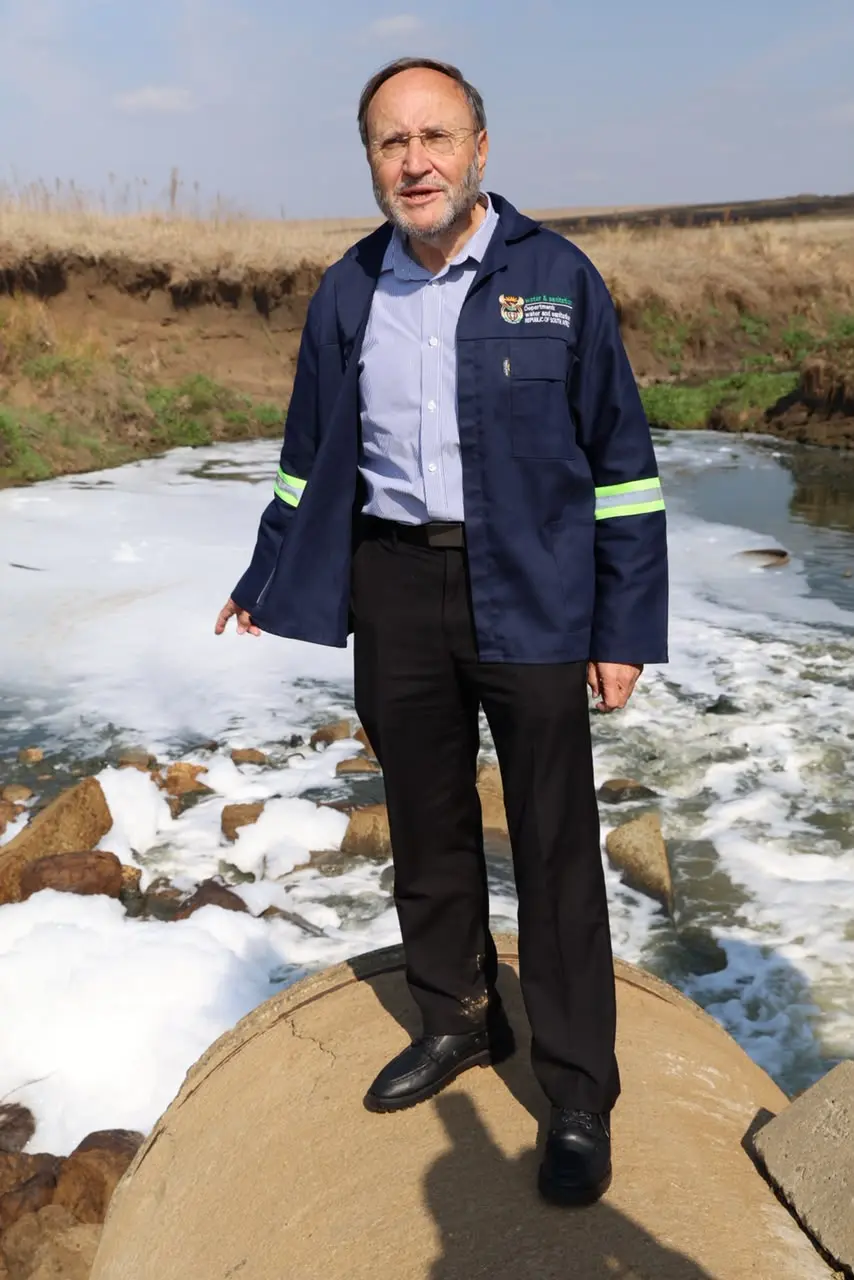
Bloom said he saw the effect of the pollution on Jacob Durr's farm, where the Klein Drinkwater stream was so toxic that it caused pregnant cows and sheep to abort.
"What looks like foam in the river is ammonia and there are high E.coli levels as well. It is a dead river with no fish and too polluted to irrigate crops that could provide jobs in the area."
The water crisis, he said, was worsened by pollution from illegal mines and Msukaligwa's 66% non-revenue water, meaning nearly two-thirds of drinking water was lost to illegal connections and pipe bursts.
The town also had ageing infrastructure. "They've got old asbestos pipes and admitted there's leaks all over the place."
For residents, the consequences are being felt. "I would say every day there's some parts of town that just don't have water or there's low pressure water ... It's dire," Conradie said.
A crisis with little room for error
Bloom said conservation campaigns could not substitute for fixing infrastructure.
"But we can't operate with such thin margins, we need reserves, we just don't seem to have a buffer," he said, noting that this was a problem in many parts of the country.
A combination of short-term interventions would be needed. Funding should be prioritised to desilt the dams, clear alien vegetation that clogs the rivers, fix leaking pipes and dig boreholes to access more water.
He also called for businesses and mines to be brought into a crisis response group. Gert Sibande District Municipality executive mayor Walter Mngomezulu has offered to facilitate the group.
"We all need to work together to avert a Day Zero for more than 200 000 people in this area."
Bloom said the immediate priority was to prevent the warning from becoming another Day Zero.
"They need to take it seriously. I would hope that the district municipality rises to the occasion and has an inclusive group and avert a tragedy."
The problems at Ermelo reflected a broader failure of municipal water management.
"This is a build up across the country. The weak link is misgoverned local authorities."
The Msukaligwa local municipality did not respond at the time of publication.