


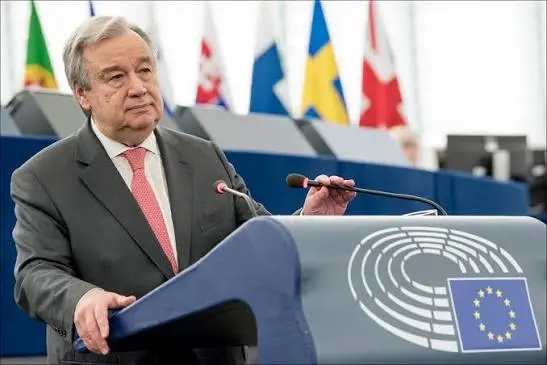
United Nations secretary-general António Guterres has called for a new Climate Justice Compact to address the deep inequalities in climate finance, warning that developing countries cannot be expected to shift away from fossil fuels and protect their populations from climate change without substantially greater financial support.
Speaking at the leaders’ summit at the COP31 climate conference in Antalya, Türkiye on Wednesday, Guterres said emerging and developing economies outside China were home to nearly two-thirds of the world’s population but received less than a fifth of global clean energy investment.
Most also paid two to three times more to borrow, making it harder for them to finance the transition to renewable energy.
“If they cannot access affordable clean energy, fossil fuels will fill the gap — locking in emissions for decades,” he said.
Guterres said the compact should rest on four pillars: accelerating a just transition away from fossil fuels, protecting people from climate impacts, making climate finance adequate and choosing international cooperation over geopolitical fragmentation.
The principle of common but differentiated responsibilities must apply and all countries must do their part, he said.
Guterres called on developed countries to cut emissions faster and deliver the finance and technology they had promised, while emerging economies accelerated their shift from fossil fuels to renewable energy.
Developing countries needed substantial support to adapt to rising temperatures and increasingly severe climate impacts.
“Climate justice is the defining challenge of the next decade,” he said. “We cannot demand that countries transform their economies while denying them the means to do so.”
On finance, Guterres said developed countries must lead in delivering at least $300 billion a year by 2035, while setting out concrete plans to at least triple adaptation finance by then. He also called for the $1.3 trillion climate finance goal to translate into funding flowing to developing countries.
He urged multilateral development banks to lend more, private investors to back the transition in developing countries and donors to replenish climate funds, including the Green Climate Fund and the Fund for Responding to Loss and Damage.
Guterres also turned his attention to the fossil fuel industry, arguing that companies benefiting from the extraction and sale of fossil fuels should help pay for the damage caused by climate change.
In the past quarter, the nine largest oil companies made $95 billion in profits, while the Loss and Damage Fund received about $600 million, he said.
“That is what these companies made in about 14 hours,” Guterres said, calling on governments to tax windfall profits and use the proceeds to help vulnerable countries recover from climate damage.
The compact also calls for a managed transition away from fossil fuels, with Guterres warning that governments cannot continue expanding fossil fuel production while claiming to be committed to limiting global warming to 1.5°C.
He called for an end to new coal and oil and gas infrastructure that would make the temperature goal harder to achieve, alongside faster investment in renewable energy, electricity grids and storage.
Guterres acknowledged that a temporary overshoot of 1.5°C was inevitable, but said the scale and duration of the overshoot remained within humanity’s power to influence.
He warned that national climate plans would leave the world facing more than 2.5°C of warming by the end of the century, even if fully implemented.
“We have a choice: Either plan this just transition — or pay for it in chaos and lost livelihoods,” he said.