


The Southern Ocean, which encircles Antarctica, may be rough and remote, but its influence on the global climate is immense. It absorbs vast quantities of carbon dioxide and excess heat trapped in the climate system.
Yet the season when it may be hardest for scientists to understand how this happens is also the season they know least about: winter.
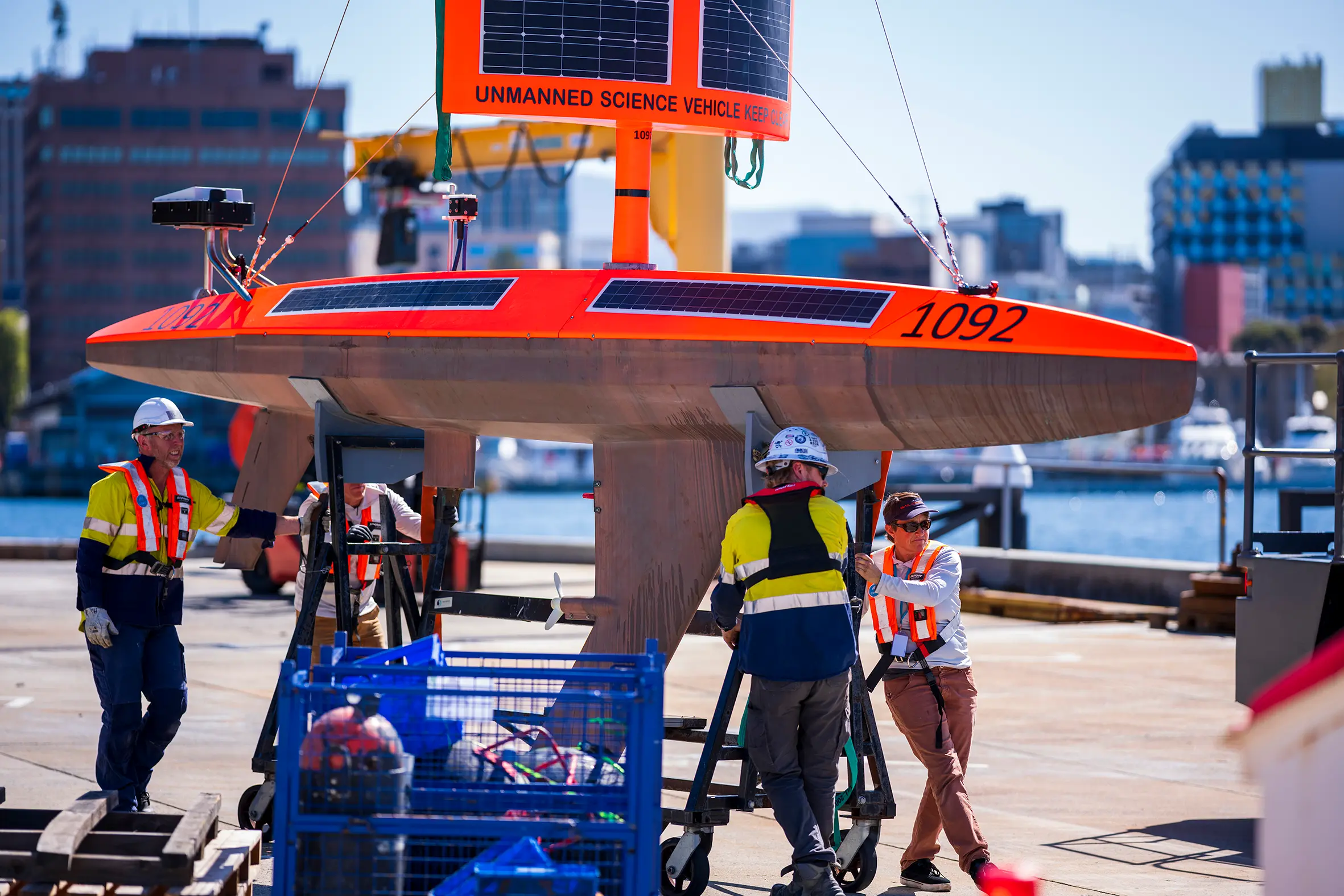
Now, an international team of researchers, including South African scientists, is sending a fleet of autonomous sailing drones into the stormy waters around Antarctica to fill that gap.
The four robotic sailing vessels will circumnavigate Antarctica, collecting data on how the Southern Ocean absorbs and releases carbon dioxide, helping scientists better quantify its role in regulating atmospheric carbon and the global carbon budget.
“Wintertime in the Southern Ocean is really poorly observed, so it's a big blind spot in our observations,” said Dr Sarah Nicholson, a lead oceanographer at the Council for Scientific and Industrial Research’s (CSIR) Southern Ocean Carbon-Climate Observatory (SOCCO), during a recent webinar about the project.
“That winter time period is hypothesised in this project to contribute to a significant portion of the uncertainty in the global ocean carbon sink. It’s really about observing in this really difficult, hard-to-reach winter period where ships aren't around.”
Ships travelling to the Southern Ocean typically do so during summer, when conditions are more manageable and research and resupply voyages to Antarctic bases take place. In winter, sea ice, powerful storms and extreme cold make observations far more difficult.
The first of four uncrewed surface vehicles, or Saildrones, was launched from Bruny Island, near Hobart in Tasmania, on 20 September. It is expected to travel more than 22 000km, measuring flux of carbon dioxide between the atmosphere and ocean, temperature, salinity, wind and other oceanographic and atmospheric conditions.
The mission forms part of a five-year international research project called Constraining Ocean Carbon with Optimised Observing (COCO2), which aims to reduce uncertainty in estimates of the global carbon budget and improve scientists’ understanding of how carbon dioxide moves between the atmosphere, land and oceans.
Dr Sandy Thomalla, a CSIR chief researcher and head of SOCCO, said the Southern Ocean accounted for about 40% of the global ocean’s uptake of carbon dioxide and absorbed about 75% of the excess heat generated by the carbon dioxide that remains in the atmosphere.
“The Southern Ocean is thus a disproportionately important ocean when it comes to buffering the impacts of climate change,” she said. “This is why it's really important to try to have a handle on how the Southern Ocean is doing this amazing job for us, how sensitive is that job to changing with these pressures of climate change.”
The annual Global Carbon Budget tracks emissions from human activities and how much carbon dioxide remains in the atmosphere or is absorbed by land and oceans. Its latest 2025 assessment highlighted reduced uptake by land, increasing the relative importance of the ocean sink.
But estimates of how much carbon the Southern Ocean absorbs remain uncertain. Existing observations and even advanced Earth system models do not always agree on the amount of carbon dioxide moving between the Southern Ocean and atmosphere.
Global climate models generally operate at relatively coarse spatial resolutions, with grid points of about 100km. They cannot fully capture the smaller-scale processes influencing carbon exchange, while modelling the entire planet at much finer resolution would require enormous computing power.
The Southern Ocean is shaped by complex currents, ocean fronts and swirling eddies, while powerful storms influence the movement and mixing of water. Many of these processes are too small or short-lived to be adequately represented in global models.
COCO2 aims to address these modelling and observational gaps, using new technology and machine learning to identify where additional measurements would be most valuable.
“It’s not just about simply collecting new observations,” said Nicholson. “We really need to know when we should collect those new observations and in what regions to collect them.”
The Saildrones are remotely operated, with researchers able to adjust their routes through satellite connections. They are powered by wind, while solar panels supply energy to their onboard instruments.
Their square sails have been designed to withstand the harsh conditions of the Southern Ocean, including hurricane-force storms.
“It’s got a very square rigid sail and that sail has been designed over time to manage pretty much hurricane conditions, something we experience in the Southern Ocean in winter quite often,” Nicholson said.
The first deployment will be followed by three more, staggered at approximately three-month intervals. Their routes can be adjusted to target regions considered particularly important for understanding carbon dioxide exchange.
“We will look at the role of winds, waves and ocean currents to see how they drive changes in carbon dioxide fluxes regionally and seasonally,” Nicholson said.

The project brings together scientists from South Africa, Australia and the United States, including the CSIR, Australia’s Commonwealth Scientific and Industrial Research Organisation (CSIRO), the US National Oceanic and Atmospheric Administration (NOAA), Columbia University and the University of Washington. Saildrone supplies and operates the autonomous vessels.
Schmidt Sciences provides philanthropic funding through its Virtual Institute for the Carbon Cycle, which aims to reduce uncertainty in the global carbon cycle to better inform climate policy.
For South Africa, the collaboration builds on nearly 15 years of investment in ocean-climate science through SOCCO, which is hosted by the CSIR and primarily funded by the department of science, technology and innovation (DSTI).
The programme has developed expertise in ocean-carbon observations, autonomous technology, high-resolution modelling, satellite remote sensing and machine learning, while training the next generation of scientists.
Thomalla said the Southern Ocean might seem remote to South Africans, but its influence is much closer than many people imagine. Its northern boundary lies at about 40° south.
“Most people think that the Southern Ocean is so far away, Antarctica feels far away, the Southern Ocean feels far away, so it feels like something that wouldn't necessarily matter to our everyday lives. But it’s surprising that the Southern Ocean really is on our doorstep.”
She has flown to Antarctica several times and uses the journey to illustrate the proximity. “The flight from Cape Town to Antarctica is the same distance as from Cape Town to Nairobi in Kenya. So really it's not very far away.
“It's really important, it controls our rainfall, it influences our climate, it influences weather patterns, which influence food security, so it matters,” she said.
The mission is not without risk. Nicholson acknowledged that autonomous ocean vehicles had been lost during previous missions. Drifting icebergs, sea ice and hurricane-force winds all pose threats.
“There’s always a risk … Unfortunately we’ve lost similar ocean drones before. It’s always a very tragic thing to happen.”
Researchers will use satellite observations of sea ice and iceberg tracking to help steer the vessels away from danger.
The partnership with Saildrone also represents an unusual arrangement for scientific research. Rather than owning the vessels, researchers pay the company for the data they collect.
“We don’t own the Saildrones. The Saildrones belong to Saildrone and what we buy is the data that the Saildrones are collecting,” Thomalla said.
She said this arrangement transferred some of the risk associated with losing an expensive research platform to the company, rather than the scientists.
The project also has an unusual feature in its scientific leadership: all four institutional leads are women. Thomalla co-leads the research with Dr Adrienne Sutton of NOAA, professor Galen McKinley of Columbia University and Dr Elizabeth Shadwick of CSIRO.
“[It] doesn't happen very often in my field of research,” Thomalla said. “To see that all of the institutional leads and PIs [principal investigators] of this project are female. It is such a privilege to work with all of these incredibly talented women on this very exciting and meaningful project.”
Ultimately, the observations will feed into the annual Global Carbon Budget and the scientific assessments used by the Intergovernmental Panel on Climate Change.
For Thomalla, South Africa’s involvement is an important part of that global effort. “South Africa is a big player in the global climate science space and the observations we will collect in the Southern Ocean using these USVs [unmanned surface vessels] will help close the biggest observational gap in carbon dioxide data during winter.
“Thanks to ongoing CSIR and DSTI support, South Africa is not watching this work from the sidelines. We are at the table, helping to generate the data and tools the world needs to understand a changing climate.”