

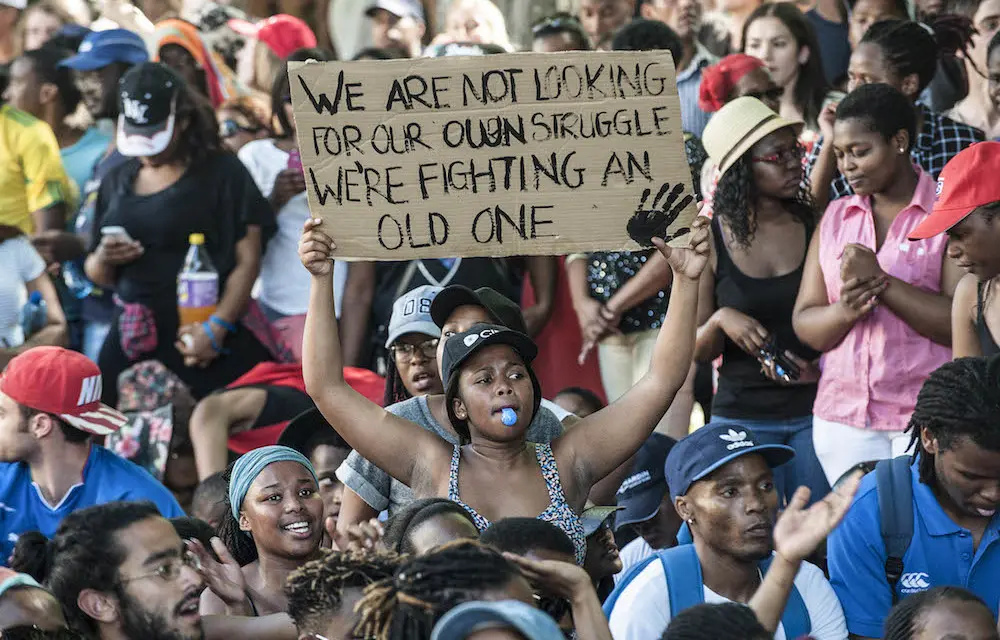
Every generation is told that it will inherit the future. For South Africa’s youth, the statement carries both promise and pressure. We are often described as the “born-free” generation, the “future leaders” and the “hope of the nation”.
Yet, 50 years after the 1976 Soweto Uprising, many young people find themselves standing at the edge of systems they are expected to fix but rarely invited to shape.
This Youth Day, on 16 June, and Youth Month, under the theme “RESET@50: The Future Calls”, we are asked to imagine how young people can help reshape South Africa’s future. But before we can meaningfully reset anything, we must confront a difficult truth: you cannot ask a generation to rebuild a house it is not allowed to enter.
For many young South Africans, the experience of youth is not defined by freedom or opportunity but by uncertainty. Unemployment remains stubbornly high, especially among young people. Quality education is unevenly distributed. Mental health support is limited and often inaccessible.
Beyond statistics lies an everyday reality: young people who are capable, creative and committed but structurally blocked from participation in the economy, politics and even civic spaces.
The problem is not a lack of ambition. It is a lack of access.
We often speak about youth empowerment as if it is a motivational exercise. Workshops are hosted, campaigns are launched and speeches are made about resilience and leadership. While the spaces have value, they are not enough. Empowerment without structural change becomes performance. It places responsibility on young people to “try harder” in systems that remain unchanged.
A true reset requires something deeper: redistribution of opportunity, trust in youth leadership and a willingness to shift power. The legacy of 1976 is not only one of resistance but of political consciousness. At the time, young people were not passive victims of their circumstances; they were active agents who understood that education, language and policy were deeply political. Their courage reminds us that youth participation is not symbolic. It is transformative when it is taken seriously.
Yet today, youth participation is often reduced to consultation without consequence. Young people are invited into spaces where decisions have been made. Their voices are heard but not always implemented. This creates a growing disconnect between youth engagement and influence.
If South Africa is serious about resetting its future, then young people must be positioned not as beneficiaries of development but as co-authors of it. This means more than representation. It means decision-making power in institutions that shape education, the economy, climate policy, technology and governance. It also means rethinking how we define “youth contribution”.
Not every young person will lead an organisation or speak on a platform. Many are contributing in less visible ways: supporting families, building small businesses, creating digital innovation, organising in communities and sustaining care networks where the state has failed. These forms of labour are often overlooked, yet they are essential to the functioning of society.
A reset, therefore, must also be an act of recognition.
But recognition alone is not enough. Young people need material support to transform potential into impact. This includes accessible funding for youth-led initiatives, fair entry into labour markets and education systems that prepare learners not just to pass exams but to participate meaningfully in society. It also requires public and private sectors to move beyond tokenism and actively invest in youth leadership pipelines.
At the same time, the youth themselves are not exempt from responsibility.
A reset is not only something done for young people but also something done by them. It requires collective action, civic engagement and a refusal to become disengaged in the face of frustration. It demands imagination: the ability to think beyond inherited systems and to propose alternatives that are more just, inclusive and sustainable.
South Africa is not short of problems. It is short of trust between generations and institutions. Rebuilding the trust is central to any meaningful reset. Young people must be trusted with real responsibility and institutions must be held accountable when they fail to deliver on inclusion.
As we reflect on 50 years since 1976, we are reminded that youth movements have always been catalysts for change. But they were effective not because youth were spoken about but because they were heard, organised and taken seriously as political actors. The future is not something that simply arrives. It is something that is negotiated, built and contested.
If we are serious about resetting South Africa, then we must move beyond rhetoric and toward real inclusion. The future is calling. But young people cannot answer it alone from the margins. They must be given a seat at the table where that future is being designed.
Only then can “RESET@50” become more than a slogan. It can become a turning point.
Lateefah Matinka is the chairperson of the United Nations Association of South Africa Stellenbosch Chapter and head of operations at UniDreams Foundation, a youth-led NGO run by Stellenbosch University students.