

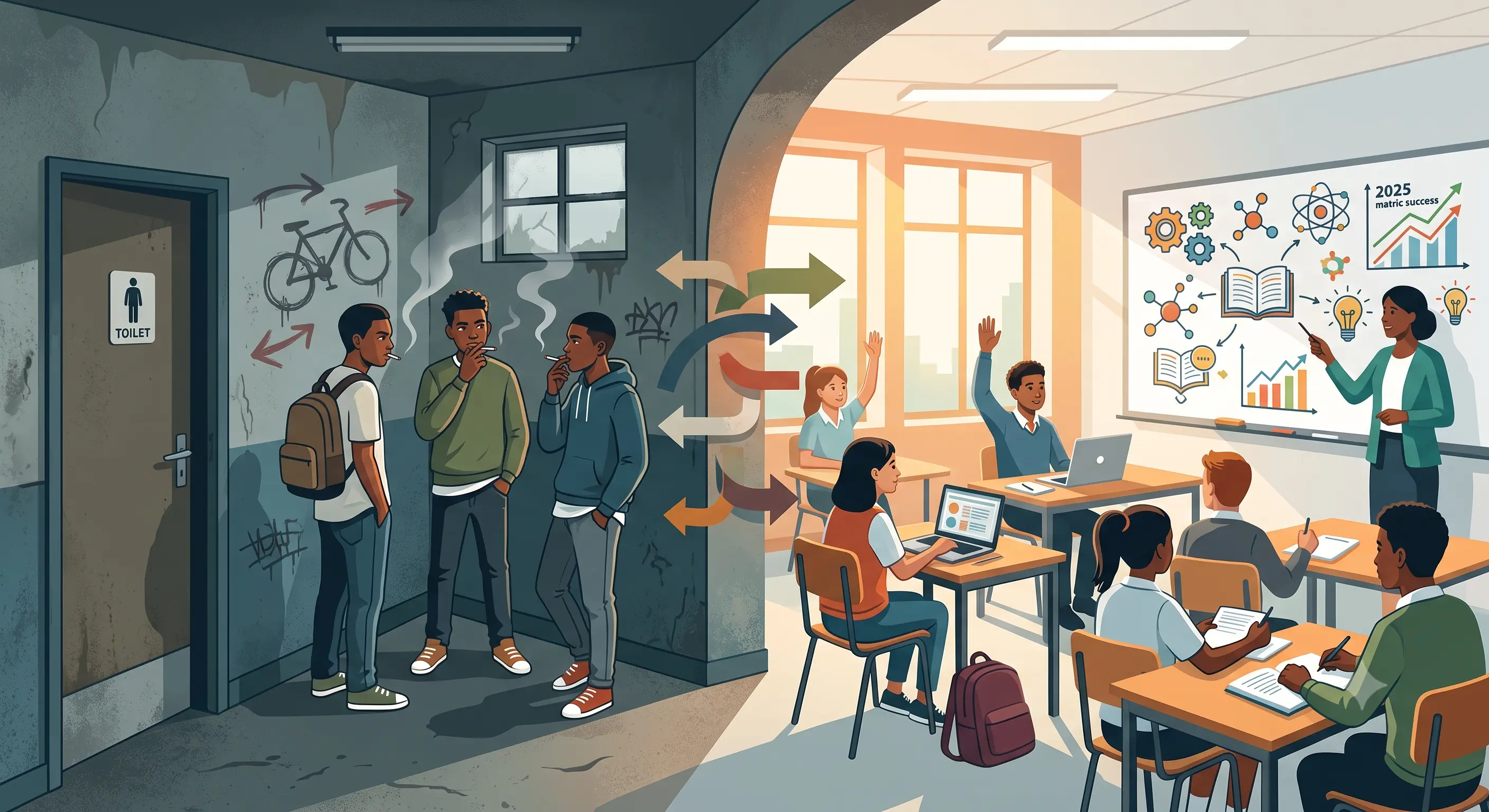
In my first week of high school, I made the mistake of going to the wrong toilet. It was a wrong toilet in the sense that there was a general, unspoken understanding that this was where boys who smoked, drank and belonged to gangs would “chill” during classes.
I knew immediately that I had made a mistake. Not because of the smell or how dark and dirty the space was but because of the group of obhuti (brothers) standing there, smoking. They gave me three options:
Option 1: Ride the bicycle drawn on the wall.
Option 2: “Donate” to the men’s forum kitty (give us your lunch-money vibes).
Option 3: Get initiated, for example, punches, slaps and kicks (you know, the usual welcome-to-high-school package).
Luckily, I did not have to choose from the above “enticing” options. One of the boys recognised that I was in class with a girl he liked and decided I could be useful. On reflection, I now realise that there is something wrong with a school system where boys would rather be in the toilet than in class. Twenty-six years later, too many black boys are literally and metaphorically in the toilet of the education system, disengaged, overlooked and struggling to find belonging, purpose or support.
South Africa’s 2025 matric results once again revealed a persistent and troubling pattern. Girls significantly outperformed boys, accounting for about 56% or so of passes, while boys made up only 44% or so, despite comprising roughly half the cohort (Department of Basic Education, 2025). This is not a marginal difference. It is a structural pattern that has remained consistent over time, indicating that something fundamental is not working.
According to Zero Dropout, roughly four in 10 children in South Africa do not complete school. The most cited reasons include bullying, financial hardship, academic struggle, peer pressure, gang involvement and substance abuse — experiences that disproportionately affect boys. The figures are often interpreted as evidence of laziness or lack of discipline. I read them differently.
This is not about boys being uninterested in education. It is about an education system that is not designed to meet them where they are, in the full complexity of their social, emotional and developmental realities.
Most schools operate under pedagogies that assume boys will engage, regulate themselves and express emotions in the same ways as girls. They do not. Emotional learning is treated as optional rather than essential. Discipline is framed primarily as punishment instead of care. Yet for boys socialised to see toughness as survival, punishment rarely feels like support; it feels like rejection.
As a result, many boys struggle with literacy, cooperative learning or open-ended tasks, not because they cannot learn but because they have not been supported socially or emotionally to engage in those ways. Globally, boys are more likely than girls to repeat grades, disengage early and drop out of school (Unesco, 2023). While this is a global trend, South Africa’s deep inequality and persistent unemployment intensify its effects. When school becomes a place of constant correction rather than connection, withdrawal becomes rational. Belonging matters more than instruction and boys will choose the former wherever they can find it.
But schools are not the starting point of this problem.
Hear me out.
Long before boys enter a classroom, they are taught what the world expects of them. From a young age, boys receive powerful and often contradictory messages about what it means to be a “real man”. They are taught to be providers, protectors and emotionally self-sufficient. Indoda ayikhali (Men do not cry). Pain is something to endure, not express. Vulnerability is something to suppress, not explore.
The socialisation often begins early, sometimes with a boy’s first physical fight, ipero (a physical fight that usually involves being surrounded by onlookers cheering on). Here, toughness is rewarded and emotional expression is discouraged. In these moments, boys learn to switch off parts of themselves that are essential for learning, connection and emotional regulation. This is not accidental; it is how patriarchy reproduces itself and their humanity begins to end.
In many households, particularly those under economic strain and without a present father, the messages are intensified. A boy’s value becomes closely tied to his perceived ability to support and protect the family. Parents often mean well but statements made in passing — “you are the man of the house” — place adult burdens on children. Even names, such as Vusimuzi (one who builds or revives the family) or Khayalethu (our homestead), can carry expectations of provision long before a boy has the capacity to carry them.
The pressure is not abstract. It has real consequences for school engagement and retention. By adolescence, many boys experience school as disconnected from the role they believe they are expected to play in the world (provider and protector). Therefore, it should not surprise us that some choose the toilet over the classroom.
When I think back to that “wrong toilet” incident, I often wonder what became of the boys I encountered there. I do not remember seeing them again at school. I do not know whether they completed their education, became parents or found purpose in their lives.
However, what that moment taught me was this: when systems are confusing, unsafe or unwelcoming, people, especially young people, find their own corners of comfort. Sometimes the corners are streets, gangs or numb routines. And sometimes, they are school toilets.
But there is another corner we can build — a school system that sees boys fully, not only as learners to be disciplined but as human beings, as evolving identities trying to make sense of a world that asks them to be strong before it teaches them how to be whole.
How we raise children, both boys and girls, matters. At present, we send deeply mixed messages. We encourage girls to enter STEM fields, rightly so, but we rarely encourage boys to imagine themselves as nurses, early childhood development practitioners, social workers, teachers or caregivers/stay-at-home parents. If we are serious about building a more equal society, we must tell boys and girls the full truth:
• Care is not a weakness;
• Emotional literacy is not unmanly; and
• Nurturing, teaching and healing are forms of leadership that both genders are capable of.
We must also tell boys this: they are not excluded from the project of equality; they are central to it. Boys, too, have a role to play in dismantling patriarchy. Boys, too, benefit from feminism because it frees them from the lie that their worth is measured only by toughness, income or dominance.
My point is: when boys are pushed out of school, it is not merely an educational failure; it is a societal one. Dropping out is not the cause of the problem; it is a symptom. This is not a problem that boys alone can solve. However, it is an opportunity for educators, policymakers, parents, and communities to rethink how we teach, how we name, how we care and how we raise the next generation together.
If we get it right, maybe, just maybe, fewer boys will “chill” in the school toilets and more will feel that the classroom and society have a place for them and they too have an active role to make this world a better and safer space for everyone.
Siyabulela Sandi is a digital strategist and communications officer for Zero Dropout Campaign at the DG Murray Trust.