



Cape Town mayor Geordin Hill-Lewis recently shared a pretty telling anecdote. A developer had told him that at one stage, there weren’t enough tower cranes for hire in Cape Town — new construction sites were having to bring cranes in from another province just to break ground. Development in Cape Town is on fire and has been for some time.
A developer who has watched this market evolve at close range is Blok.
It has been building for well over a decade, which means it has lived through the cycles — the bubble
that Facebook keyboard warriors have been calling on the verge of bursting for as long as I can remember, the cooling stretches, the devastation that Covid brought to off-
plan sales and then the strange, fast recovery that followed, the load-shedding years and the rapid semigration surge.
Through it all, it has been releasing developments. On its own, the endurance is informative.
It is worth saying plainly that Blok is a specialist. The generalist developer — active in three provinces, two asset classes and whatever opportunity walks through the door — is a less compelling proposition than it was a decade ago.
Buyers, lenders and brokers all reward expertise that is narrow and deep. Knowing exactly how planning approval moves in Sea Point, exactly which subcontractors finish to your standard, exactly what a family relocating from Sandton will pay for an extra bedroom in De Waterkant — the knowledge is not transferable between cities and it compounds with every project.
Blok’s 22-development run in a single metro is a unique selling point in my eyes. It is the evidence that it understands the market in a way a generalist or a developer new to the market cannot.
It is not the only Cape Town operator making this bet. Spear REIT Limited, the only regionally focused REIT listed on the JSE, has built its entire investment thesis around the Western Cape, on the argument that hands-on, geographically intimate management outperform a diversified national portfolio.
Spear sits on the commercial and industrial side of the market — office, warehouse, retail — so it is not a direct parallel to Blok’s residential work and the scale is different again as a listed fund. But the underlying conviction is the same: the Western Cape rewards operators who refuse to look elsewhere. Two different segments, two different capital structures, one shared thesis about where depth beats breadth.
I have been watching Blok’s projects for years and the question that keeps surfacing for me is: What does it take to keep building in the same city without running out of road, without repeating yourself and without losing the market’s attention?
Cape Town is not an easy place to develop. The crowd here is fickle and affectionately known by inkomers (incomers) as cliquey. Land (if you can find it) is expensive and becoming more so. The planning environment is complex. The buyer pool, while strong, is not infinite. Yet here is a developer releasing its 22nd development.
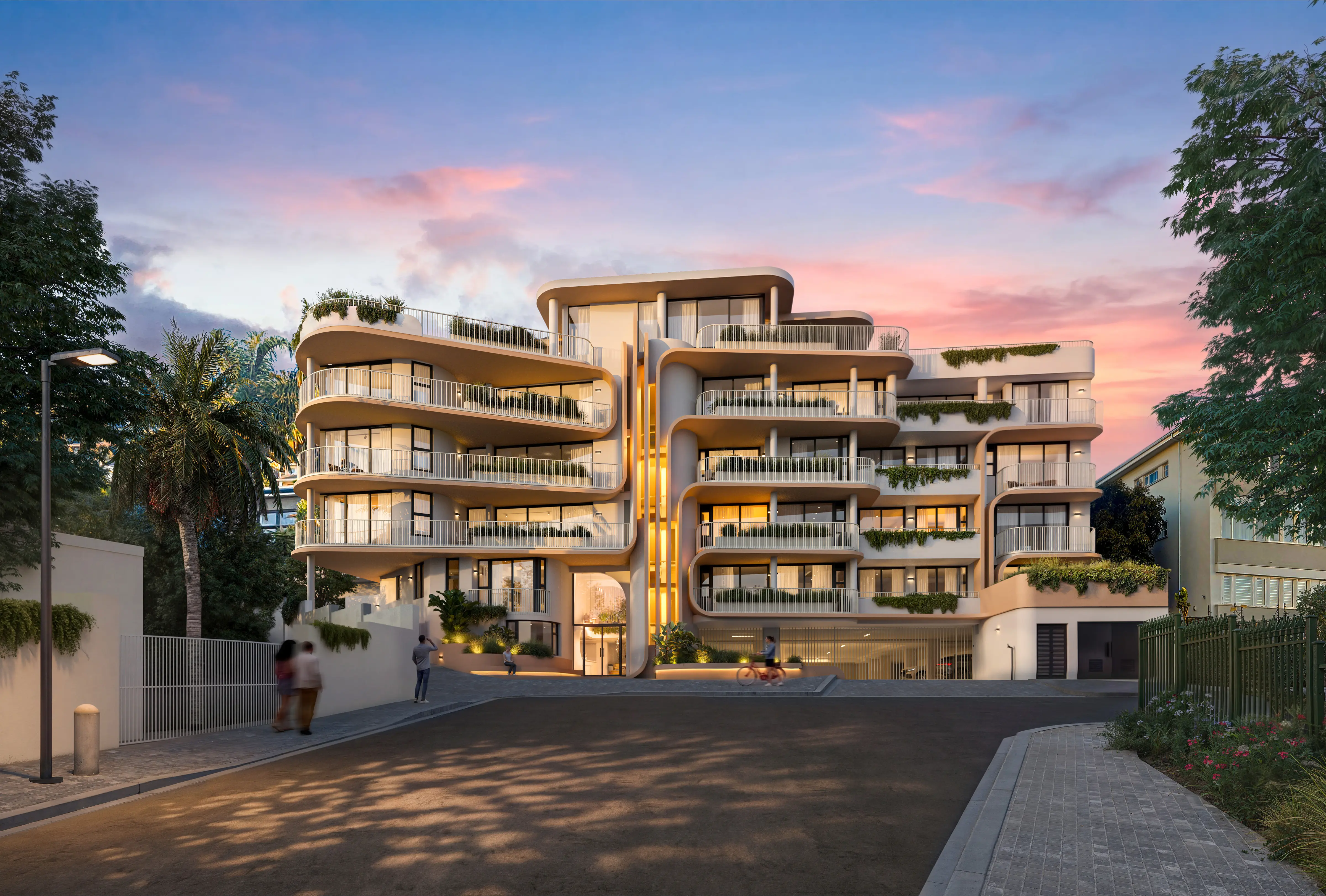
Blok’s model is built around a naming convention that tells you exactly where a development is before you even look it up. The street name, the number and a code. THIRTEENONUP is at 13 Upper Portswood Road, in Green Point. This is the first time the developer has returned to Green Point in a decade with its 22nd development.
Fifty-two flats across five storeys, with an atrium, vertical garden, pool deck and a material palette of warm wood, stone and black metal that has become its signature.
By keeping its geography tight, it has also kept its construction teams close, its subcontractors familiar and its understanding of what sells in which pocket of the city sharp.
Let’s take Green Point. A decade ago, it was something of a transitional zone — adjacent to the V&A Waterfront, walkable enough but not quite the address that Sea Point or De Waterkant were.
The precinct has matured considerably since then.
Green Point Park, the weekly parkrun, the urban biodiversity garden, an increasingly good high street, more free parking than in Sea Point, an influx of smart, road-facing retail and restaurants, a recently revamped Point Virgin Active gym with new padel courts and the city’s investment in the area around Cape Town Stadium have collectively lifted it into something more established and settled.
Which is presumably why Blok has come back after 10 years away.
THIRTEENONUP sits a short walk from the park, the promenade and the Waterfront. The location works across buyer types — an investor can point to the rental demand; a family can point to the lifestyle infrastructure; someone relocating from Johannesburg can point to both. The development launches on 8 July, with flats starting from R2.895 million.
“Green Point is one of those neighbourhoods that works on every level. It is a strong investment node but it is also somewhere people want to live and raise a family.
“THIRTEENONUP reflects our years of building for that balance between everyday convenience and long-term value,” Jacques van Embden, the CEO of Blok, says.
There is also something worth noting about Cape Town’s land constraints and their implications for a developer operating at this scale. The city is geographically bounded in ways that Johannesburg is not. The mountain, the ocean and the wine farms do not move. Developable land in well-located urban nodes is finite and getting more expensive.
For a developer whose entire model depends on finding the right site in the right suburb, the pressure is constant. The fact that Blok has completed 22 developments without moving beyond a handful of neighbourhoods suggests either extraordinary luck with site acquisition or a systematic approach to identifying opportunities before they become obvious to everyone else.
My sense, from watching it work over the years, is that it is largely
the latter.
It moves into a neighbourhood earlier than the market consensus, holds the conviction and builds. SIXONN on Norfolk Road in Sea Point came before the street became the vibe that it is now.
“We are not trying to develop everywhere. We want to understand a handful of neighbourhoods. You only gain that deep kind of understanding by building it repeatedly over the years and learning a lot along the way. That is how you make better decisions about where to go next,” Van Embden says.
There is real value in the kind of granular, neighbourhood-level knowledge that comes from a developer who has been on the same streets for more than 10 years. The knowledge is what produces a building that fits where it lands. In terms of design, scale, pricing and the kind of resident it attracts.
