

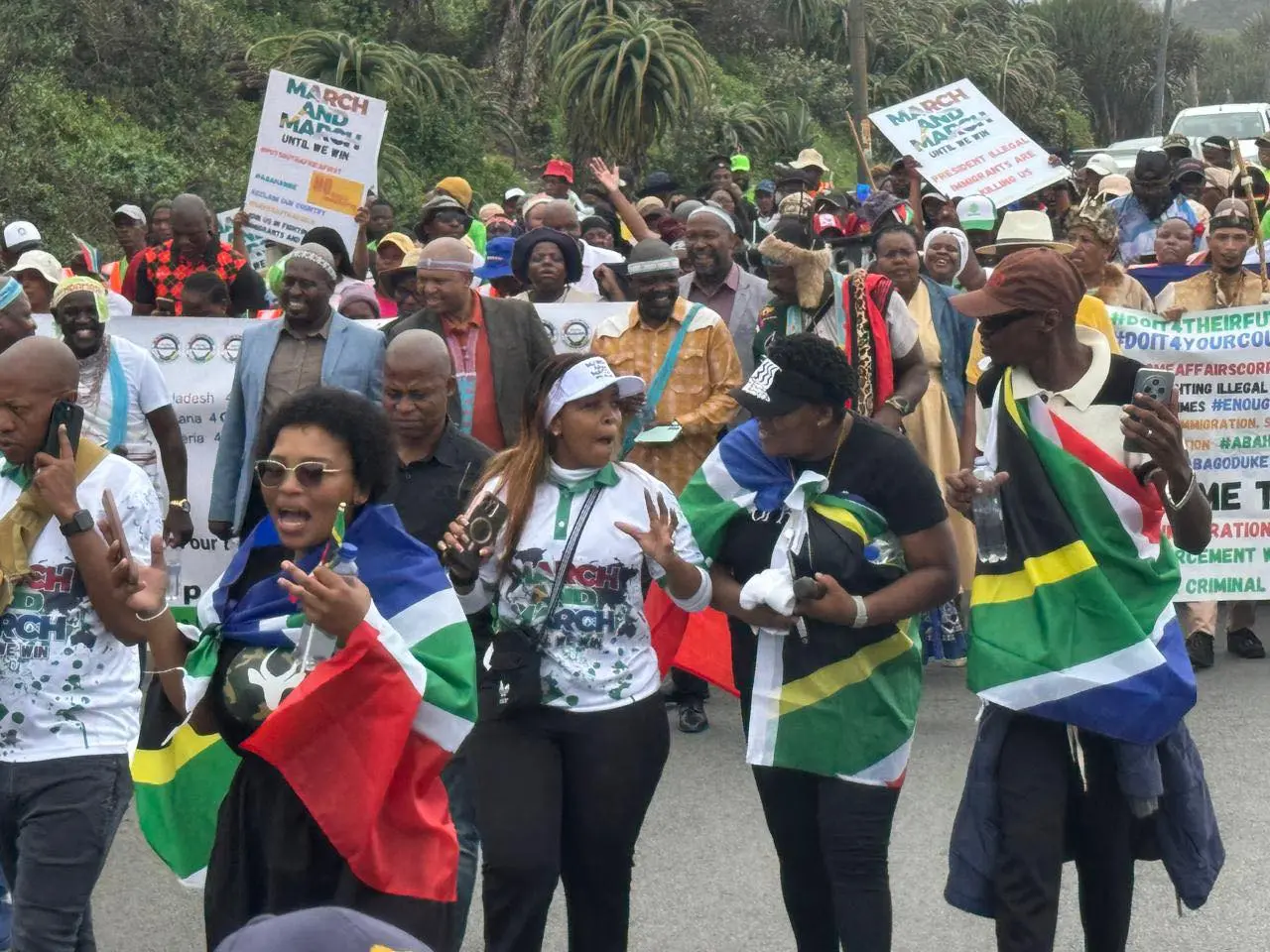
Nations are rarely undone by the questions they ask. They are undone by the questions they never think to ask. South Africa has become consumed by one conversation. Illegal immigration. Television panels debate it. Politicians campaign on it. Civil society marches over it. The government meets with advocacy groups to discuss it. The public square has become a courtroom where everyone argues over who belongs and who does not.
Yet amid all the noise, another question has slipped quietly into the shadows. What if the real story is not immigration at all? What if immigration is simply the doorway through which a much larger economic transformation is walking unnoticed?
The March & March movement has become a powerful force in shaping public discourse. Whether one applauds its objectives or opposes them is almost secondary. Every democracy benefits when citizens organise peacefully around issues they believe the government has neglected. The more important question is whether anyone has stopped to examine the unintended consequences that could follow.
History teaches that political victories often produce economic surprises. Brexit was about sovereignty. It also created labour shortages that few anticipated. The Arab Spring promised freedom. In several countries it delivered prolonged instability.
Movements begin with one objective. They often end somewhere entirely different. South Africa would be foolish to imagine it is immune to that pattern.
Commercial agriculture is one of the country's last remaining strategic assets. It feeds the nation, earns foreign exchange and sustains countless rural economies. Yet it is built upon something that cannot be legislated into existence. Experience.
A productive farm is not merely land enclosed by fences. It is the product of decades of accumulated knowledge. It requires an understanding of rainfall patterns, soil chemistry, crop and livestock diseases, irrigation systems, genetics, logistics, labour management and volatile commodity markets. Much of this expertise is passed from one generation to the next. Equally, many migrant farm workers have spent years and, in some cases, decades working on South African farms, gradually acquiring highly specialised practical knowledge.
Some have advanced into supervisory and management positions, becoming integral to the daily operation of commercial farms. Replacing that combination of institutional memory and practical expertise is neither quick nor simple. Skills transfer takes years, not weeks and no government policy can accelerate the slow apprenticeship that agriculture demands.
Agriculture is one of the few industries where experience compounds like capital. You can redistribute land overnight. You cannot redistribute 30 years of accumulated farming knowledge.
For years South Africa has watched skilled professionals leave. Engineers. Doctors. Scientists. Entrepreneurs. Farmers. Every departure widens a gap that statistics struggle to measure.
At the same time, several sectors of the economy, including agriculture, have depended heavily on migrant labour. Enforcing immigration laws is the responsibility of every sovereign state. No serious democracy disputes that principle.
The challenge lies elsewhere.
Does South Africa have a realistic plan to replace the experience that is disappearing due to both undocumented labour and the emigration of agricultural expertise? Or are we assuming that the market will simply solve itself?
Markets are efficient. Agriculture is not magical. Food does not appear because Parliament passes legislation. Nor does a harvest care about political ideology.
When key government ministers grant a formal audience to influential and unsavoury civic lobby groups such as March & March, they send a message that extends far beyond the meeting room.
March & March has employed unlawful confrontational tactics and rhetoric that have fuelled significant public and constitutional debate, raising important questions about the standards government applies when deciding which lobby groups receive official engagement.
The public deserves transparency. Citizens have a right to know not only what was discussed but also whether the government considered the broader economic, social and constitutional implications of the issues raised. Effective governance requires more than responding to public pressure. It demands the foresight to anticipate consequences that may not become apparent for years and the courage to weigh immediate political gains against the nation's long-term interests.
That is not an accusation. It is an expectation.
The debate over land reform provides another uncomfortable layer. For decades, South Africans have argued passionately over who should own agricultural land. Yet ownership, while important, is only one part of the equation.
Land without expertise is merely geography. Ownership without productivity is symbolism. The most valuable asset on a farm has never been the title deed. It has always been the person who knows how to transform soil into food.
That is why the country should resist reducing complex challenges to simplistic slogans. Immigration, land reform, economic inclusion and food security are not separate conversations. They are threads woven into the same national fabric. Pull one carelessly and the entire cloth may begin to unravel.
Perhaps the greatest danger facing South Africa is not that it enforces its immigration laws. It should.
The greater danger is that, while celebrating short-term political victories, it neglects the long-term consequences for productivity, investment and confidence.
Nations rarely collapse because they lack passion. They falter because they mistook passion for planning. The question South Africa should be asking is therefore not whether today's immigration debate is justified. The question is whether we are preparing for the country that debate will leave behind. Because history has an unforgiving habit. It does not judge nations by the speeches they applauded.
It judges them by the harvest they produced.