


A few years ago, at a conference in Kigali, Rwanda, I asked a room full of women from across the world a question: What word comes to mind when you think about walking through your city at night?
The answers came quickly: “fear”, “danger”, “anxiety” and “panic”.
Not one woman said “laughter”, “moonlight” or “joy”.
That moment has stayed with me, because it captures something we rarely stop to question. Women, not just in South Africa but across most cities in the world, have become so accustomed to organising our lives around fear that we mistake it for common sense.
Don't walk alone.
Don't stay out too late.
Don't wear that.
Don't take that route.
Carry pepper spray.
Share your location.
Call when you get home.
Our solutions to violence have increasingly become restrictions on women's freedom, especially the freedom to access public spaces at night. As Women's Day approaches, I find myself thinking about a different possibility. What if fear is not the only way women can experience the night? What if the night belongs to us too?
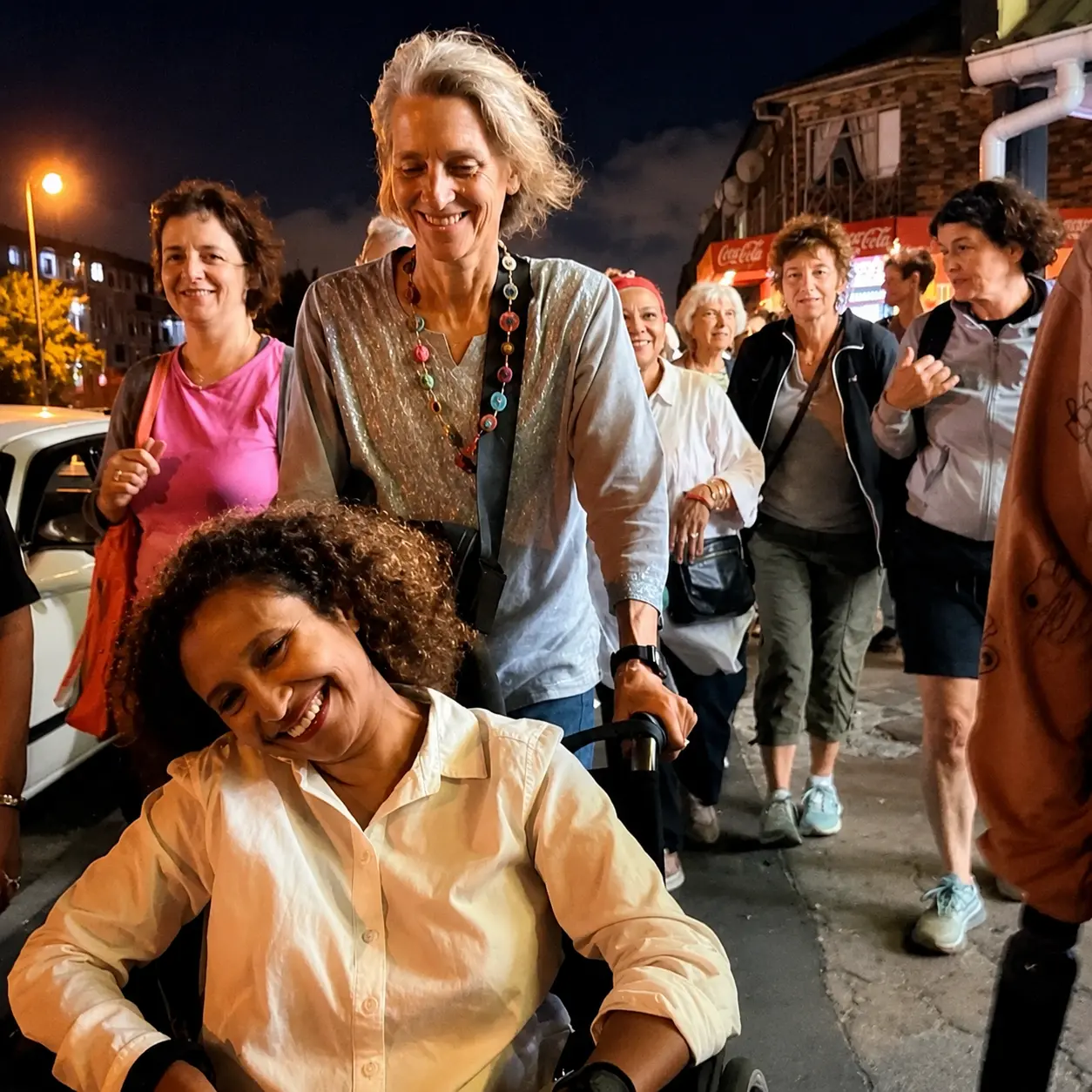
At 10pm, in August 2022, 28 women who barely knew one another met in Observatory, Cape Town, to test this possibility. The night became the beginning of what is now After 8 Sistahood, a collective of women and non-binary people reclaiming African cities after dark.
The inspiration came from Women Walk at Midnight, a movement started in Delhi after the gang rape and murder of a young woman on a bus in 2012. The horror of the story felt painfully familiar. We live in a country where stories of rape and murder punctuate our news cycles with relentless regularity.
In South Africa, we hear about violence against women to the point where, unless the violence is particularly brutal, we absorb it and carry on. The normalisation of violence has become a normalisation of fear. And the normalisation of fear has become a normalisation of restrictions on women's movement. That is what After 8 Sistahood seeks to disrupt. Not through a march. Not through an event. But by normalising the presence of women in public spaces at night.
I remember our first walk. The 28 women I had somehow managed to enthuse through word of mouth assembled outside a café in Observatory. We introduced ourselves awkwardly and, with nervous laughter, started walking. Five minutes later the bridge over the Liesbeek River was filled with women's voices, chatter and laughter. We crossed the N2. The Liesbeek looked far more palatable under moonlight, when the trash disappeared into the dark. We crossed taxi ranks and bridges many of us would never have crossed alone, even in the daytime. Somewhere between the anxiety and the laughter, the movement was born.
Like the movement in Delhi, After 8 Sistahood began with a simple proposition: women should be able to access public space at night. But as that idea took root in South Africa, it became something else altogether. What began as a response to fear became a practice of remapping and archiving joy in the violent geographies of our city.
Over the past four years we have walked through Khayelitsha, Langa, Bonteheuwel, Sea Point, Bo-Kaap, Bellville, Muizenberg, Woodstock and many other neighbourhoods. What began with 28 women now connects thousands. Yet the movement remains remarkably simple. Every gathering is hosted by women from the neighbourhood, who introduce us to their everyday lives through intimate and political histories. In the process, we have created something unexpected: an archive of women's relationships to the city, generating forms of knowledge rarely captured in urban planning, policy or academic research.
Every gathering has complicated what it means to feel safe, to belong, to occupy public space and to imagine freedom. Above all, it has reminded us that there is no singular experience of being a woman in the city.
A black woman experiences the night differently from a white woman.
A domestic worker experiences Sea Point differently from a promenade walker.
A sex worker experiences Bellville differently from someone driving through it.
A wheelchair user experiences the city differently from someone who walks.
The city teaches women to fear the night but it also teaches us to fear particular neighbourhoods and particular bodies. As hosts narrate intimate and political stories about their neighbourhoods, we have come to recognise how deeply the city remains segregated. Thirty years after apartheid, the pass books are gone but many of the journeys remain. Women travel for hours to jobs in neighbourhoods they cannot afford to live in. They spend enormous proportions of their incomes on transport and learn, through subtle and not-so-subtle means, where they belong and where they do not.
Fear itself remains racialised.
Women arrive carrying assumptions about Khayelitsha, Bonteheuwel or Camps Bay and leave having encountered a far richer reality. We do not deny violence. We walk through its geography instead. And we encounter hospitality, humour, care, political community and everyday joy. In this way, After 8 does not simply reclaim public space from patriarchy. It temporarily disrupts the spatial and racial boundaries that continue to shape life in post-apartheid Cape Town.

One of the most moving examples was our walk in Bonteheuwel, what I often think of as our bullet-to-boeber moment. Before we started walking, our hosts pointed out the corners where women had been raped, the street where a woman had been murdered and the places where children had been caught in gang crossfire. We identified safe houses and community leaders in case anything happened. As the facilitator, I confess, I was anxious. What if...?
But that "what if" dissolved within minutes. As we moved through the neighbourhood, Bonteheuwel men stood stirring giant pots of boeber for us. Uncles and aunties emerged onto their stoeps to greet us. Curious children ran out to join us. Residents stopped us to ask questions and wish us well. Many thanked us for bringing another way of seeing Bonteheuwel. They were used to hearing only one story about their community: gangs, violence, crime and poverty. That evening they saw women and children laughing, singing, talking, occupying public space and making joy.
That evening also forced many of us to confront how spatial apartheid continues to organise perception. Most middle-class women from the southern suburbs would never casually find themselves in Bonteheuwel, in midday or at midnight. We have been taught not to. Yet what we encountered there was not simply danger but community and care.
Bonteheuwel reminded us that apartheid's geography survives not only in where we live but in what we imagine about one another. For a few hours, women from different racial and class locations encountered one another outside the scripts the city usually provides.
Bonteheuwel captured what After 8 Sistahood had become. We do not romanticise resistance, nor do we deny violence. We simply refuse to allow violence to be the only story our city can tell about itself.
As the movement evolved, so too did our understanding of solidarity. One of our most important walks took place in Bellville in solidarity with sex workers and women from Sweat. Together we walked the same streets where sex workers have long been subjected to violence, harassment and abuse from clients, residents and police alike. Many of us arrived thinking we understood danger as women. We left realising that what sex workers feared were often the very institutions that claimed to protect the rest of us. Police officers and private security who wanted to keep us safe were the same institutions sex workers described as sources of harassment, violence and intimidation. The evening challenged our assumptions about safety, respectability and stigma. It reminded us that feminist solidarity begins by listening to experiences too often pushed to the margins.
Our solidarity work has extended beyond South Africa. One of our most powerful evenings was organised with Mothers for Gaza. We gathered not simply to reflect on memory and displacement but to bear witness to an ongoing genocide. We spoke about occupation, siege, collective punishment, the destruction of homes and the struggle of Palestinian mothers to keep their children alive. The point was not to collapse South African and Palestinian histories into one another. Rather, it was to recognise that struggles for dignity, land, belonging and freedom continue to connect women across borders. As we walked together through Cape Town that evening, carrying different histories but shared commitments, we asked what feminist solidarity demands in a world that increasingly asks us to look away. Our answer was simple: we walk together, we listen, we witness and we refuse indifference.
If Bonteheuwel taught us about racialised fear, Sea Point taught us about belonging. Last year, 90 of us walked in solidarity with the women leaders of Reclaim the City's Ahmed Kathrada House occupation. Many of us had walked through Sea Point countless times. We thought of it as an easy public space to reclaim. The promenade is well lit, middle class and, supposedly, for everyone. But very few of us had seen it through the eyes of women who carried passes and who spend hours commuting because housing remains inaccessible close to where they work. Women who know these neighbourhoods only as places they enter in uniform and leave again.
As we walked through some of the most expensive real estate in the country, we spoke about vacant land, affordable housing, gentrification and the continuing displacement of working-class people from neighbourhoods they helped build. We confronted a difficult question: What does it mean to reclaim the city when so many South Africans have never truly had access to it? For many middle-class women, reclaiming the night is about recovering the confidence to move through the city. For many black working-class women, the question is more fundamental: Who has ever been allowed to belong here in the first place?
The movement has also transformed physically. At first, we disrupted with our feet. Then we occupied trains. We picnicked. We sang. We danced. We stitched. We swam. One of our largest gatherings was in partnership with Prasa, where more than 300 women boarded the Southern Line. For many, it was the first time riding without clutching purses and hearts in anxious hands. That evening hundreds of women took over the train with conversation, laughter and dance.
Reclaiming our waters was equally political. South Africa's beaches carry histories of racial exclusion and the Atlantic Seaboard remains associated with privilege, wealth and whiteness. Freedom, we realised, is not only protection from violence. It must also include access to pleasure, leisure and beauty.
Floating in the freezing Camps Bay tidal pool at midnight, I found myself shouting with joy: Black bodies do more than drown. Black bodies do more than survive. We fight back. We play. We laugh. We celebrate. We belong.
That may be the most important lesson After 8 Sistahood has taught us.
Joy is political.
Belonging is political.
Over the past year, another lesson entered the movement through my own body as an injury left me temporarily wheelchair-bound. For nearly a year I have been facilitating the evenings from a wheelchair while the Sistahood wheels me through Cape Town. Suddenly I noticed what I had previously stepped over: broken pavements. Missing ramps. Impossible curbs. Sometimes no pavements at all. Even roads lined with luxury flats and cocktail bars became impassable when SUVs blocked the pavement. As my Sistahs lifted chairs, searched for alternative routes and navigated inaccessible terrain together, their care changed the way I understood the movement. This was never really about reclaiming the night through walking. It was about presence. It was about moving in many different ways together. The right to move at night belongs to all of us, even those who cannot be disruptive with their feet.
After 8 Sistahood began by challenging gendered fear. We ended up confronting spatial apartheid. Not through a campaign, a policy intervention or a legal challenge but through the deceptively simple act of women moving through a segregated city together. For a few hours at a time, Cape Town looks less segregated than it usually does in broad daylight.
What is next? The dream is not about bigger events. The dream is that one day we won't need to organise anything. One day our presence will be so normal that a woman can step outside and simply find other women already there. Walking. Talking. Laughing. Breathing. Belonging. Accessing joy without needing a hundred women around her to make it possible.
A dream that insists on a simple but radical proposition: women deserve more than safety. We have a right to joy.
Amrita Pande is a professor at the University of Cape Town