

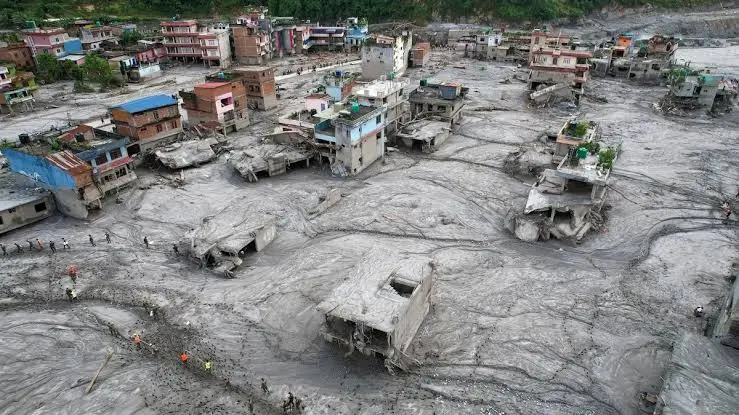
Sometimes the human cost of climate change is laid bare in ways that cut through data and dashboards. The waters around Tuvalu rise slowly. In Nepal, they came crashing down a mountainside.
On 26 August 2026, a glacial collapse on the China–Nepal border sent freezing water, mud, ice and debris roaring through the communities below. Across Nepal and Tibet, by 7 September, at least 1,380 people had been killed and more than 5,400 remained missing. More than 14,000 had been rescued or evacuated. Homes, roads, bridges and livelihoods had been swept away. Rebuilding will take years and cost billions of dollars.
We read numbers like these and struggle to comprehend them in any real sense. But behind the figures, are real people: families searching for bodies; communities trying to identify what remains of the places they called home and survivors facing the bewildering task of rebuilding lives that changed in a matter of minutes.
Nepal's Prime Minister, Balendra Shah, called it "not an ordinary flood" and warned that the risks facing the Himalayan region are increasing. Scientists say it is too early to attribute this collapse directly to climate change but warn that rising temperatures may be making the landscape increasingly unstable. His appeal was a demand that the world recognise both the danger facing Nepal and the injustice of a country being made to pay for a crisis it did little to create.
The latest edition of my book, Corporate Governance: An Essential Guide for Companies, includes a piece called A Rising Tide of Injustice. It is about Tuvalu, a remote South Pacific island nation with a population of barely 11,000 and a landmass of just 26 km². Its people have again pleaded for help as rising seas swallow their land. Climate change is their daily reality: homes disappearing into the ocean and families planning for exile from a country that may soon exist only on maps and in memory.
The people of Tuvalu have contributed almost nothing to the emissions driving the climate crisis. For the most part, they are not the ones flying across continents, launching rockets into space, consuming vast quantities of plastic or fuelling the industrial-scale pollution and relentless consumption that have pushed our planet towards its limits. Yet they are amongst the first to pay the price.
It is hard not to see the injustice of it all. The lifestyle of an average US citizen is responsible for roughly 12 times the greenhouse gas emissions of a citizen of Tuvalu. Or, put another way, on a per-person basis, the United States emits in a month roughly what Tuvalu emits in a year.
Climate change cannot be addressed by countries acting alone. It requires governments to accept shared responsibility and to honour their commitments to one another. Yet in late January 2026, the US - one of the world’s wealthiest nations and largest historical emitters – again withdrew from the Paris Agreement, the principal international accord to limit climate change.
There lies the common thread: countries with the least room for error are being made to pay the highest price. Nepal, a largely rural nation of some 30 million people, has contributed very little to global warming. It is a country where agriculture and tourism support millions of livelihoods but it lacks the resources and infrastructure of the industrialised nations responsible for most emissions. International assistance may ease the immediate burden but Nepal must live with the loss, rebuild and carry the consequences for generations.
This is not simply an environmental injustice. It is a failure of governance: those who benefited most from industrial growth have been allowed to pass much of its cost to countries least able to absorb it.
A disposable world
Much of the wealthy world continues to live within a culture of disposability. We buy clothes designed to survive a season, replace repairable appliances, throw away tonnes of perfectly good food and wrap convenience in layers of plastic. Entire business models depend on rapid consumption and planned obsolescence. We discard as though the earth can absorb indefinitely what we no longer want.
Countries measure success through growth while ignoring the depletion and pollution required to produce it. Clean air, water, healthy soil and a stable climate are treated as free and inexhaustible, so their loss is seldom reflected in the price of what we consume. The true cost of “cheap” goods and convenience remains hidden - until it appears in the waters around Tuvalu or comes thundering down a mountainside in Nepal.
That is perhaps the most disturbing feature of the climate crisis. Those who benefited most from the consumption that helped create it are shielded from its earliest consequences. We have effectively privatised the benefits of consumption while exporting the human and environmental costs.
We call these events natural disasters. The avalanche or the flood may be "natural", but the extent of the destruction is not simply an act of nature. It is shaped by a changing climate and by human decisions about who is protected, who remains exposed and who is left to carry the loss.
A failure of governance
Governance is often reduced to codes, disclosures and international agreements. Those things are important but the real test of governance comes when the people making the decisions are far removed from those who will suffer the consequences. Emissions do not remain within neatly national borders, nor does pollution disappear at the factory gates. The consequences travel - through the atmosphere, across oceans, into glaciers, rivers, homes and human lives.
This is where our conventional understanding of responsibility becomes dangerously narrow. A government may invoke its duty to its citizens; a company, its compliance with local law; and a board, its sustainability report or net-zero target decades away. But each claim can conceal a double standard: responsibility is taken seriously at home but becomes negotiable when the consequences are borne elsewhere.
I confronted this double standard in earlier editions of my book through the Bhopal disaster. In December 1984, a gas leak from a Union Carbide pesticide plant in Bhopal killed thousands within days. Amnesty International estimates that more than 20,000 people eventually died from its effects, while hundreds of thousands more were injured. Unlike the company’s US plants, UCC had no disaster plan to warn the surrounding community. The settlement that followed was widely seen as inadequate, and no senior UCC executive ever stood trial in India.
Can a multinational really claim to be responsibly governed when it accepts lower standards abroad than it would tolerate at home? A company does not shed its responsibilities simply by moving its operations elsewhere. We see the same narrowing of responsibility in the climate debate, where denial has gradually given way to delay and uncertainty is seized upon as an excuse for inaction. The price is paid by people far away, with little political influence and no voice in the boardrooms and capitals where decisions are made. And by generations not yet able to object.
But beyond governance frameworks and climate policy lies a more basic question: do we regard the lives of people we will never meet as having the same value as our own?
The Himalayas remind us that our lives are less separate than we imagine. Their glaciers and snowfields supply water to hundreds of millions in the mountains and well over a billion more downstream. What happens on a remote mountainside does not stay there. Climate change exposes the fiction that any country, company or community can operate in isolation.
When I wrote about Tuvalu, I asked what it says about us when those with the greatest ability to act can watch an injustice unfold and still choose delay. Nepal makes that question harder to avoid.
The people of Tuvalu and Nepal did not create this emergency. Yet in Tuvalu, people watch the sea take their land, and in Nepal, they bury their dead after a flood. Their appeals should not have to be justified by what may eventually happen to the rest of us. Their lives matter now. To recognise that and act on it is both a measure of our governance and a test of our common humanity.
Ramani Naidoo is a lawyer, company director and business owner, and the author of Corporate Governance: An Essential Guide for Companies, now in its 4th edition (LexisNexis, 2025).