

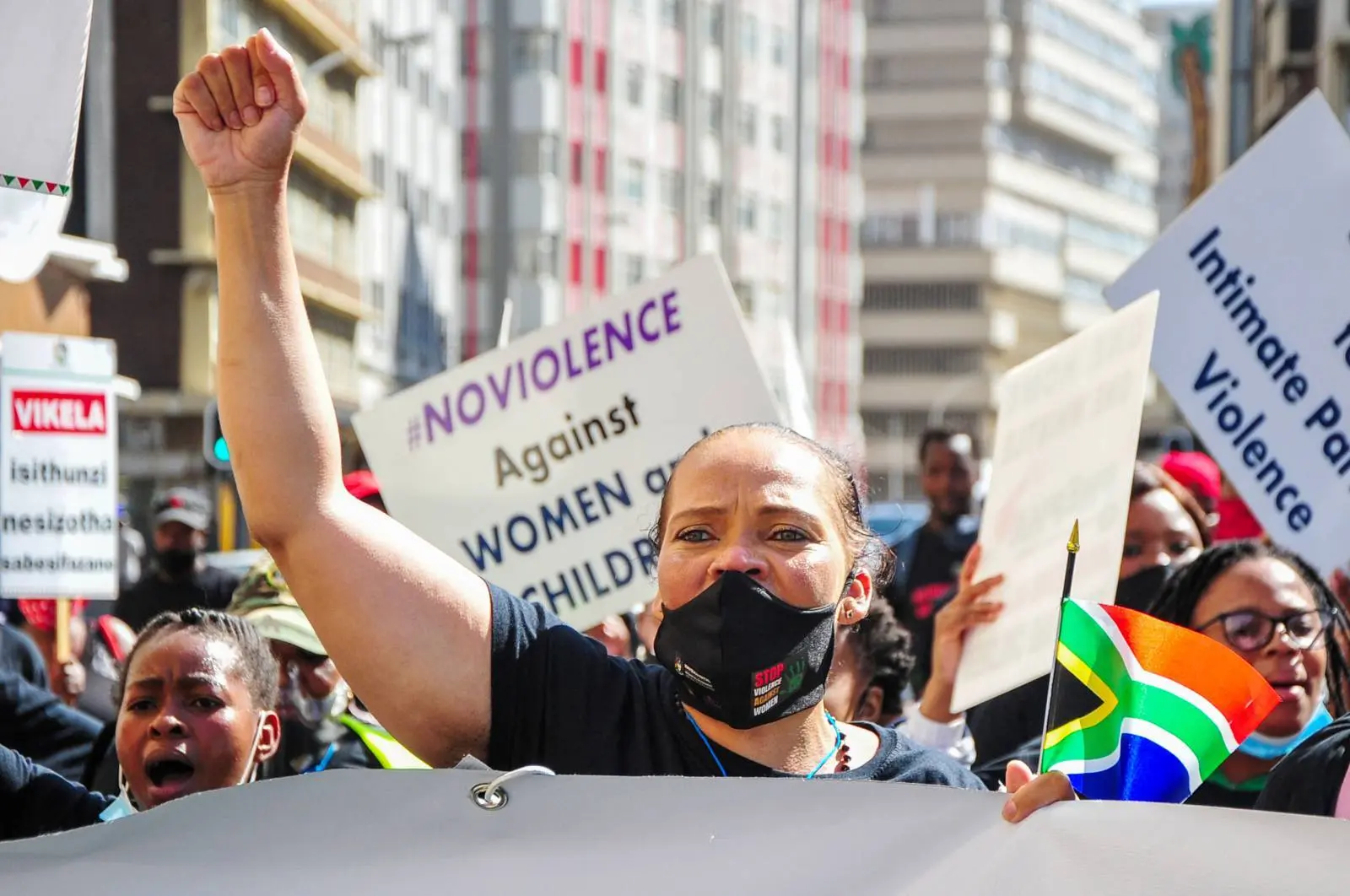
South Africa does not need another political party, summit or presidential statement. Not another multidisciplinary committee assembled after another woman is found dead. And not another campaign telling women how to dress, where not to walk, what time not to run, which taxi to avoid or which route to take home.
The femicide shows us that the problem is the system. We have to ask ourselves: If a political system has become sufficiently entrenched that incremental reform mostly reproduces the same relationships, does it sometimes take a major disruption to force a redistribution of power? If we vote for a different party, will it change anything or will it continue serving in the same systems?
This is not a defence of the ANC. The party’s record of failure is plain and it has forfeited any claim to continued power. Yet removing it from office is only the first step. The deeper structural problems South Africa faces will not disappear with a change of government.
When I say the system has to die, I am not talking about burning down Parliament. I am not calling for a coup. I am not calling for political violence or the destruction of democracy.
I am talking about dismantling the political, economic and social arrangements that keep reproducing the same outcomes while we keep pretending that changing the people operating inside the arrangements will somehow be enough. At some point, we have to stop asking whether South Africa needs another intervention and start asking whether South Africa needs a different way of organising power, accountability, opportunity and economic life.
Look at what is happening. As I write this, police have discovered the body of a ninth woman in the Ekurhuleni area east of Johannesburg in roughly two months. Authorities are investigating whether the killings are connected but have not yet confirmed that they are. Several of the victims were young women and some bodies showed signs of sexual violence.
Our first instinct is to create another task team. But does another task team change the system that allowed the conditions to exist in the first place?

If the police remain under-resourced or ineffective in certain places, if cases disappear into bureaucratic processes, if communities learn not to trust institutions, if perpetrators believe they can escape consequences, if women continue to carry the burden of protecting themselves, if boys continue to grow up absorbing violent ideas about masculinity, if economic dependence keeps women trapped in abusive relationships and if political leadership responds to each crisis only after it explodes, then what are we changing? We are managing symptoms. We are not dismantling the machinery that keeps producing them.
South Africa has been talking about gender-based violence and femicide for years. We have plans. We have frameworks. We have summits. We have speeches. The National Strategic Plan on GBVF contains pillars dealing with accountability, prevention, justice, safety, response, economic empowerment and research. The state has therefore identified many of the structural dimensions of the crisis. The question is no longer whether South Africa understands that GBV is a systemic problem. The question is whether the system is capable of changing itself. And that is where we need to be much more honest.
When I say “the system”, I do not mean one political party. I do not mean the ANC alone, the DA, ActionSA, the EFF or Parliament. I mean the much larger architecture that connects politics, economics, institutions, social norms, capital, policing, employment, land, housing, education, infrastructure and power. Changing the occupants of a building does not necessarily change the building.
South Africa’s political conversation often becomes too shallow at precisely this point. We debate who should govern, who should be president, whether the ANC is finished, whether the DA can govern, whether ActionSA can deliver, the EFF’s politics, coalition arrangements and elections. Underneath all this sits a harder question: If the political parties change but the underlying system remains largely intact, what changes?
Would voting for the DA change everything? Would voting for ActionSA change everything? Would voting for the EFF change everything? Would voting for another party change everything?
These are not questions about who someone should vote for. They are questions about whether electoral change and structural change are the same thing. They are not. A party can enter government and inherit institutions, economic structures, bureaucratic systems, property relations, labour markets, investment relationships and social norms that existed before it arrived. If the structures remain unchanged, the new political leadership can find itself administering an old system. South Africa may not simply have a leadership problem. It may have a system-reproduction problem. We keep replacing pieces while leaving the machinery running.
South African men are operating within a system that, in many ways, has historically favoured them. This is where the femicide crisis becomes particularly important. When we talk about violence against women, we often talk about individual perpetrators. Individual men who murder, rape, assault or abuse women must, of course, be held accountable for what they do. But there is another question: What kind of society allows those behaviours to reproduce themselves across generations?

South Africa’s research shows that gender norms are deeply connected to GBV. The Human Sciences Research Council’s first national GBV study examined perpetration by men against female partners and the role of gender norms in driving violence. We have created a society in which some men can grow up learning that women owe them obedience, their girlfriends are possessions, masculinity means dominance, violence can be excused, controlling a woman is normal, another man’s violence against a woman is not his business and women must change their behaviour to avoid being attacked. When those ideas are reproduced over and over again, they become bigger than individual men. They become social infrastructure.
This is why the femicide crisis should force us to rethink how we understand South Africa. The ninth woman found this week is not simply another crime statistic. Her death is another test of whether institutions can respond before violence becomes normalised. A crisis can become ordinary. We are shocked. Then angry. Then there is a statement. Then a task team. Then a summit. Then a campaign. Then another woman dies. Then we repeat the cycle.
At some point the repetition becomes evidence that something is structurally wrong. The problem is not that South Africa has never tried to respond. The problem is that our responses repeatedly struggle to transform the conditions underneath the crisis.
That is why the country’s GBVF strategy emphasises accountability, prevention, justice, response and economic empowerment rather than simply policing individual crimes. This was never supposed to be only a criminal justice problem. It was always an economic problem, a social problem, a political problem, an institutional problem, a cultural problem and a problem of power. This is where the argument about dismantling the system becomes even more uncomfortable.
South Africa’s risks are interconnected and rooted in structural weaknesses rather than isolated problems that can each be solved separately. Governance failure affects infrastructure. Infrastructure affects business. Business affects employment. Employment affects inequality. Inequality affects social stability. Social instability affects crime. Crime affects investment. Weak institutions affect accountability. And weak accountability allows corruption and organised crime to grow. These things are connected. You cannot keep treating each symptom as an independent emergency.
Political parties matter. Elections matter. Parliament matters. Government matters. None of this should be dismissed. But perhaps we have placed too much faith in the idea that political turnover automatically equals transformation. It does not. A government can change without the economy changing. A president can change without institutions changing. A governing party can change without social norms changing. A coalition can change without the distribution of economic power changing.
Sipho Mackenzie is a social anthropologist, researcher and works on technology and community-led approaches to gender-based violence, particularly the safety of young women navigating nightlife and urban spaces at night. He is a PhD candidate in social anthropology at the University of Cape Town, where his research centres on GBV, young women, precarity and social change in South Africa.