


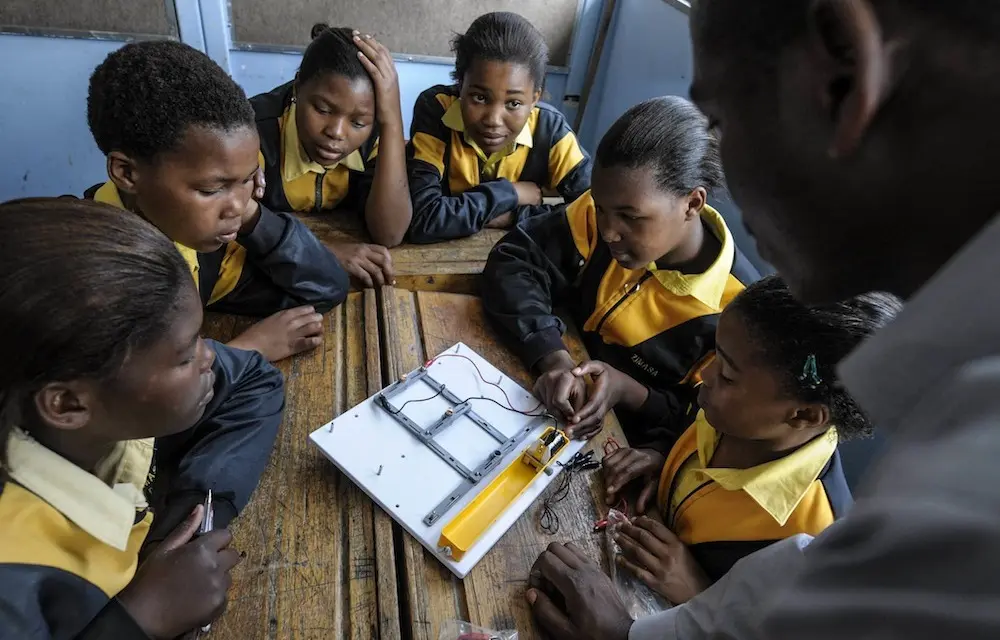
This year marks the 60th anniversary of the adoption of the International Labour Organisation/Unesco Recommendation concerning the Status of Teachers. It was created to recognise teachers’ rights and responsibilities and establish standards around their preparation, professional development, working conditions and employment. It is the foundation upon which every World Teachers Day is celebrated on 5 October.
The cornerstones of why the recommendation was adopted are the basics for the profession: fair pay, job security and working conditions shaped through negotiation between teachers and employers.
But, as with everything, the world 60 years ago looked vastly different from today. For many teachers in the classroom, their role is much more complex and often comprises roles that no recommendation on the status of teachers could have anticipated.
Teachers today are often also shouldering the responsibility of being counsellors, social workers, technology troubleshooters and frontline responders to their learners’ lives as they show up in the classroom. This is on top of ever-increasing administrative burdens and growing class sizes that are leading factors in stress and burnout for South African teachers.
For many, carrying these loads alone can feel isolating and overwhelming. But teaching was never meant to be an individual endeavour. A school is a community, a classroom is a living ecosystem and a teacher is an integral part of both those systems and is constantly interacting with all the other parts and people in them.
This is unfortunately not the reality for most teachers. From 2020 to 2024, 30 992 public school teachers resigned and the department of basic education notes that “resignations among educators are influenced by factors such as retirement eligibility, career changes, migration to other sectors or countries and workload pressures”.
Attrition of this nature sits alongside department of basic education projections that by 2030 South Africa will need about 428 000 educators to maintain the learner-educator ratio. This would require an additional 23 000 educators in the system. These kinds of gaps, if not mitigated for, can mean even bigger class sizes, less individual attention for learners and teacher resources further stretched.
It also places an increasing burden on the teachers remaining in the profession, who are facing considerable pressure that is compromising their health and wellbeing. According to the 2024 Teacher Preferences and Job Satisfaction in South Africa report by the Research on Socio-Economic Policy unit at Stellenbosch University, nearly half of South Africa’s in-service teachers are considering leaving the profession in the next 10 years due to stress.

The school as a community and the classroom as an ecosystem suddenly feel unmanageable for a smaller and smaller group of educators carrying heavier loads.
But this problem is not insurmountable. Despite all this, teaching is one of the most respected professions in South Africa and one that young people deliberately choose. Of South African teachers polled in the latest OECD Talis survey, 63% believe teachers are valued in society, which is substantially higher than the OECD average of 22%, and 62% said teaching was their first-choice career, up from 49% in 2018. Why does that goodwill often not survive once it meets the realities of the classroom?
The system that develops and qualifies teachers feels far removed from the system that receives them. They leave their initial teacher education armed with the theory of how to teach. What is missing is how that theory all comes to life when they are faced with a classroom full of learners that they need to work with in real time. Suddenly, a module from university feels far less cut-and-dried than they would have been examined on.
The first years in any profession matter enormously as people learn how to translate theory into practice. In teaching, that learning happens in real time, with real children, real classrooms and very little room for error.
None of this means the profession is beyond repair. Where we have been able to test what works, the results are telling. This is precisely the gap we have tried to close. Between 78% and 88% of our newly qualified teachers surveyed each year from 2022 to 2024 said the Jakes Gerwel Fellowship contributed directly to their sense of preparedness for the realities of the job. Year on year, 87% to 93% remained in teaching, while 62% of everyone we have supported through to a teaching qualification remains in the classroom.
Coaching addresses the load teachers are carrying most acutely. Coaching is consistently among the most valuable forms of support. In our latest survey, 67% of teachers said that having a school-based mentor helped enormously. However, this works only when it is embraced as a shared responsibility by school leadership, rather than another task added to a demanding workload.
Teachers do not just want to survive the classroom. If we want excellent teachers to enter the profession, remain in it and ultimately lead it, celebrating them once a year is not enough. We need to make teaching easier to do, and it starts with support and collaboration. Unesco has framed teaching as a collaborative profession, highlighting peer learning, mentoring, professional learning communities and shared reflection as important to strengthening teaching and learning. Its current revision of the 1966 Recommendation explicitly recognises the need to strengthen teaching as a respected, supported and collaborative profession.
That is an important shift in improving teaching conditions, but much more needs to change if we are to stem the flow of experienced and newly qualified teachers from burning out and leaving.
Inside schools, it means stronger relationships between school management teams, heads of department and teachers. It also means professional learning communities where teachers can share resources, solve problems together and learn from one another. It means coaching, peer networks and meaningful professional development that continues throughout a career.
Our goal is not simply to keep teachers in classrooms. Teachers are telling us they need support, energy and space to teach well. We need to listen. If we want learners to have a better chance of learning well, teaching should be about teacher wellbeing too.
Sarah Koopman is head of partnerships and advocacy at Jakes Gerwel Fellowship, an NGO that works with early-career teachers, providing them with wraparound support, coaching and professional development opportunities. She is passionate about advancing social impact through collaboration, strategic positioning and meaningful advocacy, leveraging her expertise to create lasting change in South Africa’s education landscape.