


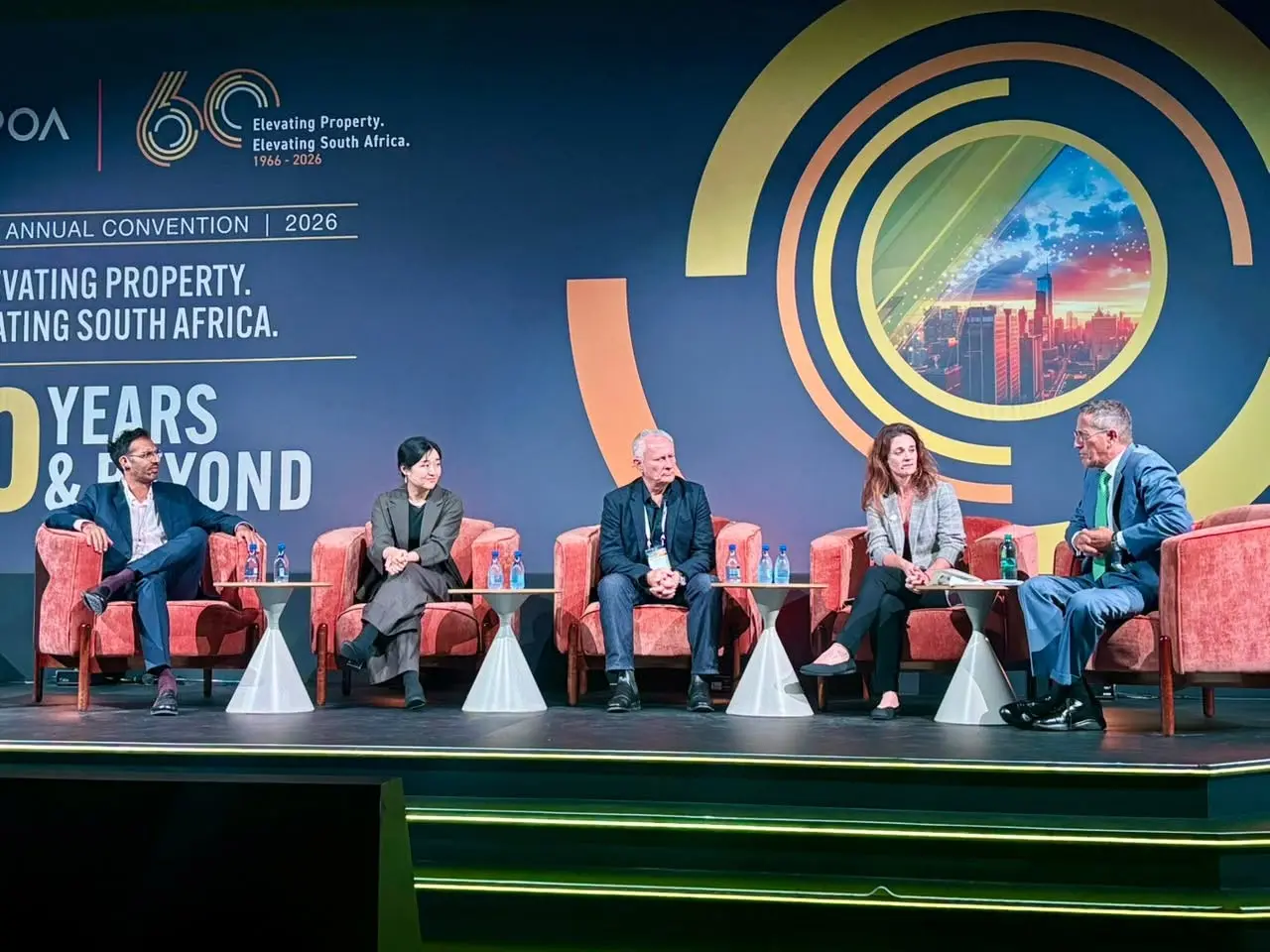
‘We change at the speed of pain.” CNN’s Richard Quest threw that line at a plenary in Sun City last month, in a room filled with South Africa’s top economists.
The occasion was the South African Property Owners Association’s (Sapoa) 60th annual convention. The people listening were the landlords, developers, lenders and fund managers who own and finance a large share of the buildings this country works and lives in.
Quest’s point was that South Africa usually waits until things get bad enough before it fixes them.
With local government elections on 4 November, most delegates wanted to know how much more pain property owners must absorb before change arrives.
Professor Adrian Saville of the Gordon Institute of Business Science (GIBS) set the tone with a keynote that didn’t sugarcoat anything. South Africa has been stuck at roughly 1% economic growth for about 15 years. Back in 1980, production sectors, like mining, made up around half of our economy. Today they make up less than a fifth. Saville called our economy “hollowed out” and added that income per person was lower than it was in 2010.
Anyone who owns property knows a building earns money only if someone pays to use it. Offices need companies that are hiring and flats need tenants with jobs. When an economy barely grows for 15 years, demand for space grows slowly too and so do rentals and values. Saville said Sapoa members sat at the centre of South Africa’s growth engine. If the engine stalled, the buildings felt it first.
Doom and gloom aside, he reminded us that South Africa was the most sophisticated economy in the world’s second-fastestgrowing region.
In my view, our banks and property industry are deeper than almost anywhere else on the continent and we keep underselling that advantage. As he put it, our problem is that we have to get out of our own way. November is one opportunity to do that.
Then came the economists’ panel. The rambunctious Quest hosted Saville alongside Annabel Bishop (chief economist, Investec), Dawie Roodt (chief economist, Efficient Group) and Duma Gqubule (research associate, Social Policy Initiative), and it got feisty fast.
Calls for corrupt officials to end up in orange overalls and blunt criticism of the governing party’s record followed. Quest challenged the panel, saying everyone knew the problems, so why hadn’t they been solved?
The same answer kept coming up: investment. When the panel argued that infrastructure didn’t attract money because investors had lost trust in the country and that cleaning our roads and towns would help win it back, Quest dismissed it as trite.
Having worked in property for years, I can tell you that is how investors behave. Very few confidently commit capital to a big building project in a town where the streetlights are off and the potholes seem to breed.
Fixed investment, money spent on things that last, like roads, factories, power lines and buildings, sits at about 14% of GDP. It was around 21% in 2008. The National Development Plan aims to raise it to 30% by 2030.
South Africa is building far less than it needs to grow. A panellist pointed out that the economy grew every year between 2003 and 2008 and that real investment per person has since collapsed.
In property, the shortfall shows up as projects that never leave the drawing board. A developer can have the land and the approved plans but if the town around the site is going backwards, the numbers stop working and the scheme gets shelved. Multiply that across the country and you get the investment figure above.
Gqubule raised a statistic that should bother anyone who builds for a living. Public-private partnerships, where government teams up with private companies to build and run things like roads or hospitals, have accounted for about 2.5% of public investment in every budget over the past 25 years.
The private sector has the money and the know-how but the state has barely used it. Gqubule also argued that government spent too much time courting Washington when it should be winning over African and Asian markets.
Roodt was harsher. He said around 30 million South Africans received income from the state every month and that the state was destroying capital rather than creating it.
The property link is direct. Tenants pay rent from wages and profits and both of those come from a growing private economy.
The panel also reminded the room how much ground remained to be made up. Official unemployment rose to 33.6% in the second quarter of 2026 and for young people aged 15 to 34 it is 47.4% (Statistics SA).
A residential landlord in a town where nearly half of young adults can’t find work chases the same small pool of households with a steady income. Developers follow the pool into a handful of suburbs and the rest of the city goes without new stock.
Bishop was the most optimistic of the four. She noted that the ANC’s share of the national vote fell from nearly 70% in 2004 to about 40% in 2024, forcing a coalition government. She credited the business-government partnership with helping. Her ask is to speed up the infrastructure drive. Roodt said Eskom and Transnet had to break before they could be fixed and now that they had, there was only one way forward: up. The elections split the panel. Roodt said 4 November could turn out very good or very bad. A weaker ANC might improve accountability but it could also fragment the country into unstable coalitions. Saville said his worst-case result was two parties on about 20% each with a small kingmaker holding the balance of power. Coalition instability affects property. Municipalities approve building plans and set property rates. They also run the water and electricity infrastructure outside your building. When a city council changes hands every few months, as Johannesburg’s has in recent years, decisions stall. Developers wait longer for approvals and tenants look at other cities. One panellist summed up Johannesburg in a single line: it is exploding and falling apart at the same time.
The cost of money adds to the pressure. The Reserve Bank raised the repo rate in May and again in September this year, taking prime to 10.75%. Each increase raises the cost of financing a building, leaving less room for error if the surrounding municipality fails to deliver.
From my years as a broker, I’d add that the municipality has become part of the asset. Two identical buildings in two cities are not worth the same if one sits under a council that maintains its substations and the other under one that can’t pass a budget on time. Buyers and funders price that in. On 4 November voters get a say in which kind of council their buildings sit under.
Saville closed his keynote with Muhammad Ali. Agility, he said, was being able to choose your speed. Every business took a punch and the ones that survived could take it and land a knockout punch of their own. South African property has taken plenty of punches over the past 15 years, from load-shedding to collapsing municipal services and thesector was is standing. Our economy has the bones to grow and the capital is waiting. What’s missing is a government at every level that does the basics and gets out of the way.
Quest said we change at the speed of pain. On 4 November, voters decide whether change comes before the next round of pain or after.
