


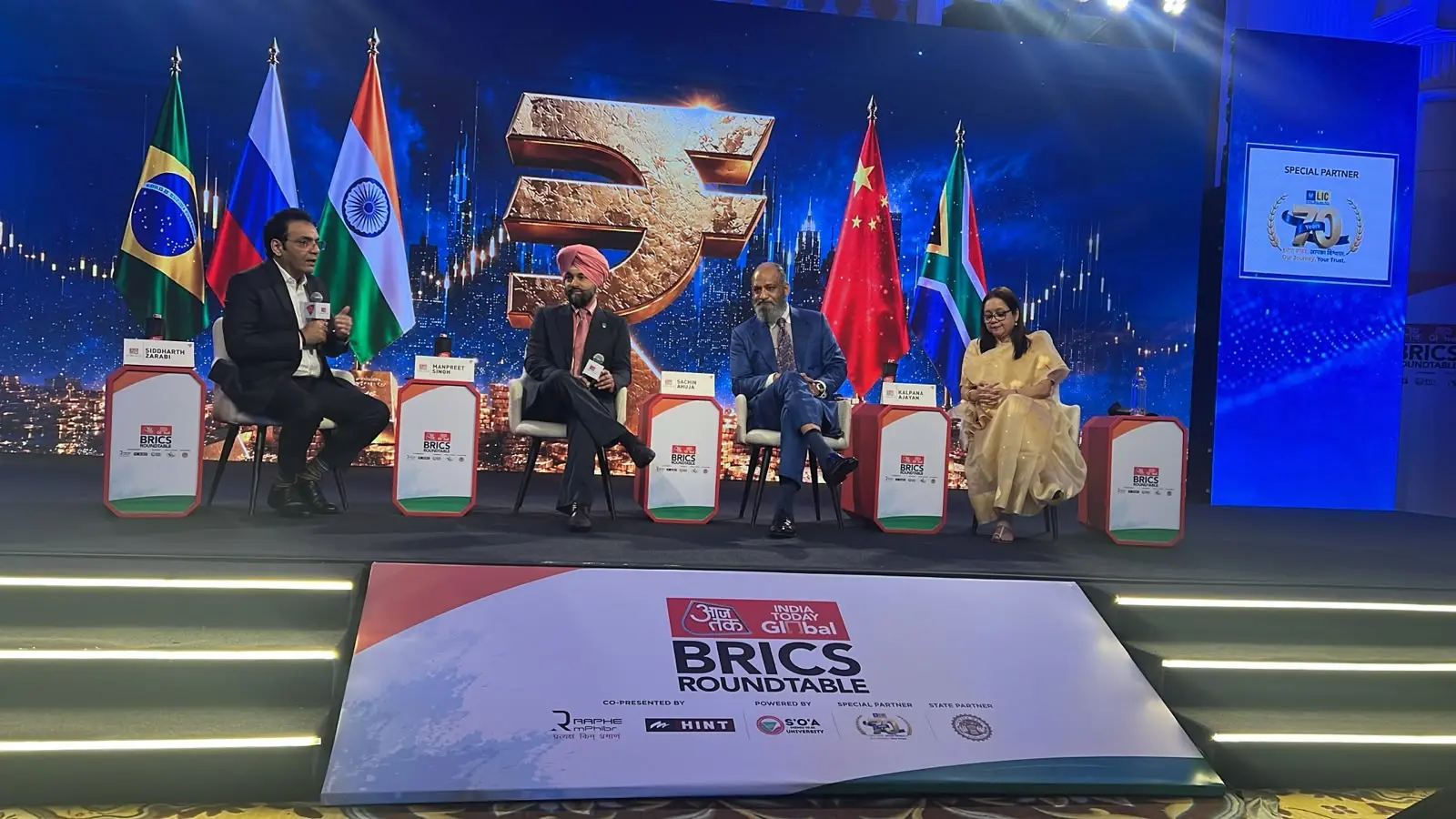
The economic potential of the BRICS grouping took centre stage at the India Today BRICS Roundtable in New Delhi, where business leaders and experts examined why companies are looking beyond traditional markets towards a new generation of trade, investment and cross-border opportunities.
The session, titled "Why Invest in BRICS: The Business Pitch for a New Growth Bloc", brought together Kalpana Ajayan, the regional head, South Asia at Women's World Banking; Manpreet Singh, the president of the Indian Chamber of International Business; and Sachin Ahuja, pictured, the CEO of Alfeco Holdings Group. The discussion was moderated by Siddharth Zarabi, the group editor of Business Today.
The conversation examined the evolution of Indian business from a heavily regulated domestic economy to one increasingly confident about competing internationally — and the role BRICS can play in accelerating the transformation.
Zarabi recalled the era of India's tightly controlled industrial and foreign-exchange regime, when companies required multiple permissions to expand production and overseas travel could present hurdles.
He said the environment had changed. The opening of sectors, such as space to private industry, illustrated the broader shift towards encouraging entrepreneurship, investment and internationalisation.
For Manpreet Singh, India's domestic scale is its strength and potentially, the reason some businesses have remained inward-looking. "An Indian company, even to establish itself within India, is like a huge opportunity within the country," he said.
The challenge, he said, was unlocking the potential internationally.
BRICS offered an opportunity to identify Indian companies with global potential while bringing foreign investors and partners into India's business ecosystem.
"The world is coming to India," Singh said, highlighting the potential for mergers and acquisitions.
Ahuja described her as "born in India but made in South Africa". His journey began 25 years ago when he arrived in the country as a small scrap dealer. Over time, he invested in new capabilities and expanded into manufacturing. Today, his group has four manufacturing plants in South Africa covering steel, copper, aluminium and energy.
His message to Indian businesses considering international expansion is that resilience matters as much as capital. "South Africa ... is a destination every Indian company should look into if they're looking into some kind of raw material security and beneficiation," Ahuja said.
But he cautioned against viewing Africa merely as a source of raw materials. "Add some value. Create some value proposition for the local economy also. Build local."
Ahuja said companies that contributed to local economies were more likely to gain the trust and support of the markets in which they operated.
He said businesses and entrepreneurs were often taught how to succeed but not how to confront failure. "For people who face failures boldly and successfully, success becomes their by-product."
The discussion also highlighted the growing role of women entrepreneurs across BRICS economies.
Ajayan pointed to the scale of the opportunity, stressing that inclusion should be viewed not only as a social objective but as an economic opportunity. For women-led businesses in particular, resilience was critical in the face of economic and climate shocks. Building access to finance, credit guarantees, skills and institutional support could help women-owned enterprises move from survival to sustainable growth.
Ahuja's South African company employs 75 female engineers.
Over four years, he said, they progressed to running operations on the steel-plant floor — traditionally a male-dominated environment.
The wider message of the session was that BRICS has moved beyond being a political or economic concept. Its real value will ultimately be measured by whether businesses can turn its enormous markets into practical opportunities.
India's IT sector demonstrates what is possible, with Indian technology companies operating across continents. The next phase could involve manufacturing, energy, defence, infrastructure, agriculture, technology and value-added resources.
Ahuja identified nuclear energy as a sector that particularly interests him as an investor in India, while discussions also pointed to opportunities for South African technology and expertise to enter the Indian market.
Yet barriers remain. Among the reforms highlighted was the need for faster judicial resolution of commercial disputes. For international investors committing substantial capital, lengthy legal proceedings can create significant uncertainty.
"There is political will," she noted. "There is capital flow." The BRICS opportunity, therefore, lies in connecting entrepreneurs, capital, technology and markets — and turning potential into action.