Evidence: Anti-poachers discover abalone smuggled in the Gansbaai
area of the Western Cape. (Photos:
Steve Eggington & Daniel Born/The Times/Gallo Images)
Before he became a poacher, the man in interview 36 said he had noticed in his village that “there are many guys who are able to afford things like cars and houses” that he couldn’t buy.
One day he approached one, asking how he could afford “the things he has and wants. He told me he was a poacher. I asked him if I could go with him and he said … he will show me how things work.”
His account is in a new report, Insights From the Incarcerated: An Assessment of the Illicit Supply Chain in Wildlife in South Africa, by Traffic, a wildlife trade monitoring group.
It interviewed 73 offenders in correctional centres, representing 49 court cases concluded between 2009 and 2019, in the first study of its kind. Of these, 74% were incarcerated for rhino-related crimes, 15% for abalone-related crimes and 11% for cycad-related offences.
“Poachers were almost all from marginalised communities with little access to alternative economic opportunities who often switched roles, from poaching to driving or concealing products as circumstances changed, displaying high levels of fluidity,” Traffic said.
The poachers were mostly unemployed or informally employed males under the age of 35 and were Mozambicans, South Africans and Zimbabweans.
The lure of more money “encouraged those on the bottom rung of the criminal ladder to become involved further along the supply chain”, Traffic said.
Some rhino poachers split their profits, while those poaching abalone were paid according to the weight of molluscs they collected.
One offender told of how he had purchased a truck and installed scales to weigh the abalone at a different location to avoid authorities’ detection.
The cost of renting diving equipment and hiring a boat would come from divers’ profits. An offender said that, on average, divers earned between R10 000 and R20 000 a dive.
Almost a quarter of those interviewed alluded to corrupt government officials as facilitators.
“I got my assistant to track one of the customs officials and to find out what the official likes to do on weekends,” an offender said. “It just so happened he liked to visit the casino each week … from there we used to give him credit vouchers for the casino so he can have some fun.
“After some time, we asked him to do us a favour in return. This favour was obviously to allow our consignment safe passage through the airport.”
Globally, the illegal trade in wildlife and wildlife products is estimated to be worth more than $72-billion annually, ranking alongside the illegal trafficking of narcotics, arms, and humans, Traffic said.
South Africa is a key player in the illicit wildlife trade because of its role as a source, transit and destination country.
Over the past decade, more than 8 200 rhinos have been poached for their horn; an estimated 37 000 tonnes of abalone was illegally harvested between 2000 and 2016; and from 2011 to 2019, rare cycads worth more than R18.5-million were illegally removed in the Eastern Cape alone.
South Africa has been implicated in the illicit trade of elephant ivory, shark fins, body parts of big cats, pangolins, reptiles and succulents.
One offender spoke of how he did internet searches of private game reserves with rhino populations while another researched the natural distribution of cycads in South Africa.
Once a wildlife commodity was harvested, it was usually transported by vehicle to cities with airports or ports such as Cape Town, Durban, Port Elizabeth, Pretoria and Jo’burg, and in Mozambique to Maputo and Beira.
Offenders bribed government customs officials at airports or border posts and highlighted the active involvement of rangers, police officials and soldiers in poaching and transporting wildlife commodities.
An offender responsible for the sale and export of abalone said he used lawyers and accountants to launder his proceeds.
Rhino poaching offenders said they relied on employees at private game reserves or national parks to inform them about rhino presence or facilitate the transport of poachers inside reserves.
Abalone divers usually harvested between 25kg and 100kg per night. An offender claimed on one occasion, 10 divers were able to harvest 1.8 tonnes of abalone near Port Alfred.
Another told how there were sometimes up to 60 boats a night that went out with abalone divers.
“There are different groups, but they still talk to each other, because it’s them against the police. They also have block watchers (lookouts) everywhere,” said an offender.
Abalone processing facilities were said mostly to occur in Gauteng, or municipalities where abalone was harvested.
Intermediaries claimed Chinese people would be employed to process the abalone “because there’s a certain way it has to be cooked”. They usually came from “rural areas in China” and would not receive compensation, but their families in China would be paid on their behalf.
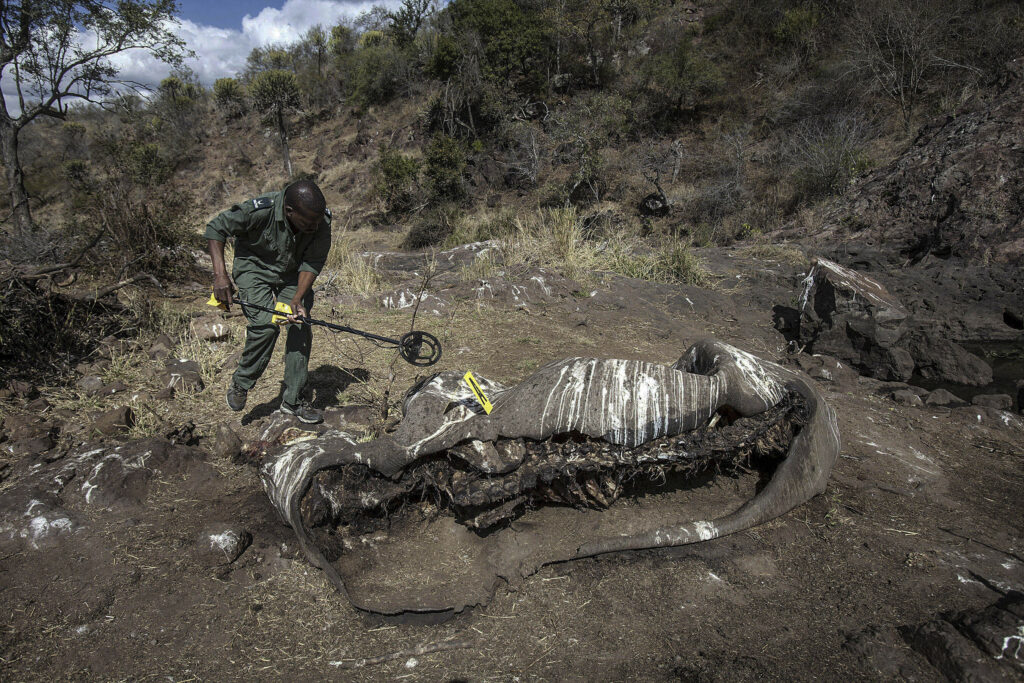 An investigator uses a metal detector to search for a bullet used to poach a rhino in Kruger National Park. (Photo by Gallo Images/The Times/Daniel Born)
Abalone was packaged in potato bags, concealed in coffins, speaker boxes, modified hidden compartments in vehicles made to look like minibus taxis. “So, we got a taxi and then we got big speakers and boxes and seats and everything to make it look legit,” one offender said. “Just before the border, we would pick up anybody that wanted to go across. They did not know they were sitting on millions of rands of abalone.”
There was one woman among the 54 offenders jailed for their role in the illicit trade in rhino horn.
Most rhino poaching groups consisted of experienced repeat offenders responsible for shooting the rhino, alongside first-time offenders tasked with removing the horn or carrying food and water.
Most offenders suggested their bosses were either South Africans or Mozambicans and the buyers were Chinese and Vietnamese. About half of the offenders were recruited through friends or family members.
Some poachers were unaware of the value of the rhino horn. “I think they [his accomplices] used to rob us because the first time I poached, they gave me 30 000 [rand]. When we went to poach again, I was arrested and convicted. After that, I heard some poachers were getting a lot more money than we earned.”
Traffic interviewed nine offenders incarcerated for the illicit trade in cycads. Half of them claimed they were hired to cut down trees.
“You have to have somebody who knows how to take it [a cycad] out carefully, because if it is not done properly, by the time you sell it and replant it, it may die,” an offender said. “So, I would have one, maybe two, group leaders who knew what to do. I would pay them more than the other guys who I would recruit because I needed extra hands to help carry. These guys, whom I usually picked up in town, were unemployed people looking for day jobs. They don’t know about cycads, and I don’t tell them. I would pay them much less than the others.”
An intermediary told how he earned more than R100 000 for 20 cycads.
A repeat offender said that most illegally harvested cycads were laundered through nurseries. The buyers were thought to be the wealthy living in Jo’burg and Pretoria who purchased them for their gardens.
Traffic said that valuable new insights into the organisation of criminal activities was gained through the interviews, but what was notable was those orchestrating the trafficking were not behind bars.
[/membership]