Shutdown: Protests in Mangaung last month called for the suspension of city manager Tankiso Mea. (Mlungisi Louw/Gallo Images/Volksblad)
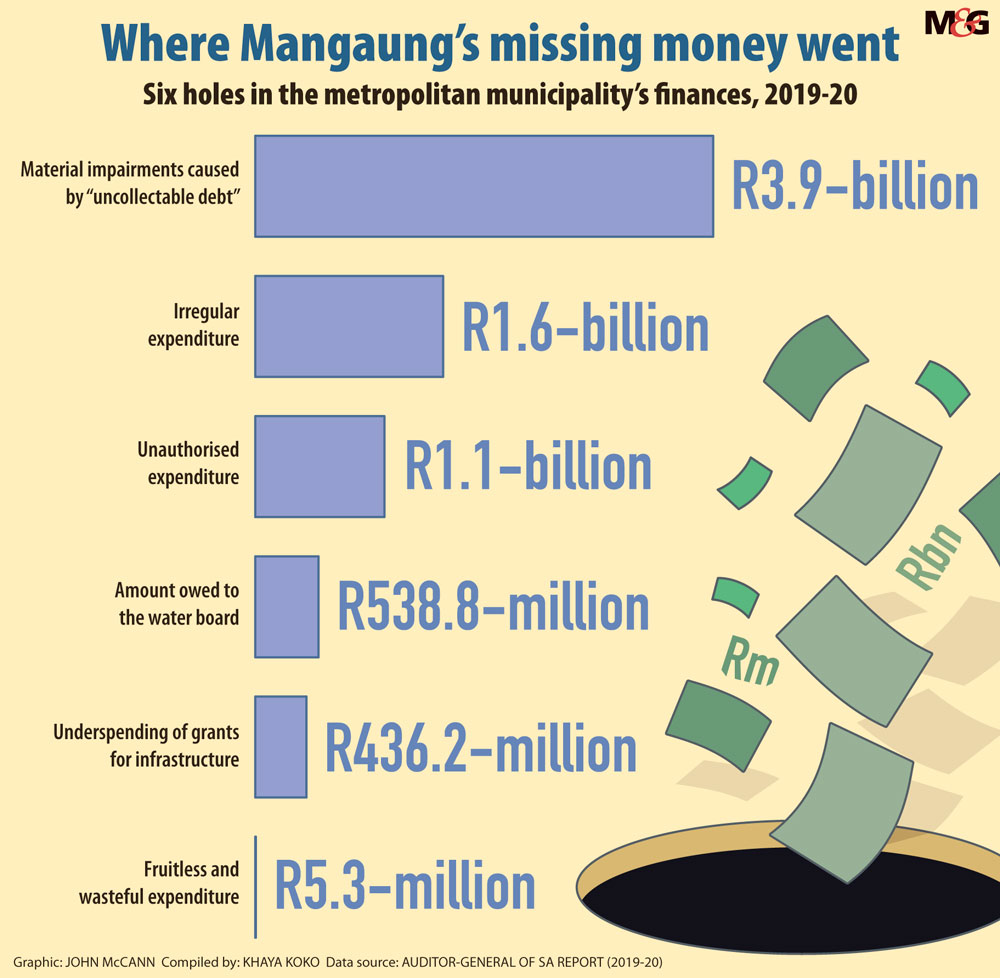
The recent violent and deadly protests in Mangaung have highlighted the consequences of the more than R2.7-billion in wasted funds the municipality incurred, which have placed “doubt” on its ability “to continue as a going concern”.
In a report sent to the Free State provincial legislature, which the Mail & Guardian has seen, the auditor general’s office also highlighted R3.9-billion in material impairment due to “uncollectable debt”, as well as a dire lack of consequences for officials failing in their roles.
In total, according to the report dated 16 April 2016, the Mangaung metropolitan municipality incurred a cumulative R2.7-billion in unauthorised, irregular, fruitless and wasteful expenditure.
These figures, as well as the statement from the auditor general on the municipality’s financial position, underscored residents’ assertions last month of a Mangaung that failed to provide services to its people. The municipality has been under administration since 2019.
The report further added, as reasons for the municipality’s woeful expenditure, gross flouting of supply-chain management (SCM) and other procurement prescripts; issues that the auditor general said were flagged in the previous financial years.
“Some goods and services with a transaction value above R200 000 were procured without inviting competitive bids, as required by SCM regulation 19(a). Some deviations were also approved by the accounting officer even though it was not impractical to invite competitive bids, in contravention of SCM regulation 36(1).
“Some of the contracts were awarded to bidders that did not score the highest points in the evaluation process [and] some of the bid documentation for procurement of commodities designated for local content and production,did not [meet] the minimum threshold for local production and content as required by the 2017 preferential procurement regulation 8(2). Similar non-compliance was also reported in the prior year.”
For four days last month, Mangaung was engulfed in violent protests that resulted in a shutdown of much of the municipality and the killing of a 14-year-old boy.
The child was hit by a stray bullet, allegedly from the gun of 56-year-old security officer, Lefu Letsela. Letsela was arrested and released on bail of R1 000.
A day after the protests ended, the city council voted for the suspension of its city manager, Tankiso Mea, to supposedly pave the way for a probe into alleged maladministration.
Mea’s suspension followed one of the demands of the organisers of the so-called “Mangaung shutdown”, known as the Mangaung Concerned Community grouping, which called for the city manager to be removed for his alleged failure to stem the deterioration of the municipality.
The residents’ contentions of a dysfunctional Mangaung were echoed by the auditor general’s report, which painted a damning picture of the municipality’s management. This included that the municipality took an average of 284 days to pay its suppliers, and owed the water board more than R538.8-million in the 2020-21 financial year, which was up from R485.4-million the previous year.
“Furthermore, the unspent conditional grants of [R436.2-million] exceeded the available cash and cash equivalents of [R395.2-million]. These events or conditions, along with other matters… indicate that a material uncertainty exists that may cast significant doubt on the municipality’s ability to continue as a going concern,” reads the report.
The conditional grants that were underspent were the urban settlements development grant (USDG), which is used to alleviate housing shortages; the public transport infrastructure grant, and the municipal disaster recovery grant.
“The metro received the USDG of R511 856 000 to fund the repair, maintenance and upgrading of water and sanitation infrastructure. Despite the grant funding received, the metro reported in the annual performance report that for 13 of the 30 performance indicators relating to water and sanitation, the targets were not achieved [and] funds should be made available,” the auditor general recorded.
In April, the M&G reported that hazardous, badly marked gaping holes and a dilapidated road network were what was available for the more than R524-million spent.
Mangaung said it paid controversial company GladAfrica to run the construction of its integrated public transport network, known as the IPTN.
The R524-million figure was according to Mangaung’s spokesperson, Qondile Khedama. The IPTN project entailed creating a bus rapid transit system similar to the ones in Johannesburg, Tshwane and Cape Town.
GladAfrica was first appointed in July 2015, with the first phase, which is still incomplete, meant to have been completed and running 19 months ago.
In a subsequent statement to the M&G following publication, GladAfrica said the IPTN was a “multidisciplinary” project, including construction and project management.
“The appointment entailed providing the client with detailed engineering designs of the new IPTN including routes and stations. We also provided other related services such as stakeholder management, consultations with affected stakeholders such as the taxi industry, business forums, institutions of higher learning and members of the community at large,” the company had said.
 (John McCann/M&G)
However, in the auditor general’s report, it emerged that the municipality had spent R709.4-million, including on feasibility and construction.
“One of the projects, the Moshoeshoe [Road] trunk route, commenced on 21 January 2019 with a contract amount [of R36.1-million] and a planned completion date of 14 November 2019,” reads the report, which added that the delays “negatively affected service delivery”.
Questions sent on Friday to municipal spokesperson Qondile Khedama went unanswered, despite repeated text messages that also showed he had received and read them.
The report also recorded a lack of consequences for wasted funds, noting that “reasonable steps were not taken” to deal with unauthorised expenditure.
“The majority of the unauthorised expenditure was caused by overspending the approved budget. The majority of the irregular expenditure was caused by competitive bids adjudicated by a bid adjudication committee that was not composed in accordance with SCM.
“The majority of the disclosed fruitless and wasteful expenditure was caused by interest charged on the late payment of suppliers.”
[/membership]