Failing to invest in a decarbonised economy could cost South Africa trillions, but calls to mobilise capital come amid fiscal strain. (Simon Dawson/Bloomberg via Getty Images)
The cabinet is to consider recommendations by the president’s climate change coordinating commission to decarbonise the economy as the country struggles to pull itself out of an economic downturn and is saddled with an energy master plan that prioritises investment in coal.
The commission released its recommendations on the country’s carbon emissions targets last week. The draft targets have set climate financing at about R64-billion a year in the period 2021 to 2024. This will increase to R114-billion a year in the period 2025 to 2030.
The treasury has previously acknowledged the transition to a greener economy will be expensive. Calls for a decarbonised economy come amid acute fiscal strain, worsened by the Covid-19 pandemic.
The commission has said the country needs to scale up efforts to mobilise the financing needed for the climate transition. The transition risk has been estimated at R2-trillion.
More ambitious targets open up the prospect of greater levels of international climate finance support, the commission noted in its recommendations.
The treasury would not be drawn into details of its plans to leverage climate funding, saying only that it “will not be able to participate on this topic at this stage”.
Last year, in the thick of the economic uncertainty triggered by Covid-19, the treasury released for public comment a draft technical paper titled Financing a Sustainable Economy.
Among its recommendations, the technical paper called for the development of a taxonomy for green, social and sustainable finance initiatives “to build credibility, foster investment and enable effective monitoring and disclosure of performance”.
The draft green finance taxonomy was published last month.
Find the money
The paper notes that addressing both climate change and South Africa’s development agenda “will require the reallocation of capital, the mobilisation of new financial resources and the strategic realignment of existing resources (public and private) over the short, medium and long term”.
According to the South African Climate Finance Landscape report, published earlier this year, R62.2-billion in annual climate finance was invested in South Africa in 2017 and 2018. The bulk of this (R35.3-billion) came from the private sector while the government contributed R12-billion a year.
“If we look at the climate finance we have at the moment, compared to what we need, we need a lot more — both from the public and private sector,” said Gaylor Montmasson-Clair, a senior economist at Trade & Industrial Policy Strategies, a nonprofit economic research organisation.
Mobilising investment now should be a priority, Montmasson-Clair said, adding: “What is clear is that it’s a lot better — not only in financial terms, but also in economic and in social terms — to invest now and do what’s needed, rather than having to deal with the problem later.
“And we do face significant risk as an economy if we don’t transition. So that’s really the discussion that we need to have.”
Funding will have to be raised through international finance and financial instruments such as green bonds, but a lot of money can already be found by repurposing and redirecting existing funds, Montmasson-Clair said.
“It might not answer all of our concerns. Definitely not. But we still channel a significant amount of money towards fossil fuels. And we could channel that money to other investments.”
The Eskom albatross
The coordinator for the presidential climate coordinating commission, Crispian Olver, said the entire energy transition must be funded.
State power utility Eskom plays a major role in the financing dilemma, Olver said.
“Their balance sheet problems are well known, but at the same time we need them to upgrade the grid, roll out renewable energy and battery storage, manage the decommissioning and repurposing of power stations, et cetera,” he said.
Eskom’s liquidity crisis improved slightly when its debt recently dipped below the R400-billion mark after rising to R465-billion. It will need about R144-billion, by its own estimates, to decommission coal fired power by 2050.
“They cannot be expected to do this on their own. International partners have not come to the party in terms of their financing commitments, and this is one area where they need to help. At the same time workers and communities affected by the transition must be assisted to adjust, including retraining, economic development and social security,” said Olver.
Salim Fakir, director of Africa Climate Foundation, said Eskom’s position on climate change would influence South Africa’s status in the global market and that the electricity sector would be the core transformative sector that kicked off a larger transition.
“Once you create that tipping point you set the foundation for much deeper cuts down the line, and it might come sooner than later. I think external pressure in the world particularly with decarbonisation, carbon border tax adjustments is going to drive industry to put pressure on the government because there will be penalties,” he said.
“If Eskom were to decarbonise, it would need to invest in new infrastructure. Under its current debt burden and inability to cover full costs it will be difficult to finance a long-term net zero target, but also in the interim it can be a major player in investments in infrastructure for decarbonisation.”
Eskom may lose out on better loan terms to finance decarbonisation if it transitions too slowly. But Fakir said the decommissioning process for old coal power stations would pave the way for the power utility to get finance to repurpose its infrastructure.
 (John McCann/M&G)
Resource plan’s off-track
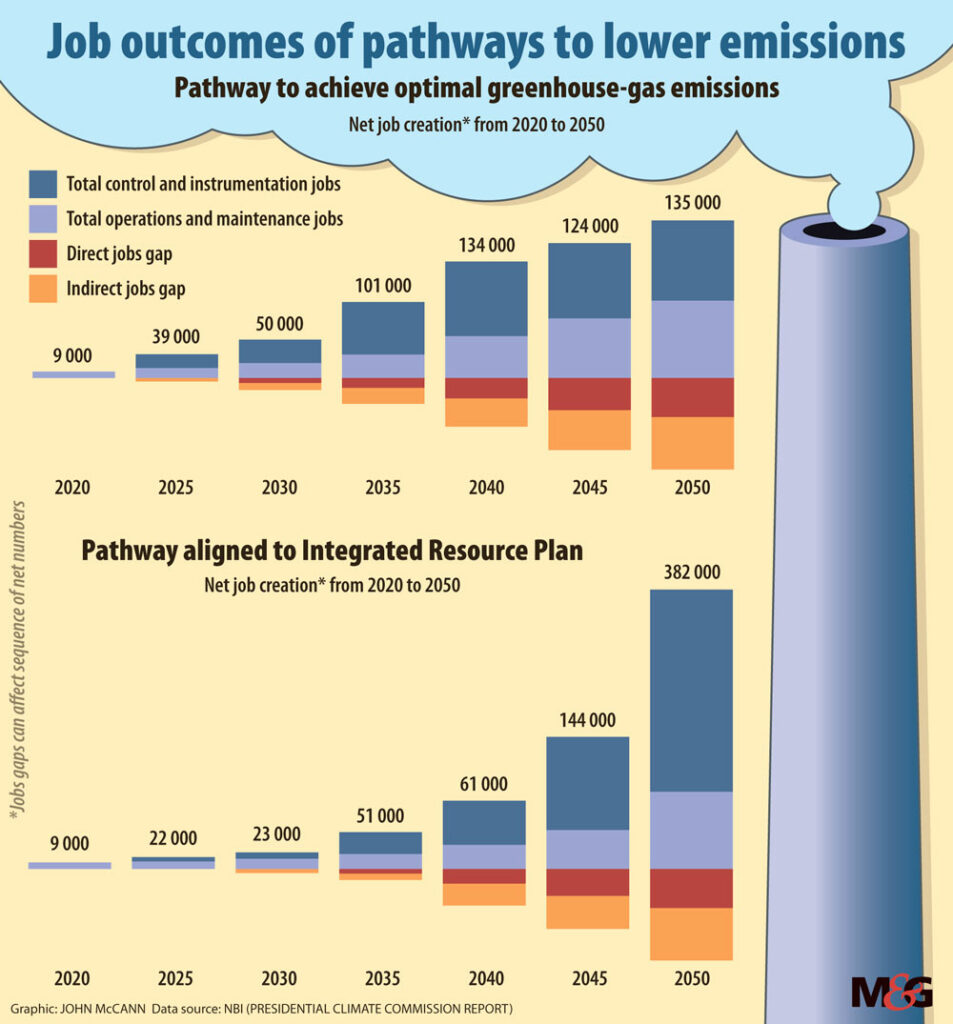
The president’s commission also highlighted that the Integrated Energy Resource Plan, which envisages 750 megawatts of new coal-fired power being added to the grid in 2023 and 2027 respectively, is not the most cost-effective route towards a green economy.
The draft estimates the financing needed for mitigation activities at between R860-billion and R920-billion over the next decade. But, the commission noted, these costs are likely to be higher.
The National Business Initiative (NBI) found that new investments needed for a master plan-aligned pathway will cost an estimated R2.7-trillion by 2050. According to the NBI, an optimal emissions pathway, which would mean no new coal investments, will cost about R2.9-trillion by 2050.
Energy researchers say renewable energy policies can be used to lower the cost of implementing the existing energy plan.
The commission found that South Africa can and should increase its targets and provides the calculations to prove that it will save money by doing so. The current trajectory is not on a pathway to a net zero economy in 2050, although the country’s draft targets work on a five-year cycle, after which it is reviewed
The commission consulted various sectors and researchers before delivering the recommendations to the president last week.
To achieve a higher reduction target of, say, 350 metric tons of carbon dioxide equivalent, the country would require between R900-billion and R1.18-trillion a year by 2030, according to the projections presented to the commission by the Energy Systems Researcher Group.
The findings show that the most cost optimal route for South Africa is to cancel the planned coal-fired power developments envisaged in the Integrated Energy Resource Plan and increase investment in renewable energy.
[/membership]