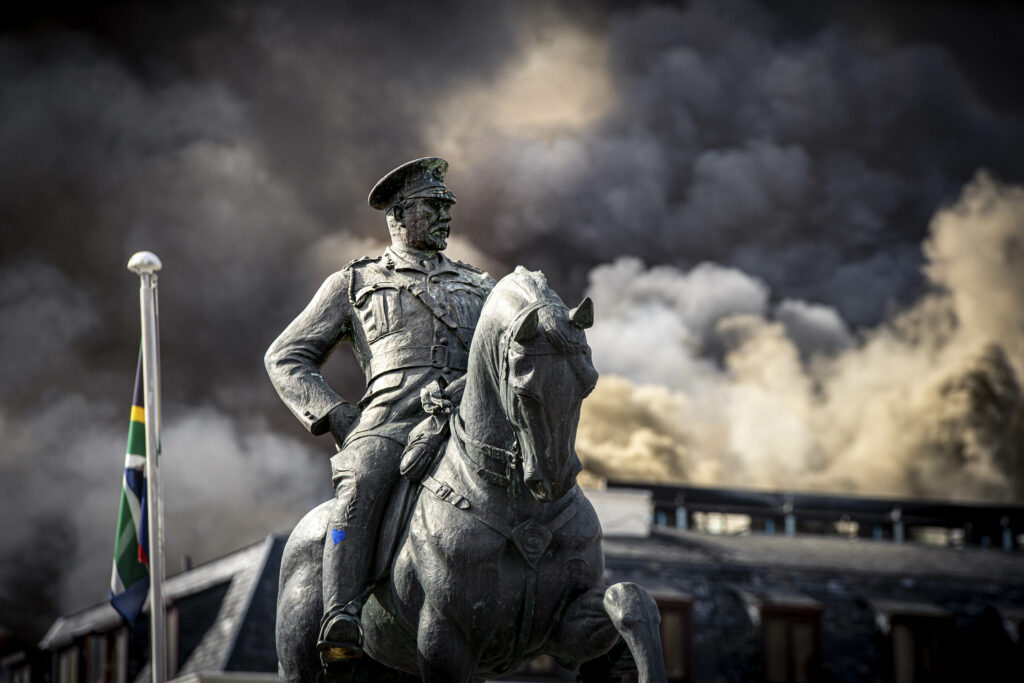
Where there’s fire: Zandile Mafe, who has now been charged with terrorism and is homeless and could be mentally ill, seems an unlikely suspect, leading to the idea that he was used as a patsy by others. Photo: Gianluig Geurcia/AFP
The story that a hapless, homeless man laid waste to half of parliament after spending hours in the building, stealing sensitive documentation, sounds suspect to many, including sources in the government.
Yet it is reliably understood that the Hawks are “extremely confident” Zandile Mafe is the person responsible, and hence have additionally charged him with terrorism. Footage of Mafe inside parliament is understood to be pivotal to the investigation and the further charge.
A source with access to parliament questioned how the suspect could gain access to the building and lay his hands on laptops, documents and other valuables when it is common cause that MPs and staff religiously locked their offices.
The preliminary report released by Cape Town’s chief fire officer, moreover, stresses that the fact that office spaces were locked contributed to the difficulty in fighting the fire.
“How did he even know where to go? Parliament is a big space,” the source said, adding that there was a risk that the fire was part of a fight-back effort by the ANC’s increasingly desperate radical economic transformation (RET) faction “and that the government will allow that to be covered up, conveniently, because there actually is an ANC link”.
It was “very, very tricky” for President Cyril Ramaphosa to deal with trouble fomented by the RET faction plotting his defeat at the ANC’s elective conference in December, the source said.
“There are many questions to answer here and the case needs to be watched very closely. They must release the footage. Show us that it was him, show us what he was doing, and how it could have spread so fast.”
But an intelligence source, who said the timing was too suspicious to be a coincidence, cautioned that if the arson was planned properly, the truth may never come out.
“It is too targeted. My gut feel is there are spooks involved so you are never going to know the whole truth because they use these false flags, [using] street people who’ll do anything for a little money,” he said.
“If these things are executed properly, the crooks always get away, and the patsy is the guy who takes the fall and he knows nothing.”
 Rumblings of discord: Some sources are suspicious that the arson at parliament could be part of a feared ‘second wave’ of attacks planned by the disillusioned ANC radical economic transformation faction, this time on state institutions, after the looting in July. (Carina Bruwer)
Had the attack not happened over the festive season, it may again have whipped up wider violence, he said.
“If people weren’t on holiday it may well have sparked a new July eight days of unrest or worse.”
A former MP said close attention must be paid to Higher Education, Science and Technology Minister Blade Nzimande’s warning that the arson at parliament was linked to the violent unrest that shook the country over a week in July, following former president Jacob Zuma’s incarceration.
“I’m not sure it was as orchestrated as people will make out. I think even when the ANC says it was an orchestrated attempt, they don’t necessarily mean people sat there and planned who we mobilise in what area.
“What they did was — in what they were saying in the media — they riled people up, particularly in KwaZulu-Natal. Then there was a tribal element that came into it and they knew very well that it would come up. And there is unhappiness around Cyril and general social unhappiness.
“So these guys, Carl Niehaus and them, mouthed off, and they themselves were caught a little bit on the back foot then.
“They did not quite expect what happened to happen. In terms of their support in the NEC, that has disappeared now, because people were really shocked. So even people who would have supported them in the past have gone: ‘No, this is too much. This is the end. It is one thing to fight for Zuma.’ ”
The same source drew a link to repeated sabotage at Eskom.
“Even in Eskom, there are definitely people still closely related to Zuma and [suspended ANC secretary general] Ace [Magashule] and so on and who are obviously on the pay, but that money must run out at some point. Some of these instances are related to that.
“I suppose it could be possible that there are some cops in parliament who are working there, who were okay to turn a blind eye, just fall asleep at the post and some money was given to some homeless guy … It is more possible than some homeless guy just jumping the fence. There are too many holes in that story.”
A government source concurred, and said at worst the country could be seeing an attack on the constitutional order.
Acting Chief Justice Raymond Zondo, who last week released the first part of his report on state capture, was the first to hint in that direction after a former convict took a hammer to windows at the constitutional court. It happened on the same day as a fire at the department of justice’s offices in Cape Town. That blaze was minor and might, an official said, well be one of the many random fires set in the city every month. But the department is still in the dark as to the origin of a ransomware attack it experienced last year.
Not everything need be related, or plotted, an ANC member said.
“The thing I’m worried about is a similar thing happening as with the riots. [That] it starts off with something planned and then something else takes over, just a general sense of lawlessness.”
Former ANC employee and Zuma acolyte Carl Niehaus, meanwhile, has rubbished claims that he has links to Mafe. But in government circles there are those who think a connection is not far-fetched and flag oddities about Mafe’s identity, saying his history is vague and in dispute.
“This is how MK veterans would operate. They plant someone in a community and he is not from that community but eventually he is known in that community,” a government source said.
Those who followed the Zondo commission recalled that a year ago, then-director general of the State Security Agency (SSA) Loyiso Jafta testified how an “inherently unlawful” situation prevailed at the entity, with staff serving Zuma’s whims. He expressed worry that firearms had disappeared. A source this week asked if the intelligence community knew where its former rogue staff were. “What happened to them?”
A witness identified as Miss K told the commission the abuses at the SSA extended to establishing a parallel protection force for Zuma, spearheaded by former agency heavyweight and ambassador to Japan Thulani Dlomo.
He was detained in the wake of the deadly July violence, then released.
In July, sources close to Zuma said those instigating the violence were “soldiers”. There were threats of sabotage and striking “where they don’t expect it”. The aim, they said, was to push Ramaphosa out of power and to secure the release of Zuma, then jailed for contempt of court.
At the same time, the M&G reported that the South African Police Service (SAPS) had gone into high alert after receiving intelligence about a second wave of attacks, which would include police stations, state buildings and the judiciary.
SAPS deputy national commissioner General Fannie Masemola sent a memorandum to commanders around the country regarding the threat of further attacks, including plans to rob police stations, armouries and training facilities of weapons and ammunition.
In a letter to provincial and divisional commissioners, the Hawks and SAPS training facilities, dated 18 July, Masemola said the threat had been raised by the national intelligence coordinating committee (Nicoc) at the joint operational coordinating committee (Jocom).
Jocom was set up to coordinate the response of the intelligence community and the security cluster to the riots and met daily to assess threats of violence, looting and arson.
Masemola said Nicoc had warned of the “threat of possible attacks on police stations in KwaZulu-Natal to obtain firearms, ammunition and other weapons.”
Masemola also warned that the instigators of the violence might collude with SAPS members and other security service personnel perceived to be sympathetic to their cause in order to get additional supplies of weapons, ammunition and tactical equipment.
While the “identified threat is to KwaZulu-Natal”, there were concerns that it might spread to other provinces and to SAPS facilities where weapons were stored. Commanders with arsenals under their control were placed on alert and instructed to take the “necessary measures’’ to ensure weapons and ammunition were secured.
Ordinary SAPS members were to be briefed and told to remain “vigilant and operationally ready to combat the threat,” Masemola said.
At the time, intelligence community and political sources told the M&G that there were very real concerns that the July attacks were “just the beginning” and that further mobilisation and attacks on state buildings, and attempts to incite racially based attacks in areas like Phoenix where more than 30 people were killed during the July violence, were possible.
In the latest indication that the state remains aware of the ongoing threat, the presidency has extended the deployment of troops to support the police until March. The deployment of 2 700 South African National Defence Force troops was authorised on 18 December last year and will remain active until 18 March at a cost of around R233-million.
The troops were brought in “in cooperation with the SAPS” in “preventing and combatting crime and preserving law and order” according to correspondence from the presidency to parliament last week.
The use of soldiers to back up the police was authorised after the first few days of the July unrest and was extended before the festive season.
Two ANC national executive committee (NEC) members who spoke to the M&G said that a possible sabotage of the government and the executive was discussed during its first meeting on 6 January.
The NEC members said that some in the party’s highest decision-making body during conferences also made links of the unrest to the recent fire in parliament.
“This matter of parliament and the July unrest has been discussed extensively. We decided that the president’s decision to restructure the security cluster has to be supported. Even the security cluster’s shortcomings were briefly discussed.”
Another NEC member said a decision lobbied by many in the NEC was that the rehabilitation of security institutions must be fast-tracked.
“There is a belief that the plan in place will be helpful to reclaim that space. There was also a common understanding that the president’s decision to take the cluster under his office was the best one. Even those who had shown some hesitation over this decision now agree that this is the only way we can restructure and strengthen our security arm,” another NEC member added.
[/membership]