Nailing it: An EFF supporter carries a mock coffin with a picture of then president Jacob Zuma during the party’s 2014 election rally at Lucas Moripe stadium in Atteridgeville. Photo: Madelene Cronjé
In a split away from the ANC in 1997, Bantu Holomisa and former National Party leader Roelf Meyer formed a new party. Fashioned as a pro-diversity party, the United Democratic Movement gained traction with the electorate in its formative years and won 14 seats in parliament.
Two decades later, Holomisa’s project has plateaued to only two seats in parliament.
In 2008, another alternative to the ANC was born. Formed by ANC leaders loyal to former president Thabo Mbeki, the Congress of the People (Cope) fell flat quicker than its formation. A year after it won 30 seats in parliament, a leadership row ensued between its founder, Mosiuoa Lekota, and Mbhazima Shilowa.
The power battle, which ultimately forced a Shilowa departure, caused permanent damage to Cope.
With only two seats in parliament, Cope, a party that was once thought to be formidable enough to take on the liberation movement, has little sway in the political discourse.
Enter Julius Malema’s Economic Freedom Fighters, which would rival all other new parties. It’s safe to say that the ANC and its leaders did not consider Malema a worthy opponent. At least those were the sentiments of the then president, Jacob Zuma, shortly after the EFF was launched.
When asked about what he thought of the EFF during a media briefing in 2013, Zuma, the man behind Malema, said he did not see the party as a threat. How wrong he was.
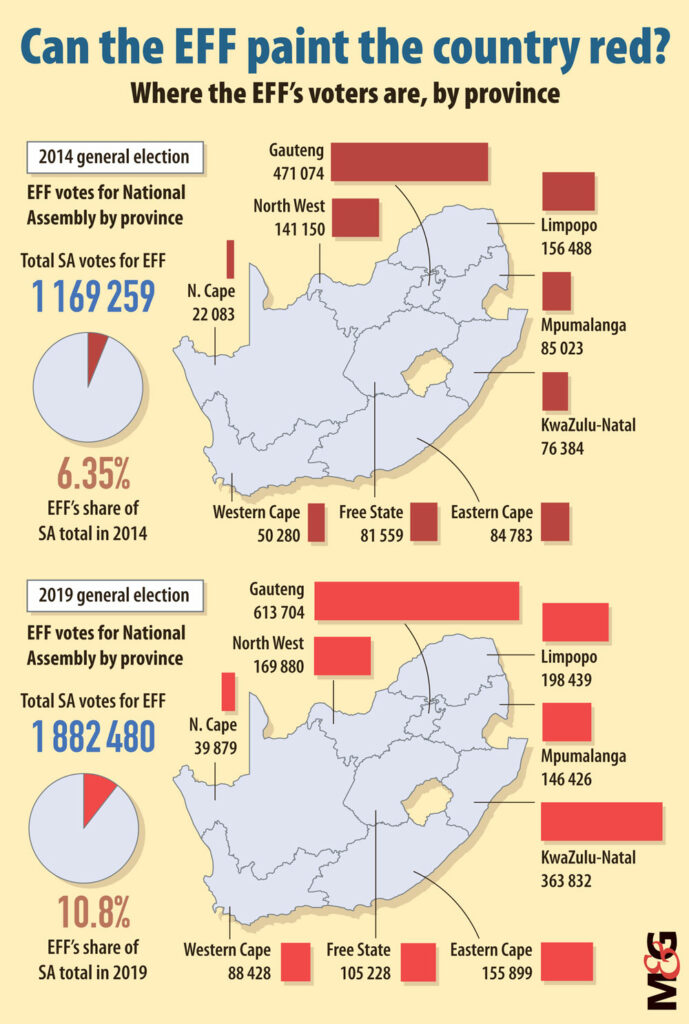
The EFF has shaken South African politics. With Malema spearheading a nationalist, populist agenda, the party has grown in each election. Why is that? We asked political analyst Ongama Mtimka and associate professor of political studies at the University of Johannesburg Mcebisi Ndletyana how the EFF defied the odds and, unlike other splinter groups born from the ANC, why it had flourished.
Mtimka says this can be attributed to a combination of many factors: a generational dynamic of young leaders, its strategy and tactics and Malema’s authority in the party.
To Mtimka, Malema’s authority is at the centre of the EFF’s growth.
“The legitimacy of Malema as a leader has remained for the longest time, widely accepted inside the party, and there hasn’t been a viable and even that much of a strong intention inside the leadership structure to challenge Malema. They have been able to contain whatever aspiration for leadership.”
He said that regarding Cope, this was the opposite; the contest about who should lead the party led to its downfall.
He argues that contested leadership was also the reason for Herman Mashaba and Mmusi Maimane moving away from each other and the Democratic Alliance to form two parties — ActionSA and the One South Africa Movement respectively — destined to compete for the same constituency in the 2024 elections.
Ndletyana makes another compelling argument about contestation in the EFF. He refers to the party as a blend of a patron-based party with a charismatic leader.
“Over time the way it has operated has become extremely patron-based. It revolves around the charisma of the leader, so the leader has superseded the ideological foundation of the party to a point where you hardly know who a provincial leader of the party is,” he said.
“It would be almost impossible for a new leader to have the same level of excitement and credibility as Malema. There is a potential that the party can survive his departure, but his personality has become so predominant that it is doubtful whether that can happen. I don’t rule it out but it is doubtful.”
 (John McCann/M&G)
Mtimka adds that the EFF’s strategy and tactics were also integral to its growth. From slogans such as “pay back the money” to its bravado in parliament, the EFF’s use of unconventional politics that dominate the media space created a mass appeal.
“The EFF went into a docile parliament and proved that through strategy and tactics you could augment your impact to be greater than your numbers. They became the de facto official opposition and even drowned government messaging,” he argues.
“For wider appeal they used unconventional tactics, and SA developed a love and hate relationship with them. The unconventional politics created the kind of drama that gets news headlines. The EFF eroded parliament’s decorum and it was the theatrics of that process that got them to have media coverage. They played into the structure of media production. The media helped posture the EFF as an organisation that is taking the fight head on, to an unaccountable ANC,” Mtimka says.
Although Holomisa might share some of Malema’s traits, Mtimka says the general’s outspokenness has a significant degree of respect, which is why, when he left Nelson Mandela’s ANC, he remained a friend of the family.
“Over some time the ANC has managed to gravitate more towards the centre, balancing the ideological contestation. So what Malema did when he left was to give expression to the leftist ideology as well as the impatience that members of the ANC have had with the rate of transformation.
“Instead of being overly cautious not to upset the upper class, his message is that you have to act urgently. Malema simply pursued that one factional interest, prioritising Africans using the state and focusing strictly on the interests of the poor.
“That ideological strand within the ANC coupled with populism presented an impression that all these dreams are realisable,” Ndletyana notes.
The EFF’s clearest Achilles heel is Malema’s obsession with the ANC, Mtimka argues, equating his legacy to that of DA federal council chair Helen Zille.
“He has behaved almost like Zille. You build an organisation outside of the politics of where you come from and you succeed in doing that, and then you turn around and take it back where you left. This is in the same way Zille built the DA and defined it beyond the politics of Tony Leon, only to come back 10 years later and destroy that very same legacy.”
[/membership]