African refugees and migrants fleeing war and dictatorships in search of safety on European shores. (AFP)
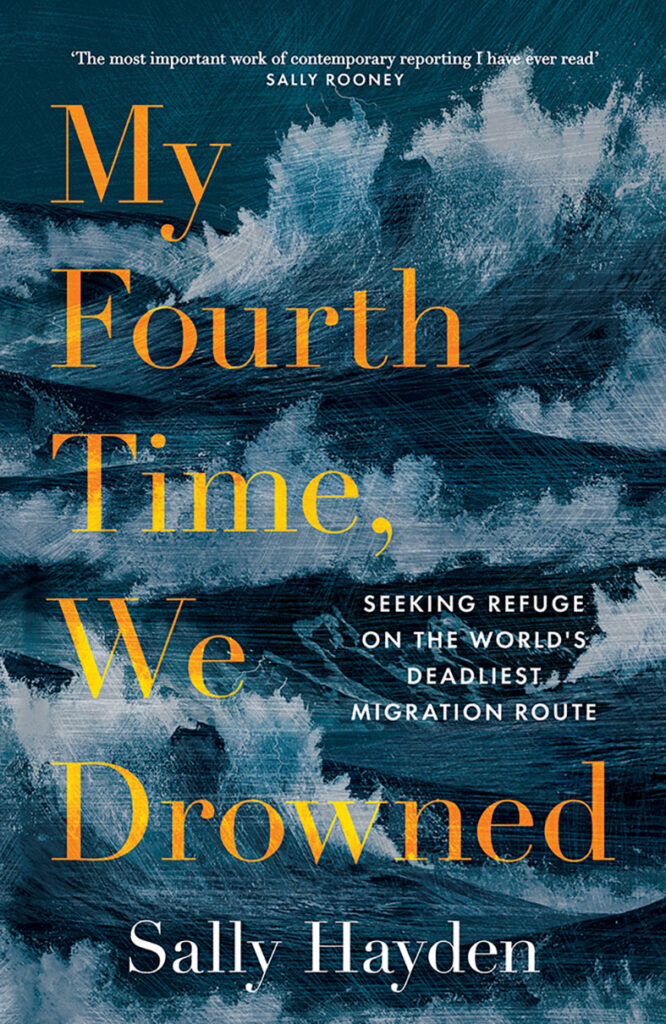
My Fourth Time We Drowned, by award-winning Irish journalist Sally Hayden, illuminates the pivotal human rights concern of our times: the rights of refugees and migrants to safety and security.
Hayden’s reporting from 2018 to 2021 has been used in human rights reports, to support planned litigation, and in a submission to the International Criminal Court calling for EU officials to be charged with crimes against humanity.
“I wanted to document the consequences of European migration policies from the point that Europe becomes ethically culpable: when refugees are forcibly turned away,” Hayden writes.
A powerfully written amalgamation of narrative nonfiction and investigative journalism, My Fourth Time We Drowned is compelling reading for a wide audience that documents the misery and torment of vast numbers of African refugees and migrants fleeing war and dictatorships in search of safety on European shores.
Thousands drown crossing Mediterranean Sea by boat; thousands more (87 752 from 2017 to2021) are captured at sea by the Libyan Coastguard following an agreement between Italy and Libya in 2017 “to stem the influx of illegal migrants”. The EU pledged a sum of almost €100-million towards training and equipping the coastguard.
With searing honesty and courage, Hayden tells the story of refugees and migrants incarcerated indefinitely in brutal circumstances in Libyan detention centres without access to any legal process. As her investigation evolves, she exposes the backdrop to a humanitarian catastrophe: the hypocrisy and obfuscation of the EU and UN agencies; the heartless expediency of some NGOs that stage photographic shoots to promote themselves but are nowhere to be seen when help is needed; and the money the EU pumps into keeping African refugees out of European countries.
Hayden said when interviewed by the Mail & Guardian that a key theme of the book is how “a life and death situation for one group of people” comes up against organisational policy that does not value all human lives equally.
“People are being pushed back because of deliberate European policy,” she said. “It is not that they have to be in a detention centre; it’s just random…Then you have these organisations with staff that are comparatively very privileged, whose security is being measured on a completely different spectrum. What I tried to look at is the much broader picture in terms of the value we place on different lives. When should they be deemed to be protected?”
In 2017, with sponsorship from Transparency International’s Journalists for Transparency (J4T) programme, Hayden went to Sudan to investigate how the EU Trust Fund for Africa was being spent there. The fund, established in 2015, is a multibillion pot of money aimed at stopping migration to Europe.
“I was aware of the Trust Fund’s effect across Africa and I had heard a little about what was happening with the Libyan coastguard, but I think a lot was being done to muddy the waters … A lot of refugees that go to Libya, first go to Sudan. The brother of one of the people in Ain Zara [Libyan detention centre] knew about me from my reporting on Sudan and that is how he contacted me.”
Back in London, Hayden received a Facebook message from the man asking for help. At first she was sceptical but they exchanged WhatsApp numbers and she listened to his story.
“He was telling me that a war had just broken out around them; that there were 500 men, women and children, and they had been abandoned in what he called a ‘prison’ — a detention centre — in Tripoli and they needed emergency help. They had no food or water and they could hear the sound of warfare and see people outside patrolling.”
After confirming that war had broken out in the region, Hayden waited 24 hours before sharing information on social media.
“When I started reporting on this I didn’t have preconceptions.” Trying to figure out what was going on, Hayden initially spent days doing research. “I realised that the Libyan coastguard was being supported by the EU and that this had been going on for a year and a half. It very quickly became clear that what was being said by this vulnerable group of people was very different to what was being said by the entities in power; I refer to both the EU and the UN and also sometimes some NGOs who were working in Libya, and also the Libyan government obviously.”
“We knew that Libya was in turmoil anyway but I hadn’t really understood the total chain of command and the total culpability in terms of how everything was happening,” Hayden said. Her communication with refugees showed that they invariably arrived in Libya; spent up to a year — sometimes with smugglers — paying off their debts to travel to Libya, and then tried to cross the sea, and it was at this point that they were intercepted by an EU-supported body and locked up.
There are smuggler-run detention centres; unofficial detention centres and official, government-aligned detention centres, Hayden explained.
“There is confusion about official and unofficial, but actually a lot of them were aligned with the government. There were 26 or 24 at the time I was reporting on this initially. They are basically being run by militias, but they are aligned with the government. The way they were described internationally made it sound as though they were unofficial and not aligned to [the] government, but actually it was government policy to have these places opened and to have people being sent there,” Hayden said.
“If somebody is taken to what is called an ‘official’ detention centre — and this happened a lot — the guards in the centre will sell them back to smugglers or will send them somewhere run by smugglers,” Hayden said. “At that point, they are still going through official means, but being sent to an unofficial place. The crimes against them are being hidden by separating them from the official chain of command. But this actually is almost an official policy.”
“When I received those first messages, I could not have anticipated the personal ramifications of reporting on this crisis. The following years would see my life threatened in North Africa and my freedom on the line in Europe. I would travel across three continents chasing leads, spending weeks on a ship in the Mediterranean Sea and coming face to face with human smugglers accused of torturing people to death. I would uncover corruption, lies and gross negligence, and be denounced by government propaganda channels,” Hayden writes.
[/membership]