Members of the Disaster Management, South African Police Services (SAPS), volunteers and other law enforcements agencies pack food parcels at the Search and Rescue Centre at the old Virginia airport following heavy rains, mudslides and rain and winds in Durban, on April 18, 2022 as the death toll from the disaster that struck the coastal city of Durban surged passed 450 wreaking havoc in the surrounding region destroying homes and infrastructure. (Photo by RAJESH JANTILAL / AFP)
Civil society organisations and opposition parties want all government spending on flood relief and infrastructure rebuilding in KwaZulu-Natal made public for oversight to prevent a repeat of the looting of Covid-19 emergency funds in the province.
They believe that while live audits of spending by the office of the auditor general and other agencies will help, a public register of what was spent and to whom contracts were allocated is “critical” to ensuring accountability and preventing looting.
Allegations of abuse of emergency relief and water tankers by officials in eThekwini and elsewhere – including claims Phat premier Sihle Zikalala had a water tanker based at his La Mercy home – have already emerged since the response to the disaster began.
There are also concerns that funds allocated to rebuild infrastructure, schools and roads will be looted by corrupt networks in eThekwini and in departments – including education and social development – which were exposed for Covid-19 looting.
While some implicated officials have been sanctioned, others remain – particularly in the education department – and will now be responsible for procurement in the multi-billion rand rebuilding of schools, roads, water and sewerage infrastructure.
The devastating floods which swept Durban and other coastal parts of the province last week left more than 440 people dead and thousands others homeless and inflicted damage to roads alone estimated at R5.6 billion.
Estimates provided by the presidency suggest that more than 40 000 people have been displaced, with 4 000 homes completely destroyed and another 8 300 partially damaged by flood waters.
More than 630 schools have been flooded and damaged – 124 of them extensively – along with 23 hospitals and 34 clinics and community health centres.
President Cyril Ramaphosa and Zikalala have both made bold declarations that there is “no room” for corruption in state spending to repair flood damage.
However, the president announced this week that the national treasury would make R1 billion available through the Solidarity Fund – which had dispensed Covid-19 funding on the state’s behalf – a clear indication of a lack of trust in government departments to do so.
In an address to a special sitting of the KwaZulu-Natal legislature on Wednesday, Zikalala said his administration would tighten up financial controls to prevent corruption in flood relief spending.
Zikalala said the steps announced by Ramaphosa – including the involvement of the auditor general, professional bodies and civil society – would be supplemented by monitoring conducted by the SA Human Rights Commission and the office of the Public Protector.
“We welcome the stern warning by the president that there will be no room for corruption and that measures will be put in place to prevent corruption. There must be transparency and full accountability for every Rand spent,” Zikalala said.
However, Zikalala himself faces a call for his resignation over his admission that a water tanker had been deployed to his home at La Mercy in north Durban, one of the areas that has been without running water since
Democratic Alliance (DA) KwaZulu-Natal leader Francois Rogers made the call in the legislature after Zikalala apologised for the tanker incident and said that it would not happen again.
The premier had earlier said the tanker had first delivered water to his neighbours, but had made a new disclosure in the debate over his address.
Roger said Zikalala’s actions were a “shocking abuse of power which amounts to theft.”
“What the premier has done is steal water from the most vulnerable residents of our province,” he said.
DA councillors have asked the acting eThekwini city manager Musa Mbhele to provide metro police escorts for water tankers to ensure that they reached their allocated destinations because of claims that ANC councillors were hijacking tankers.
The ANC’s eThekwini region has instructed its councillors to involve party structures in relief efforts, sparking fears that this will see food, water and other resources being delivered to its supporters and not the general public.
Its newly elected chairperson, Zandile Gumede, has played a highly public role in initial relief efforts despite being impacted by the party’s step aside resolution over her R400 million corruption case. Gumede goes on trial next month.
DA provincial education spokesperson Imraan Keeka said his concern was that the education department – and others – had failed to remove corrupt officials implicated in PPE procurement by the SIU.
This meant that procurement by the department was being handled – and overseen – by officials who had actively participated in the looting of PPE funds and who had faced no consequence.
“There is nothing that can be demonstrated to show that they have taken proper steps to ensure accountability. Instead, every trick in the book has been tried to avoid implementing any consequence management,” Keeka said.
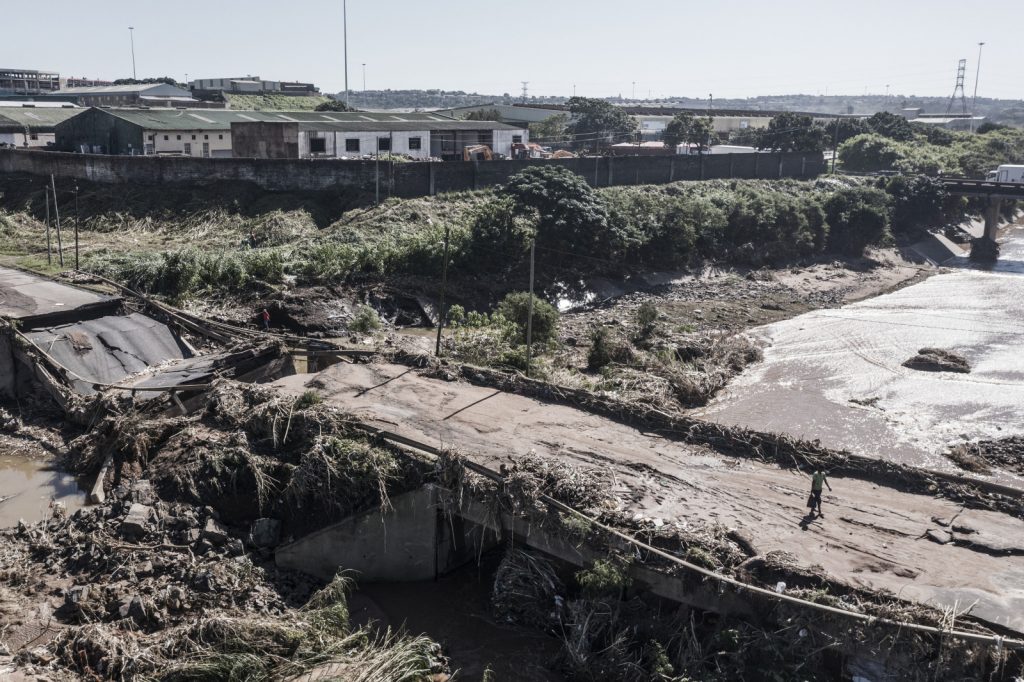 This areal view shows a man walking across a destroyed bridge north of Durban, on April 14, 2022. – Victims of South Africa’s worst flooding on record clamoured for relief on April 14, 2022 as the death toll from the disaster that struck the coastal city of Durban surged past 300. At least 306 people have been killed since rains, the heaviest in six decades, wreaked havoc on Durban and surrounding region destroying homes and infrastructure. (Photo by MARCO LONGARI / AFP)
During 2020, the department had defended its spending, but subsequent facts had shown that the corruption that had been “vehemently denied” by education MEC Kwazi Mshengu had been subsequently proved.
Mshengu has challenged the SIU’s findings that his department’s top brass – including chief financial officer Lalisingh Rambaran and former acting department head Barney Mthembu – should be sanctioned over corrupt spending.
“I have no doubt that there are already shady backdoor deals being done with regard to money that will be allocated to the province. What we will have to do from the opposition benches, not only in education but across portfolios, is to pay attention to the rands and cents,” Keeka said.
The DA would also be pushing the government to publish a register of all flood-related spending across departments and municipalities to ensure that there was proper oversight.
“We believe that not only must such a list be made available, but that the entire bidding process should be public and open. This is public money that is being spent and everybody has a right to know exactly what it is being spent on,” Keeka said.
Corruption Watch executive director Karam Singh said the floods had exposed the government’s failure to protect communities from the effects of climate change and its failure to learn from previous floods.
Singh said it was “critical” that the disbursement of flood relief funds – and those for rebuilding damaged infrastructure – was monitored closely to prevent them being looted, as had been the case with Covid-19 spending.
“Experience has clearly shown the vulnerability of our procurement systems to corruption in times of crisis, if one considers the rampant corruption during the Covid-19 pandemic,” Singh said.
“The immediacy of the situation, and the precarious situation of so many KwaZulu-Natal residents, require fast and efficient use of resources to meet the most basic needs of water, food, shelter.”
Singh said there needed to be “absolute transparency and full disclosure” of how the funds are distributed to ensure that they reach the communities for whom they are intended.
Systems should be put in place to allow government, oversight bodies and civil society to monitor the allocations and spending, Singh said.
This included making the information public, as had been the case with Covid-19 emergency procurement.
“The auditor general must be activated to do real time audits of spending, in a potentially effective and appropriate preventive measure that should be used in this instance,” Singh said.
Lessons should be learned from the personal protective equipment (PPE) debacle and the subsequent publication of Covid-19 related spending, which allowed those monitoring the spending to pick up irregularities.
Parliament’s portfolio committee on water and sanitation on Tuesday cautioned against “the temptation to steal while the intervention is underway.”
Committee chair Robert Mashego said while it welcomed the interventions being made by the department to make sure people had water in the short and medium term, systems needed to be put in place to prevent “the abuse of state resources and the tankering system for the benefit of a selected few.”
The committee would continue to demand regular updates on the cost of the damage and budgets allocated to address it and wanted “openness and accountability” over spending which had been re-prioritised in response to the disaster.
[/membership]