QINGDAO, CHINA - MAY 09: Aerial view of shipping containers sitting stacked at Asia's first fully automated container terminal of Qingdao Port on May 9, 2022 in Qingdao, Shandong Province of China. (Photo by Zhang Jingang/VCG via Getty Images)
The world’s economy was dealt a heavy blow by Russia’s assault on Ukraine. The war prompted the International Monetary Fund (IMF) to cut its global growth expectations, while inflation began to heat up well beyond what some central bankers are willing to endure.
Meanwhile, another threat to the global economy is also raising eyebrows: China’s growth, which has been put on the line by its government’s uncompromising approach to containing Covid-19.
South Africa’s economic fate is closely tied to China, which imports the highest percentage of the goods produced by Africa’s southernmost country. But still-elevated commodity prices could keep South Africa from being pulled down by China’s slowed growth.
Shanghai was put under lockdown in March, after the financial hub faced an upsurge in Covid-19 infections. Shanghai is the largest single Chinese city to be locked down since the outbreak of the pandemic.
Last week, China’s President Xi Jinping reportedly doubled down on the government’s zero-Covid policy, opting to tighten Shanghai’s lockdown despite the falling number of infections. He has reportedly endeavoured to boost infrastructure investment in an effort to support economic growth.
China — which has also recently been hit by a property crisis, exemplified by the fall of embattled developer Evergrande — is the last major economy committed to containing Covid-19 through isolation.
Meanwhile, authorities in Beijing are doing their utmost to avoid a similar fate for China’s capital. In certain badly-hit districts, residents have been told to work from home. Some restaurants and public transport have halted operations.
Zero-Covid knocks growth
In the latest sign of the effect of the Chinese government’s zero-Covid policy, the country’s exports grew by 3.9% in April compared with a year earlier, marking the lowest growth rate since June 2020, when the world still felt the full effects of the pandemic’s grip.
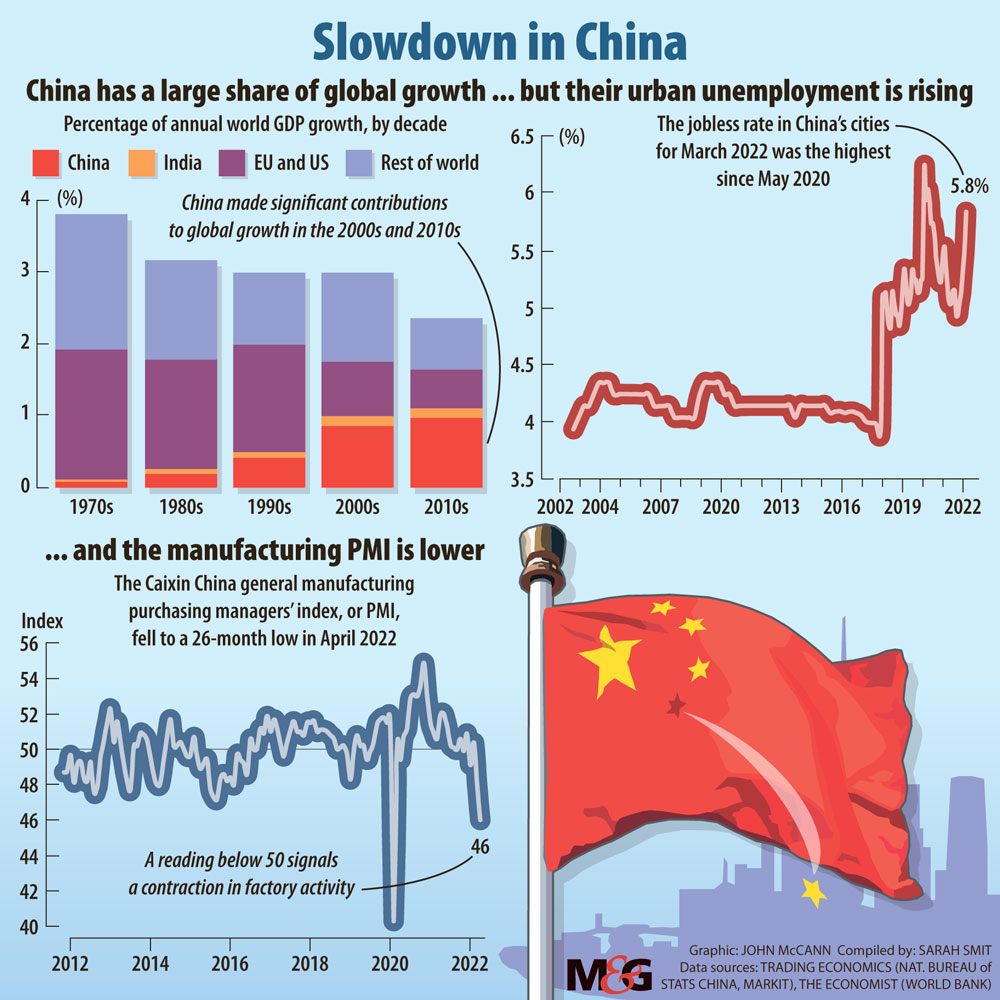
The export data comes off the back of other high-level data raising red flags about China’s stalling growth. Factory activity declined to a 26-month low in April, with the Caixin Purchasing Managers Index (PMI), which measures the prevailing business conditions in the manufacturing sector, falling to 46 from 48.1 in March. A reading above 50 indicates production growth, while a reading below indicates contraction. The contraction in the PMI is the third in 2022.
Weaker trade and manufacturing in China, which is sometimes referred to as “the world’s factor”, will feed into global inflation concerns, which have prompted central banks to begin to rein in growth-boosting monetary policy.
Last week, Fitch cut China’s GDP growth forecast, citing the government’s zero-Covid policy. According to the ratings agency, China’s economy will now grow by 4.3%, instead of 4.8%. Chinese policymakers have a 2022 GDP growth target of 5.5%, which Fitch surmises is unlikely to be met given current trends.
The IMF, which recently cut China’s growth forecast from 4.8% to 4.4%, seems to agree with this conclusion. China’s economy expanded by 8.1% in 2021 compared with the year prior. In its World Economic Outlook, published last month, the IMF noted that slower-than-expected growth in China will have consequences for Asia and beyond. “This could further set back the recovery, particularly in emerging market and developing economies.”
China’s rapid industrialisation, which started in the late 1970s, contributed significantly to a higher demand for exports from commodity producing countries such as South Africa. Between 1978 and 2017, China’s GDP growth averaged almost 10% a year and helped sustain the commodity boom of the early 2000s.
If China sneezes, SA catches a chill
Martyn Davies, Deloitte managing director for emerging markets and Africa, noted that South Africa’s growth trajectory “has been coupled with China’s very robust growth in the course of the last generation”.
For this reason South Africa ought to be very concerned about slower growth in China. “What happens when China catches a cold, or sneezes, we’ll certainly catch a chill,” Davies said.
But, he noted, South Africa has become decoupled from China, because of an inability to keep up with whatever demand comes our way. “We are in a very precarious situation now where our growth — to put it in polite terms — has, because of supply-side constraints in infrastructure, hs decoupled from a China-driven commodity supercycle,” he said.
“If our infrastructure was working correctly — rail and ports — and if we had more pragmatic policy impacting the mining sector, we would have seen significantly more of an upside on GDP growth.”
Thungela Resources, South Africa’s largest coal exporter, notified shareholders last month that it had received word from Transnet that the state’s logistics company was unable to perform its duties because of a number of factors impeding its operations. The effect of these factors, including rife vandalism on the coal line, resulted in an annual rail performance of 58.3 million tonnes of coal delivered to the Richards Bay Coal Terminal in 2021 compared with its annual capacity of 77 million tonnes.
“So if China slows down,” Davies said, “what little tailwinds we currently have will also go on the back burner and that certainly is very negative going forward.”
Conflict buoys commodity prices
Ravi Bhatia, S&P Global’s lead sovereign analyst on Africa, noted that the continued Russian invasion of Ukraine has pushed many commodity prices up. “So that could partly counterbalance a potential China slowdown.
“But South Africa has been unable to take full advantage of high commodity prices and significantly ramp up commodity volume production across the board,” Bhatia added. “So it is a concern, but there is the other factor of the ongoing, terrible fighting in Ukraine. That is keeping global commodity prices elevated and there is demand for South African commodities.”
Coal futures have more than doubled since the start of 2022 and are currently priced above the $350 a tonne mark. South Africa is the world’s fifth largest coal exporter after Russia. The European Union’s ban on coal imports from Russia has thrown the energy market out of whack, prompting the region to seek supplies from elsewhere, including South Africa.
Momentum economist Sanisha Packirisamy said commodity prices are expected to remain favourable, at least in the near future. “It is quite difficult to tell off the back of the Russia-Ukraine developments how long those sanctions will persist.
“Obviously, the longer that sanctions persist on the market, the more upward pressure there will be on raw material prices — and that will be positive for commodity export prices for South Africa. But that is unknowable.”
[/membership]