The ANC in KwaZulu-Natal and Gauteng faces its toughest question ahead of the 2024 election. (Delwyn Verasamy)
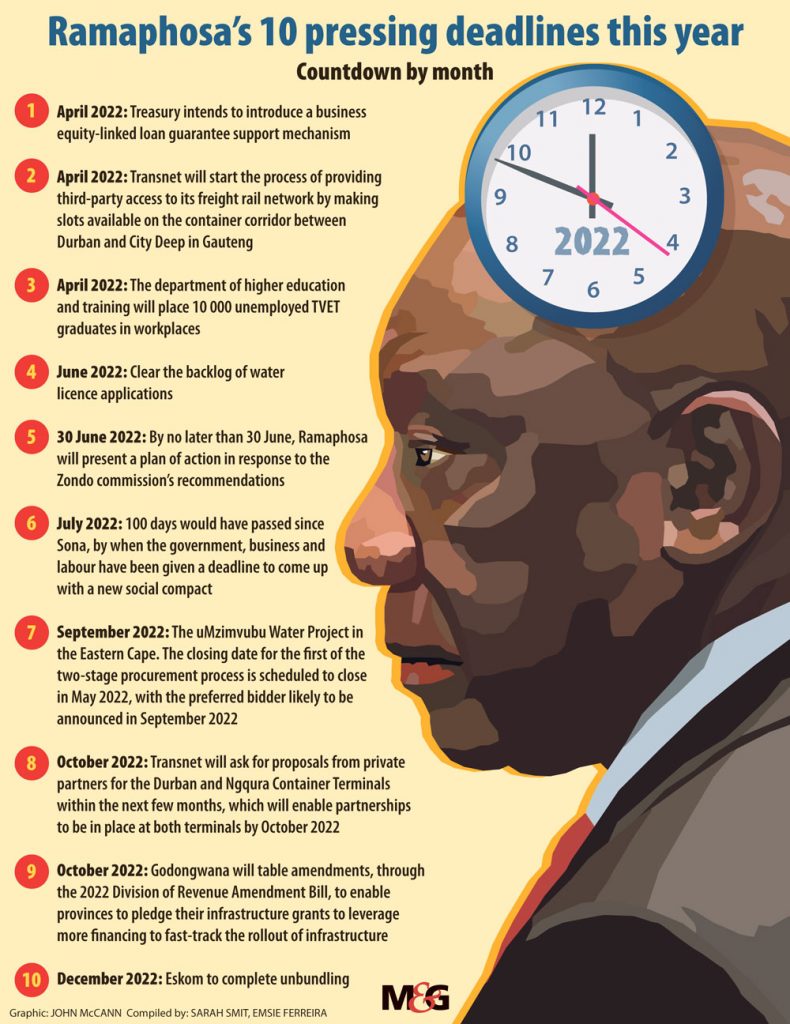
Amid red warnings on the economy, President Cyril Ramaphosa’s 100-day deadline for civil society, business and labour to forge a new social compact to create jobs and fight deepening poverty expires next week.
That is if you count calendar days, which puts Ramaphosa’s deadline at 21 May. A more generous interpretation — that he may have meant working days when he announced the compact in his state of the nation address — gives parties until the end of June to find each other.
But, according to the parliamentary coordinator of labour federation Cosatu, Matthew Parks: “Whichever one you choose, I don’t think you’re going to meet either. It’s not going to happen. We have not even got to the stage of any clear proposals at Nedlac [the National Economic Development and Labour Council], far from it.”
Alexander Forbes chief economist Isaah Mhlanga concurred. “The hundred days is not going to be met. There are a couple of things that seem to not be in place,” he said.
 (John McCann)
For one, Ramaphosa is yet to bridge the divide between government and business in his drive to implement a basic income grant. The February budget provided a R44‑billion stop-gap to extend the R350 social relief of distress grant to some 11- million people for another year.
The basic income grant is intended as a centrepiece of the compact Ramaphosa has mooted since he took office in 2018. Calls for the grant have intensified as South Africa’s jobs crisis has deepened, causing the real unemployment rate to hit 46.2%.
The government and labour’s ideal interpretation would extend the grant to some 15- million beneficiaries. But business firmly opposes the political ambition to cast the welfare net any wider by agreeing to a universal grant.
Nhlanhla Ndlovu, who represents organised community at Nedlac, said his constituency won’t budge on the basic income grant. Earlier this year, Nedlac research seemed to back calls for the provision of such a grant.
But social partners have received mixed messages about the grant, with policy positions seeming to change depending on the department, Ndlovu said. The department of social development, for example, has been far warmer to the idea than the treasury, which has stuck to the line that the regular payout would put too much pressure on the public purse.
On the latter department’s position, Ndlovu said: “We are doing this social compacting on the understanding that we need to take extraordinary steps to address the problems that the nation is facing. You can’t say that we’re taking extraordinary steps, but we are not going to touch finances.”
Mhlanga noted that the government — the president and the department of social development, in particular — wants a higher social wage. “It is one of the things the president wants big business to buy into and support, but currently it is highly contested,” he said, adding that there is little agreement on how much the grant would be and who should receive it.
“I think the other ask from business is that the social wage must be not universal, but must be targeted to those in absolute need, with the focus more on creating jobs, helping SMEs [small and medium enterprises] by reducing red tape and implementing reforms that extend to energy and the labour market … That is what business is asking for in return for supporting the social wage.”
Business also wants guarantees in the labour law reforms, which have been a hard sell, “at least for now”, Mhlanga said, “which for me would imply that business is unlikely to support a universal basic income grant. So we seem to be a little bit far from where we would expect convergence that would then make a social compact possible.”
Reality and ideological contestation will probably prevail, resulting in another extension of the R350 grant come next year, Mhlanga said.
‘A no-go area’
Organised labour has held informal meetings with government representatives. It was expecting another round soon, Parks said, because there was a push to bring proposals to Nedlac to meet the deadline. Parks described the process so far as one of weeding out contentious ideas to put consensus within reach.
He was adamant that Cosatu had sunk the proposal to exempt small businesses from labour law requirements, which has been floated publicly for the first time in more than a decade.
“For us that was a no-go area,” Parks said. “As far as we are concerned we had these very same labour laws in the 2000s when the economy was booming. We are not even sure of the argument that these make it hard to hire and fire people because we’ve lost two-million jobs since Covid struck. That proves that you fire people quite easily.”
The answer to companies complaining about protracted labour disputes was not to change the law but to fix inefficiencies in the system — such as the Commission for Conciliation, Mediation and Arbitration (CCMA) — which is within state power.
“We also don’t want workers to spend three months at the CCMA hearings. But the fault is not with the labour laws, the fault is that you’ve cut the budget of the CCMA so they’ve reduced the number of commissioners and are running with an archaic IT system. So why don’t you fix that?” Parks said.
The recalcitrance on the labour regime will affect the willingness of banks to come to the party on the latest loan guarantee scheme, Mhlanga predicted.

The latest iteration of the loan scheme offers R20-billion in support to small businesses hit by the pandemic, last July’s violence and looting and recent devastating floods.
The original scheme, which was part of Ramaphosa’s R500-billion Covid-19 stimulus package, failed to reach its 10% loan disbursement target.
“Labour has to concede. If it does not concede, lending might not be extended to the extent that it should be,” Mhlanga said.
The message labour has imparted has been that to fix the economy, the focus should be on fighting corruption, ending load-shedding and arresting the collapse of Eskom, Transnet and municipalities.
‘Sacrifices need to be made’
In the to-and-fro regarding the compact, Cosatu has also lashed out at the “absolute silence” of business on the wage gap in the private sector — a battle the federation has waged and lost since the Employment Equity Act was in draft form in the early days of the postapartheid parliament.
Mining company Sibanye-Stillwater has recently received backlash after it emerged that its chief executive, Neal Froneman, received a R300-million pay package while workers waging a two-month strike are asking for R150 be added to the company’s latest offer.
Former Goldman Sachs partner Colin Coleman, the co-chair of the Youth Employment Service, said stakeholders could not maintain their rigidly orthodox positions if they were to chart a course towards an inclusive economy and stem inequality.
Sacrifices need to be made because the alternative was allowing unlawful extraction to proliferate to the point of economic destruction.
“Is it hard for business to agree that workers go on their boards? Well it probably is, but it shouldn’t be. This kind of excessive demand by public workers for wage rises above inflation, does it make sense for them? Yes. Is it good for the country? No. Are they going to concede on that? Probably not,” Coleman said.
“The difficulty is that the underpinning of the society is filled with cross tides of the vested interests of all these powerful people who are using the political machinery to advance their economic interests. So it is very difficult without a political rupture to get these economic reforms to happen.
“So you need to get the politics realigned to make the economics and the social compact happen. What that means is business, workers, and public servants have to come closer to each other. They have to unify and they have to look past their narrow interests and find common ground in a much more thoughtful way than has been the case in the past.”
Investor sentiment improved when Ramaphosa took office in 2018 and reached out to the private sector.
As one economist put it: “For the first time we had a government that said the private sector should drive growth — as opposed to an interventionist government in the previous decade — which says to the private sector you are partners, not ‘you are white monopoly capital’, and let’s work together.”
But Ramaphosa’s more business-friendly approach has not been met with the amount of private-sector investment needed to turn the economy around. The voting public and the private sector wanted a deeper reckoning, Coleman suggested.
“We have stopped the rise of a kleptocrat like Jacob Zuma but we haven’t managed to see Ramaphosa really turn it around. The jury is out to see whether the hard work is being done to clean the ANC and if it is not, then what are the consequences.”
Seven months from now the ANC’s election conference will give an indication of whether the party can find the resolve to fight lawlessness and implement the Zondo commission’s recommendations on state capture.
Political rupture
“It is true to say that across society there is a very wide berth of space for gangsters to do as they please without consequence. The number of political killings, assassinations, murders of competitors in the taxi industry, it is astonishing. So there is no hope of stopping the extraction without the prosecution function working,” Coleman said.
“I think there is a groundswell in society for that to happen; whether there is the will among political power-brokers is a different question. What happens in the ANC in December will be an indication of what the ANC members think, but many of the criminal forces are attracted to the ANC precisely because that is where state power resides, and with state power comes resources, and they can use those state resources and capture them for economic gain.
“That is the Zuma phenomenon, which didn’t disappear just because Ramaphosa got 51% of the votes at Nasrec. It won’t disappear.”
Economic turnaround demands a greater political shift, Coleman said. That shift may only be seen at the ballot box in 2024.
“It may be that there are political alternatives that arise that are not there at the moment. So it is a very fluid political environment. But a rupture can take many different forms,” he said.
“Economic reforms without a political rupture, or without significant political movement, are going to be snail paced. We cannot afford snail-paced economic reform.”
The private sector may judge the state’s response to Zondo’s recommendations with pragmatism, Mhlanga said. “How that translates to actual prosecution and the recovery of monies that have been stolen — I think that is what business wants.”
A totally clean state is not realistic, he added. “As long as the core of the public sector, in the core sectors of governance, are relatively clean, I think that would be a good outcome. If we look at institutions like SARS [South African Revenue Service], we need it to be the best it can be.”
The same goes for the treasury and the state-owned enterprises that are integral to economic growth, foremost among them Eskom, followed by Transnet, Sanral and water authorities.
“Eskom is integral. We cannot speak of a 3% growth rate without guaranteed electricity provision, even in the event that we do all the other reforms, like the ports, rail and the roads tomorrow and we do not have electricity guaranteed, we will not get to see a higher growth rate. It is a binding constraint, a drag to the ability to grow and to attract investment,” Mhlanga said.
Even if the unbundling of Eskom were to happen by December — as promised by the president — it will not ease the energy generation crisis and until that happens, foreign manufacturers will not set up on South African soil, unless they can factor in their own generation as part of the fixed-investment outlay.
A senior economist, who spoke on condition of anonymity, said the private sector would be closely watching the outcome of the ANC policy conference in July, by which date the social compact may still be on the drafting table.
High stakes
“December is very important. But I guess even before that June is also important from a policy discussion point of view. Because that will give a sense of how December is likely to unfold. If July comes and we have populist policies that are put as the agenda of the ruling party, we already know who has won the debate there, and we already know who is likely to come and implement those in December,” the economist said.
“So far, there is a realisation that there is a lot at stake, society is on the edge, looking for quick change, but also the lessons of the last decade might influence a lot of what me might expect of the leadership that should come and the support from business that should be there — or should not be there should we get a non-reformist group of leaders.”
Certain members of the business constituency were hesitant to air their stance on the new social compact, saying they are still in discussions with the government.
The chief executive of Business Leadership South Africa (BLSA), Busi Mavuso, repeated the private sector’s view on looser labour restrictions to make it easier for businesses to hire and fire. “The smaller the business, the more important it is to get the right person for the job. Getting it wrong is costly, both financially and also in terms of lost productivity.
“Given that risk, the rational decision for many business managers is not to hire. Unfortunately, people who have never been exposed to any sort of operating business fail to realise how important this issue is.”
Improving the quality of the education system and rooting out corruption should also be a priority, Mavuso said, adding that “there are too many people in office at all levels of government that have been implicated by the Zondo commission, the Special Investigating Unit or elsewhere”.
She said she was perplexed by Ramaphosa’s 100-day deadline to finalise a new social compact.
“In BLSA’s view, a social compact was achieved with the Economic Recovery and Reconstruction Plan that was agreed between all social partners last year … What matters now is implementation.”
Kaizer Moyane, the organised business representative at Nedlac, weighed in on whether the government has kept up its end of the bargain on previous social compacts.
Using the 2018 jobs summit as an example, he said there were times business felt it was waiting on the government to do its part.
At the time, Ramaphosa said the commitments made at the summit would lead to 275 000 jobs a year. In the years since, social partners have also signed off on the Economic Recovery and Reconstruction Plan, as well as a compact to resolve the country’s energy crisis.
“There have been compacts in the past. There have been some successes. There have been failures,” Moyane said. “And each party to the compact will probably be able to point the finger at the other and say ‘Had you done this, I might have been able to do my part.’”
On the current compact, Moyane said he is not overly concerned about making Ramaphosa’s 100-day deadline. “It is not about the 100 days. It is about getting real, genuine commitments from the social partners to do that which is needed,” he said.
“If it takes less than 100 days, or if it takes longer than 100 days, that is not the issue. It is about whether we’re all willing to do what is needed to get the country working.”
[/membership]