Questions: Zondo commission evidence leader advocate Paul Pretorius. (Deaan Vivier, Netwerk24/Gallo Images)
After exposing one media house for receiving R20-million in State Security Agency (SSA) payments, the Zondo commission, in its final report, did not honour its undertaking to give the names of other journalists who were captured through bribes.
In January last year, the commission — which this week released its sixth and final report on alleged state fraud and corruption — heard testimony from an SSA operative with the pseudonym “Ms K”, who detailed a covert operation named Project Wave that paid out a combined R48-million to journalists and media houses.
Although the report handed over to President Cyril Ramaphosa on Wednesday by Chief Justice Raymond Zondo mentioned how operations such as Project Wave “weakened the SSA” and the state, it neither named the other reporters and media houses that received the R28-million balance over a two-year period, nor gave reasons why the names were omitted.
Zondo conceded at the handover that the commission was not able to investigate all the allegations that were brought before it, including alleged fraud and corruption at law enforcement agencies.
According to the report, Project Wave was established in the 2015-16 financial year, with an initial R24-million budget, to “infiltrate and influence the media” to counter negative reports about South Africa and its former president Jacob Zuma.
The report stated that in January 2017 the then SSA director general, Arthur Fraser, signed off on the release of R20-million that was paid to the African News Agency (ANA), which had submitted two invoices the previous year to the security agency as part of the project.
The report said this was during a period when several “irregular” operations were launched by the cash-flush SSA, which increased its budget from R42-million in the 2016-17 financial year to R303-million for the 2017-18 reporting period.
“This concentration of SSA funds in the office of the DG [director general Fraser] during the 2017-18 financial year came at the expense of [a] legitimate operational structure and SSA provincial offices in particular,” reads Zondo’s report.
Ms K, testifying in January 2021 at the state capture commission, said Project Wave’s initial aim was to counter members of the governing ANC, some of whom were in the cabinet, from effecting alleged “regime change” against the Zuma administration.
Ms K added that when the mandate of the project changed in 2015, an “area of interest” was the media but sections of the industry proved “difficult to penetrate” for SSA operatives.
This, a declassified SSA document submitted to the commission contended, was because “either the remuneration demands were higher than what the operatives could offer or the targeted media house was equal on a security alert, hence alert to approach or to be recruited”.
“One of the largest payments under Project Wave was for the amount of R20-million in respect of an invoice raised by Apricot [the ANA pseudonym], purportedly for service rendered,” reads the SSA document.
It said Thulani Dlomo, the agency’s former general manager for operations, received the invoices in March and June 2016.
In a January 2021 statement, Vasantha Angamuthu, the ANA’s chief executive, denied that the news agency was a front for the SSA. The ANA is part of the Independent Media group owned by Iqbal Survé.
She said the ANA was contracted “to provide multimedia training for SSA analysts and interns across Africa, and to use its platforms, in particular the African Independent newspaper, to carry positive stories about South Africa and the South African government”.
Ms K testified: “The invoices [were] only paid in January 2017. So, what I note here is the signature … it is the signature of Mr Arthur Fraser.”
Ms K said there were attachments added to the documents she submitted to the commission naming reporters who received payments from the SSA under Project Wave in the form of “salaries”.
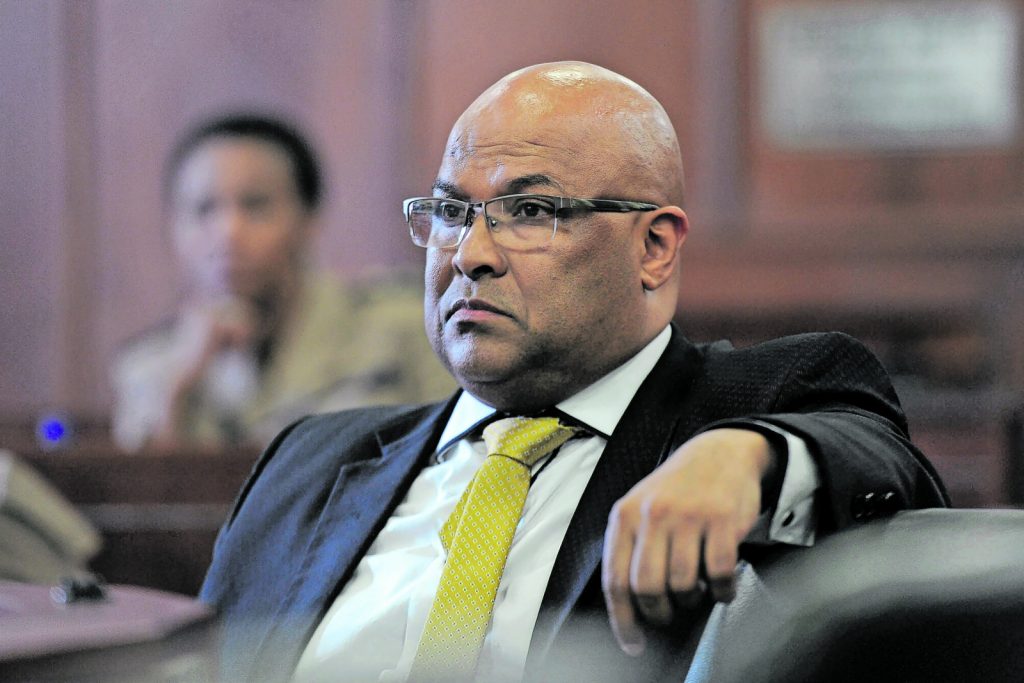 Former State Security Agency director general Arthur Fraser. (Jaco Marais/Netwer24/Gallo Images)
Advocate Paul Pretorius, an evidence leader at the commission, said he could not allow Ms K to reveal the names of the implicated reporters, saying the commission had to send commission rule 3.3 notices, which alert named people, such as the journalists, that they had been incriminated at the inquiry.
“For me, if we [the State Security Agency] ended up having a list of people, in terms of their salaries [and] their names … I infer that we were trying to make sure that it was affordable, or we match whatever demands [that were] made,” Ms K said, adding that her testimony was based on her conclusion and not necessarily on facts.
Responding to Ms K, Pretorius said there was documentary information of attempts, some successful, to meet the demands of reporters, who negotiated higher payment from the SSA to implement its “media infiltration” objective.
“There is evidence in the [evidence] bundle that individuals within the media received money as part of Project Wave. That evidence, in its detail, I would prefer to consider and place before the chair [Zondo] at a later stage, once we have considered its import, and what we need to do to follow the rules.
“We have a number of positions that received [money] in the media,” Pretorius said.
The Zondo report found that the then state security minister, David Mahlobo — now Deputy Minister of Human Settlements — “actively involved himself in operations”, which the inquiry recommended needed to be relooked at, and that the minister was involved in the establishment of Project Wave and Project Justice, the latter which aimed to “bribe some judges”.
“Above all, there was a letter [titled] ‘Projects Approved By the Minister’, which involved the spending of some R130-million. In fact, one of [Mahlobo’s contentions] was that the law did not prohibit him from being involved.
“If what he says is correct, the situation would require a very close look,” the report asserted.
It recommended that the office of the inspector general of intelligence should be more involved in oversight of the country’s covert activities, and that the auditor general should have access to the SSA’s finances to flag irregular and illegal expenditures.
“The commission notes as commendable the efforts of Mr [Loyiso] Jafta, the former acting director general of the SSA, that he has opened the door to the auditor general to audit the SSA.
“It is a step in the right direction and an indication that this recommendation is implementable, particularly subject to other conditions such as security clearance at the appropriate level,” the report said.
In his testimony before the Zondo commission in January 2021, Jafta outlined how, during the Zuma era, the SSA fought factional battles in the ANC, provided covert election support to the governing party and served the personality cult of the former president to the point of unlawfully detaining one of his wives on suspicion of having poisoned him.
Jafta recounted how the security agency had lost R9-billion in assets without a record, because proper controls were routinely disregarded.
The losses included firearms, some of which remained missing despite scrupulous attempts to recover them.
The fear that these may have been used to commit crimes caused him considerable anxiety, he added.
[/membership]