Climate activists have accused President Cyril Ramaphosa of selling out developing countries by accepting climate funding from the Global North. Photo" Supplied
Climate activists have accused President Cyril Ramaphosa of selling out developing countries by accepting climate funding from the Global North.
The Climate Justice Charter Movement (CJCM) said in a statement: “The South African government’s acceptance of loan-heavy financing has undermined the historical calls for climate debt, loss and damages and debt write-off by countries in Africa and the Global South not responsible for the climate crisis.”
Their accusation comes after France and Germany gave South Africa R10.7 billion to assist the country to move away from coal to cleaner energy.
In November last year, at the United Nations Climate Change Conference (COP26) in Glasgow, Scotland, the Just Energy Transition Partnership (JETP) founding partners— France, Germany, the United Kingdom, the United States and the European Union—pledged $8.5 billion to South Africa.
The CJCM said South Africa had let the Global North off the hook for adaptation finance by accepting the primarily loan-centred financial model for mitigating the effects of climate change.
The organisation called on the Presidential Climate Commission (PPC) to resign for accepting the JETP, “which undermines the collective struggle for global climate justice”.
Blessing Manale, the spokesperson for the Presidential Climate Commission, said: “Those calling for the resignation of the commissioners do not serve the interest of these constituencies and want to deny South Africans the opportunity and space to engage and build a social compact for a just transition.”
He said the commission was open for submissions and discussions on its work.
“In announcing the [just transition] investment plan two weeks ago, the president further committed and instructed the PCC to take the investment plan into the public domain for intensive consultation with communities and all social partners,” Manale said.
The CJCM also argued that Western countries have been hypocritical in their approach to climate change because they continue to invest in oil and gas projects.
The Guardian reported that regardless of climate change, the US,and China continue to invest in fossil fuels projects such as oil and coal from African countries. The energy crunch is being felt globally. African countries, China and India are pushing for oil and gas, arguing they are transition fuels.
Brian Kamanzi, an energy researcher at the Institute for Economic Justice, argued that the renewable projects speak to privatising electricity and will not lead to a “jobs bonanza”.
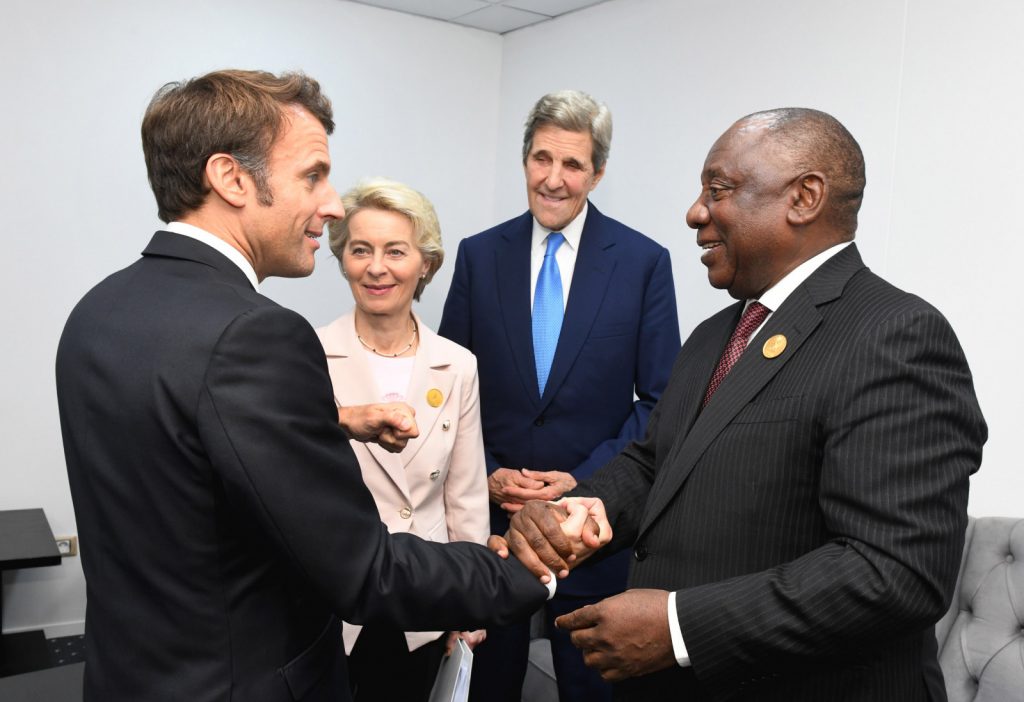 The Climate Justice Charter Movement (CJCM) said in a statement: “The South African government’s acceptance of loan-heavy financing has undermined the historical calls for climate debt, loss and damages and debt write-off by countries in Africa and the Global South not responsible for the climate crisis.” Photo: Supplied
The CJCM also called for the just transition framework to provide clarity on whether South Africa intended to invest in more coal, oil, gas and nuclear power.
Manale said the PCC will establish a plan that will benefit the country’s development when considering which projects to invest in.
Irvin Jim, the national secretary general for the National Union of Metalworkers of South Africa, said the JETP would harm the working class who rely on the coal industry for jobs.
“The investment plan is a debt trap because the bulk of the funding is in the form of loans. We are signing up for unnecessary debt which will burden generations of the working class, and doom them to a perpetual cycle of poverty and inequality because we will not be able to pay it back.”
He added that international banks and finance capital will benefit at South Africa’s expense.
Given the corruption involving finances intended for Covid-19 relief, the CJCM questioned the government’s ability to ensure the money was used to mitigate the climate crisis.
“We have seen recently how even a pandemic could be used as an excuse for corrupt politicians to feed themselves at the trough at the expense of the sick and vulnerable,” it said.
Ramaphosa’s spokesperson, Vincent Magwena said the just transition investment plan was open to the public and people continued to be consulted.
Last month, the Presidential Climate Commission held consultation sessions with people living around power stations that would be decommissioned and to discuss South Africa’s implementation plan.
Komati was the first power station to be decommissioned, which happened last month. The facility will be transformed into a wind and solar energy production site. Eskom said a micro-grid assembly factory has already been established on the site that workers will be reskilled to work in the renewable energy sector.
Decommissioning the power station follows a process that included a socioeconomic impact study, the power utility said. Others such as Camden and Hendrina power stations are in the pipeline to be shut down.
Eskom said it “held extensive engagements with the employees, labour unions, the community and all affected stakeholders and communicated the requirement to shut down the plant timeously and clearly with everyone involved”.
But the CJCM says the transition will benefit only a few people and will not improve the climate crisis in the world.
“Let us not be fooled by the ‘climate talk’, big investment numbers, mega development emphasis and international game playing.”
[/membership]