Of the 448 rhinos killed for their horns last year, 124 were in the Kruger, representing a 40% decrease compared with those killed in 2021. Photo: Getty Images
The Kruger National Park is notching up successes in its battle against rhino poaching but organised poaching gangs have shifted their sights to KwaZulu-Natal.
Releasing the 2022 poaching statistics statement on Monday, the department of forestry, fisheries and the environment said “relentless pressure” had forced rhino poachers to “abandon” national parks last year.
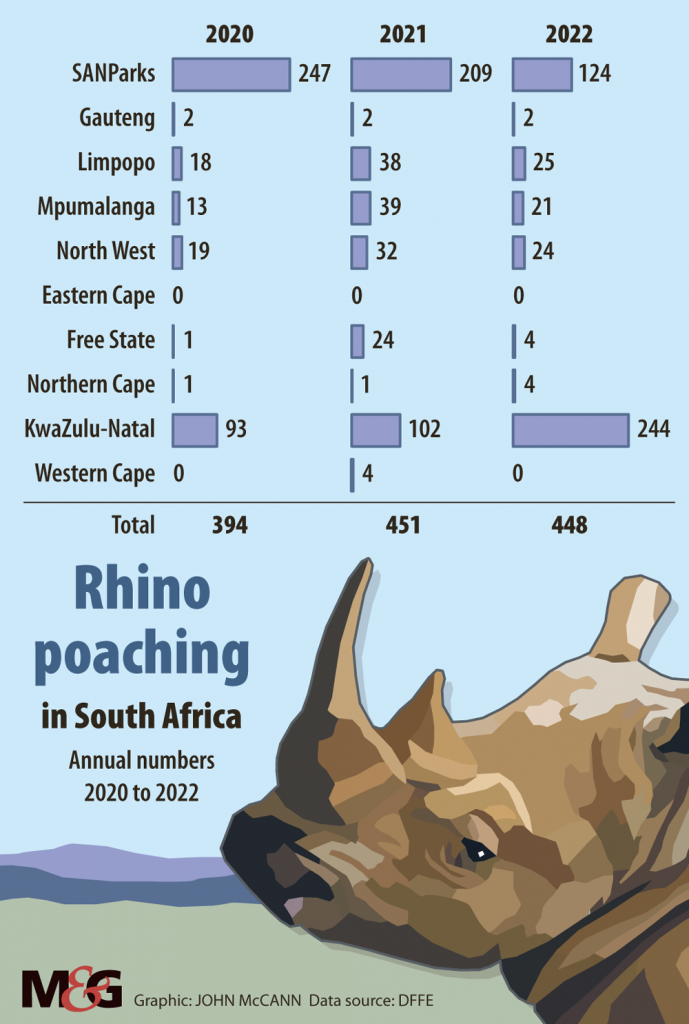
Of the 448 rhinos killed for their horns last year, 124 were in the Kruger, representing a 40% decrease compared with those killed in 2021. No rhinos were poached in any other national park, the department said.
Overall, the statistics revealed a slight decline in rhino poaching losses from 451 in 2021 to 448 in 2022. The toll for private rhino owners, meanwhile, was 86 rhinos countrywide.
The decline in poaching numbers are down to a number of factors like ramped-up security, better prosecution, dehorning in parts and targeting the networks. But challenges remain in other areas of the country as the Kruger has become more secure.
KwaZulu-Natal poaching hotspot
The poaching threat has shifted to KwaZulu-Natal, which lost 244 rhinos to poaching last year. Of these, 228 were killed in provincial parks and 16 in private reserves. The Hluhluwe-iMfolozi Park was hardest hit.
“The steady decline in rhino poaching in national parks is related to the relentless war that has been waged by our fearsome anti-poaching machinery as well as a comprehensive dehorning programme,” said Barbara Creecy, minister of forestry, fisheries and the environment.
“Last year’s outcome shows that collaboration between conservation authorities, the South African Police Services, revenue authorities and international agencies, works. We believe that if provincial authorities in KwaZulu-Natal follow our model, they will be able to significantly curb rhino poaching in their provincial parks before it is too late,” she said.
Musa Mntambo, the spokesperson for Ezemvelo KZN Wildlife, said it was considering dehorning rhinos in the Hluhluwe iMfolozi Park. “So far we haven’t taken any decision to dehorn. We need to consider the impact that it may have in terms of conservation and ecotourism.
“At the moment, we are discussing it and once we decide what to do, we’ll then take it through to the relevant stakeholders, like the department, the portfolio committee [on forestry, fisheries and the environment] and the legislature for approval, before we implement it.”
The size of parks like Hluhluwe-iMfolozi Park, compared to the Kruger, worked in favour of poachers, he said. “Maybe say in Kruger, you might take three days or so to see a rhino that is well-positioned to poach, while here it’s within a day, you’ll see a rhino. So, they’ve moved from Mpumalanga to our province.”
‘Misleading’ statement
Kim da Ribeira, the director of Outraged South African Citizens Against Rhino Poaching, said the department’s media statement carried a misleading headline, “when KwaZulu-Natal’s numbers are double what they were for 2021, to in any way infer that poaching statistics are down is disingenuous”.
“I’m so disappointed to see that minister Creecy sees the KwaZulu-Natal parks as something other than ‘our national parks’. On paper, they are provincial parks yes, but in reality they are as much part of our national parks as any.”
The statement leaves a lot to be desired, she said. “I think every South African should be disappointed in our government’s lack of transparency when it comes to rhino poaching. Once again, no rhino population statistics are given and a true comparison cannot be made without them. We need to know how many rhinos there are before we can say poaching is declining in our national parks. I’m very disappointed.”
Severe pressure for Kruger’s rhinos
In its 2021 annual report, SANParks stated that the relentless rhino poaching onslaught over the past decade had caused the rhino population in the Kruger to decline from about 10 000 animals in 2008 to about 2 800 animals.
“The bulk of the rhino currently occur in the southern Kruger National Park and it is this last core population that is now facing severe pressure,” the report said. “The continued and relentless pressure on the Kruger National Park rhino population from poachers had a negative effect with the rhino population in Kruger National Park continuing to decline and is now at its lowest level since 2010. Surveys during 2020 estimated 202 black rhinos and 2 607 white rhinos living in Kruger National Park.”
Prolonged drought effects of preceding years, additional calves lost when cows are poached and low birth rates in the past year resulted in births being lower than the combined natural and poaching deaths, it said.
Successful arrests, prosecutions
The department noted that a total of 132 arrests were made during 2022 for rhino poaching — 23 in the Skukuza area in Mpumalanga, 49 in KwaZulu-Natal and the balance in Limpopo.
“The recent focus on money laundering and international cooperation with other law enforcement authorities saw the arrest of 26 rhino horn traffickers and 13 people for money laundering and bribing of rangers,” it said.
“To support anti-poaching efforts in KwaZulu-Natal, special interventions were introduced in collaboration with the department, NGOs and the South African Police Service, which resulted in four key arrests of syndicate members who were focusing their illegal efforts in KwaZulu-Natal. These agencies will continue to collaborate this year,” the department said.
The work of the department’s Environmental Enforcement Fusion Centre (EEFC) enables authorities to track information pertaining to wildlife crime at a national level and understand trends and changing modus operandi while supporting the investigative and tactical teams.
During 2022, the National Prosecuting Authority, in collaboration with the department established a Director of Public Prosecutions environmental working group. Its purpose is to foster closer collaboration between the provinces working on wildlife trafficking cases and help identify repeat offenders moving around the country.
In relation to rhino prosecutions, verdicts were handed down in 62 cases which resulted in the conviction of 92 accused rhino poachers/rhino horn traffickers with a conviction rate of 100%, the department said.
As part of continued efforts to ensure the survival of the rhino species, SANParks is identifying suitable safe habitats across South Africa for the introduction of new rhino communities.
Organised crime networks
Conservation group WWF South Africa welcomed the release of the country’s rhino poaching numbers for 2022, noting that “transparency and regular communication about rhino numbers and rhino poaching are vital to understand the threats to our rhinos and the best solutions to conserve them”.
On the slight decrease in poaching, it said it was concerned that the organised crime networks orchestrating the trafficking of rhino horns continue to move their targets onto important rhino populations in large conservation areas across southern Africa. Of specific concern, it said, is the ongoing rhino poaching pressure in KwaZulu-Natal.
The 40% decrease reported in rhino poaching losses in Kruger National Park “provides hope and important lessons” regarding successful interventions for rhino security in large conservation areas within a landscape exploited by organised criminality.
The Wildlife Justice Commission’s 2022 Global Threat Assessment into rhino horn trafficking from 2012-2021 identified “irrefutable evidence” pointing to the involvement of transnational organised criminal networks, it said.
“The report called for in-depth, intelligence-led investigations that focus on the criminal networks rather than individuals, conducting further investigations after seizure incidents to identify the product owners, using advanced investigation techniques, conducting parallel financial or corruption investigations, and seizing assets. The EEFC plays an important role in these national responses to wildlife crime in South Africa.”
Dr Jo Shaw, the Africa rhino lead for WWF-SA, said: “Over the last year, several positive security interventions have been proven in disrupting wildlife criminals including dehorning programmes, multi-agency law enforcement collaborations including financial investigations and efforts to build ranger morale and integrity.”
But the transnational organised crime networks targeting large conservation areas and important rhino populations across southern Africa remain a serious concern, she said.
“At the same time as targeting the criminals involved in wildlife trafficking, we must continue our parallel platforms of rhino population management to grow numbers as quickly as possible and build relationships with communities around protected areas for the long-term benefits of people and nature,” Shaw said.
[/membership]