Scientists on both sides weigh in as concerns are raised over animals’ welfare and viability of ambitious project to repopulate Asian savannah. (Supplied by DFFE)
The young female cheetah went down less than five minutes after Dr Andy Fraser darted her. Gingerly, the wildlife veterinarian crept inside her enclosed boma to make sure she was immobilised, and carefully loaded her onto his vehicle.
Mopping sweat off his brow, Fraser, who runs Rooiberg veterinary services in Thabazimbi, Limpopo, explained how this two-year-old feline was the last of nine cheetahs darted early on Friday in preparation for their voyage to India later that day. She was also one of the easiest. “The other ones ran up and down and I had to shoot them while they’re running.”
Since July, the nine wild-caught cheetahs had been held in quarantine facilities on his property, awaiting government sign-off on South Africa’s first cheetah translocation to India. Three other cheetahs were kept at Phinda Private Game Reserve in KwaZulu-Natal.
“It’s been a long time [in quarantine] but you’ll see they are going to start hunting next week in India, so it will be good,” Fraser grinned. Still, the darting procedure is stressful for the big cats. “Unfortunately, there’s no other way for us to get our drugs into them. In a way, these cats are going through the most stressful process today, but it’s for the survival of their species.”
‘Viable, secure population’
Last month, the governments of South Africa and India signed a long-delayed memorandum of understanding on “cooperation on the reintroduction of cheetah”, agreeing to send a dozen southern African cheetahs to the unfenced Kuno National Park in India, 70 years after its own Asiastic cheetah was declared extinct.
The agreement facilitates cooperation between the two countries to establish a “viable and secure” cheetah population in India. It aims to promote conservation and ensure that expertise is shared and exchanged, and capacity built, to promote cheetah conservation.
(Video courtesy of Vincent van der Merwe)
This includes human-wildlife conflict resolution, the capture and translocation of wildlife and community participation in conservation in the two countries.
“It’s a very well thought out project,” said Fraser. “Just to have an entire government’s political will behind it is a total game changer.”
It’s the initial capture “that is the stressful part”, remarked veterinary wildlife specialist Adrian Tordiffe, of the University of Pretoria’s faculty of veterinary science. On Friday, he and his team spent six hours hydrating the sedated cheetahs, monitoring their body temperature, taking blood samples, checking their collars and administering medication, among others.
“Getting the darts in, getting the animals down and loaded in a reasonable time frame so we can still check them out of here and get the nine cats to OR Tambo International Airport is really important,” he said. “And with nine cats, there’s always going to be one or two who are going to give you some trouble or might take longer than the others to go to sleep.”
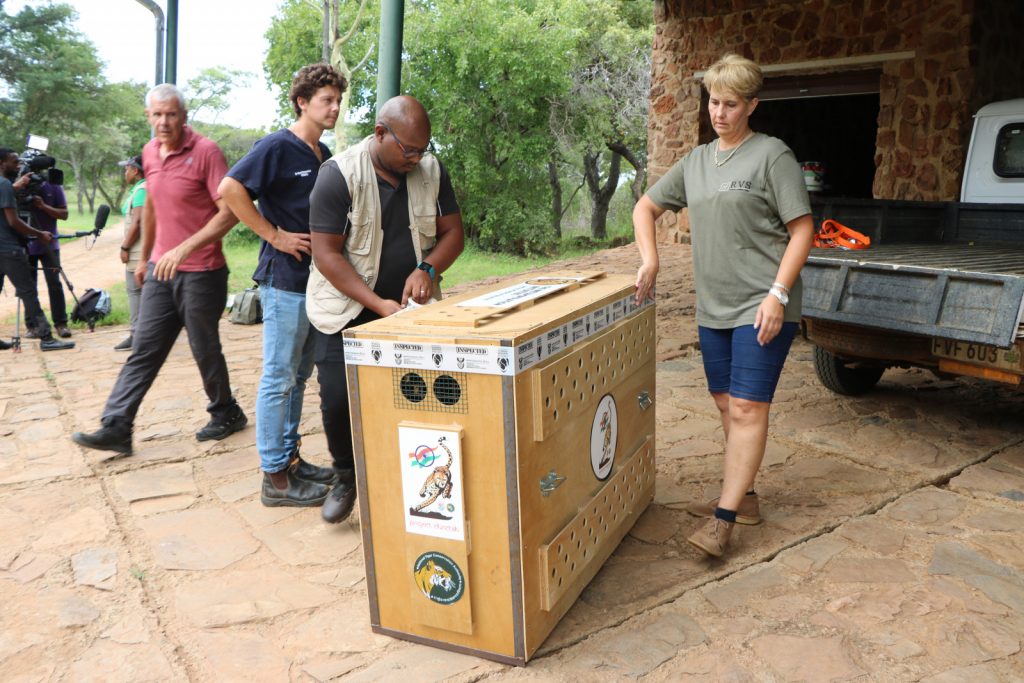
Once in their transport crates, an antidote was administered to reverse the sedative, as well as tranquilisers to keep the big cats calm during the 10-hour flight. Around midday, the cheetahs were transported to OR Tambo, boarded an Indian military aircraft and arrived in India on Saturday.

South Africa’s active role in translocations
Conservation translocations conserve species and restore ecosystems, said the department of forestry, fisheries and the environment. South Africa is playing “an active role in providing founders for the population and range expansion of iconic species such as cheetahs”.
Minister of forestry, fisheries and the environment, Barbara Creecy, said: “It is because of South Africa’s successful conservation practices that our country is able to participate in a project such as this — to restore a species in a former range state and contribute to the future survival of the species.”
The project, which has drawn criticism from Indian and South African wildlife scientists, will translocate a further 12 cheetahs from South Africa to India annually for the next eight to 10 years.
But these numbers are not set in stone, said Flora Mokgohloa, the department’s deputy director general for biodiversity and conservation.
“Our scientific authority will be involved in periodic assessments to see how well the cheetahs are established on the other side. We will be getting reports on a regular basis and discussing their progress with our Indian counterparts at every stage,” she said.
“For the next batch, the decisions on how many can be translocated, will then depend on the outcome of those discussions.”
Project Cheetah ‘prestigious, important’
The project is “very important and very prestigious” for India, Dr Amit Mallick, the inspector-general of the National Tiger Conservation Authority, told a media briefing in Limpopo on the eve of the translocation.
The agreement is “historic” as it is a “transcontinental relocation from wild to wild”, he said, describing how the objective is the establishment of a cheetah population in India, where the big cat is the only large carnivore to have become extinct since independence in 1947.
In September, eight cheetahs from Namibia were translocated to Kuno and are kept in fenced enclosures.
“In India, we don’t have fenced protected areas, they are all free ranging. In a week or 10 days, the first two or three [Namibian] cats will go free-ranging … We are very optimistic about the next phase,” he said. All the cheetahs have been fitted with tracking devices and will be continuously monitored, while work is underway to make Kuno ‘cheetah conducive’,” he said.
India is home to more than 70% of the world’s wild tiger population.
“We have immense expertise on big cats in terms of active management, rewilding and moving animals from low-density to high-density areas,” he added.
Long boma period
Vincent van der Merwe, the manager of the cheetah metapopulation project for the Metapopulation Initiative, worries the long boma period for the cheetahs from South Africa will “compromise their prospects for reintroduction success”.
“Of the 12 cheetahs, five are actually fit and seven have been in [bomas] for seven months. I know they’ll get out and catch [prey] but I’m worried about their vigilance to other predators. That cheetah hasn’t been under attack by anything for seven months, it’s been in the boma sleeping, now he’s got to go back and all these things are going to be out to kill him.”
Twelve “predator savvy” cheetahs were selected for South Africa’s translocation, having grown up among competing predators, including lion, leopard, hyena and wild dog packs.
“But we still lose more than 50% to competing predators … In India, they will encounter a new predator guild including tigers, sloth bears, wolves and dholes.”
The metapopulation is a managed population of 520 “excess” cheetahs within 70 protected areas in southern Africa. It is growing by about 50 individuals a year and these surplus wild cheetahs need to be placed somewhere. India represents a “massive amount of safe space” for wild cheetah conservation, he explained.
“Essentially, we’ll introduce them into a small number of reserves and just swap the cheetah between those reserves to prevent inbreeding, to make sure they remain genetically healthy … and create a managed cheetah metapopulation.”
Reality of cheetah mortalities
Cheetah mortality is a “reality”, Van der Merwe said, noting the first reintroduction attempts between 1965 and 1992 failed and 279 cheetahs died.
“We learnt a lot in that process. Cheetah reintroduction is not easy and we have to brace ourselves for losses. But we have done the necessary assessments, we know our population is increasing, and we know we can beef these populations up [in India] despite any potential losses.”
He anticipated low survival rates for the initial founder populations sent to India.
“Leopard densities are extremely high at the first reintroduction site (Kuno). All the proposed reintroduction sites are small and most are unfenced. The cheetah will walk right out of the unfenced sites. High cheetah losses will be caused by conflict with leopards, snaring, starvation and possible retaliatory killings in human-wildlife conflict.”
‘Unjustifiable number of animals lost’
On the eve of the translocation, lawyers representing the EMS Foundation, an environmental non-profit organisation, petitioned Creecy to halt South Africa’s involvement in the project until her department has obtained public comment and “more robust information” regarding the effect of the project on the cheetah population in South Africa and on the welfare of the individual animals concerned”, warning the project will result in an “unjustifiable number” of of animals being lost.
In a letter in Nature Ecology & Evolution, scientists from India, South Africa, Portugal, the Netherlands and Australia described the project as “ecologically unsound”, costly and one that “may serve as a distraction rather than help global cheetah and other science-based conservation efforts”.
 (Supplied by DFFE)
In response last week, scientists from South Africa, India, the UK, the US and Namibia noted that cheetahs historically occupied an ecological niche within Indian savannahs and open-forest systems “that are now vacant” and that carnivore reintroduction is “particularly important for ecosystem restoration”.
Poaching and human–wildlife conflict that caused cheetah extinction in India have abated through effective legislation and enforcement.
“Reintroduction was proposed within protected sites in the historical range after habitat, prey availability and anthropogenic [human-caused] pressures were assessed.”
There is currently about 100 000km² of legally protected wildlife reserve within the historical range of the cheetah in India “that can potentially accommodate breeding cheetah populations” and 700 000km² of total habitat that can potentially sustain cheetah occupancy.
Few sites in Africa can provide an adequate level of protection for the animals to “ensure reintroduction success”, they wrote. “We believe it is clear that cheetahs are less likely to suffer persecution in India where other large carnivore conservation efforts have been notably successful.”
[/membership]