Wrong number: Telkom is planning to shed employees as it focuses on cutting costs. Photo: Nadine Hutton/Bloomberg
The technology sector has been making headlines for its job cuts, the frequency of which has become a concern, and the worst is, unfortunately, not over.
Analysts have attributed the lay-offs to the market normalising after the Covid-19 pandemic, company-specific structural challenges and a potential upcoming recession. They say the industry will probably shed more jobs in the face of rising interest rates, which have increased the cost of doing business.
Mobile operator Telkom has become the latest company to announce retrenchments. South Africa’s third-largest mobile operator by market share announced recently it would lay off as much as 15% of its workforce as it focuses on cost-saving initiatives.
Telkom said in a statement it would enter a formal section 189 consultation process, as it looked to restructure some of its operations, and that all its business units and subsidiaries would be affected.
Other mobile operators in the country are likely to follow Telkom’s lead, according to Peter Takaendesa, an investment analyst at Mergence Investment Managers.
“Vodacom and MTN are probably not far off and sooner or later they’ll start to get where Telkom is. MultiChoice is also one of those that have been cutting its workforce as it’s been struggling to grow,” Takaendesa said.
“Our inflation is running about 6-7%. A number of these businesses in telecoms, their South African revenues are growing 2% to 3%. How will they make up the difference?”
Consumer inflation is at 6.9%, according to the latest data from Statistics South Africa.
By comparison, Vodacom’s annual results for the year ended 31 March 2022 showed its South Africa service revenue grew just 3.8% to R58.5 billion.
MTN’s South Africa service revenue rose by 3.5% for the quarter ended 30 September 2022 while MultiChoice actually saw revenue for its South African business decrease 2% to R17.4-billion for the quarter ended 30 September.
“In South Africa, a large part of the retrenchments in tech is to do with the economy and the cost of doing business is getting more and more challenging, be it load-shedding or fuel prices and, unfortunately, this has implications for jobs,” Takaendesa said.
According to The Challenger Report by Challenger, Gray & Christmas, an outplacement firm based in the US, more tech employees were laid off last year than in 2020 and 2021 combined. The sector announced 97 171 job cuts last year, up 649% from the previous year.
Global companies have led the trend, with Amazon laying off 18 000 people globally, Google 12 000, Meta 11 000, Microsoft 10 000 and Twitter 3 700. Domestically, Naspers announced a 30% cut of its workforce last month.
The reason for these layoffs, globally, is cyclical, Takaendesa said.
“Businesses are concerned that the economy could slow down, given the interest rate hikes that we have seen from the central banks.
“Interest rates, which is the cost of borrowing for these businesses, was almost zero, so they could start many new businesses because the cost of funding them was very low.
“Unless they cut interest rates to zero, I don’t think the situation will change any time soon,” he said.
If the global companies are reducing their workforce, he added, they are clearly seeing something on the horizon.
Arthur Goldstuck, chief executive of World Wide Worx, concurred, saying there is a general expectation that the world will enter a recession, which has already happened in some countries, resulting in plummeting demand for tech products.
“Last year, we saw a 9% drop in smartphones unit sales globally that, for example, will also result in layoffs as companies generate less revenue,” Goldstuck said.
Corrective measures
At the height of the pandemic, the use of technology grew significantly as everything moved online. Remote work became the “new normal”. Shopping online gained momentum, including for groceries, which was largely unheard of in South Africa a few years earlier.
Nowadays, branded scooters delivering groceries purchased online have become commonplace, particularly in the suburbs.
Cinemas entered business rescue as streaming movies became the norm in households. Even schools moved to online learning.
The result of this surge in online activity, which brought tech companies record-level profits, was that companies over-hired. Part of the current rise in layoffs is a correction after the hiring of too many people.
“The trend that is shaping global staff reductions is the rebalancing of workforces after the pandemic. What we saw in 2020 was a massive spike in hiring people to address the explosion in demand for cloud and online services, in particular online retail.
“Essentially what you saw in 2020 was over-hiring and, since 2022, it has been the rebalancing of workforces,” Goldstuck said.
Unskilled people in the tech space have been the most affected by the job cuts.
“The kind of people who were largely retrenched were customer service people and retail workers and warehouse workers. All of those were unskilled workers from a tech point of view and that’s where you see most of the layoff continuing,” Goldstuck said.
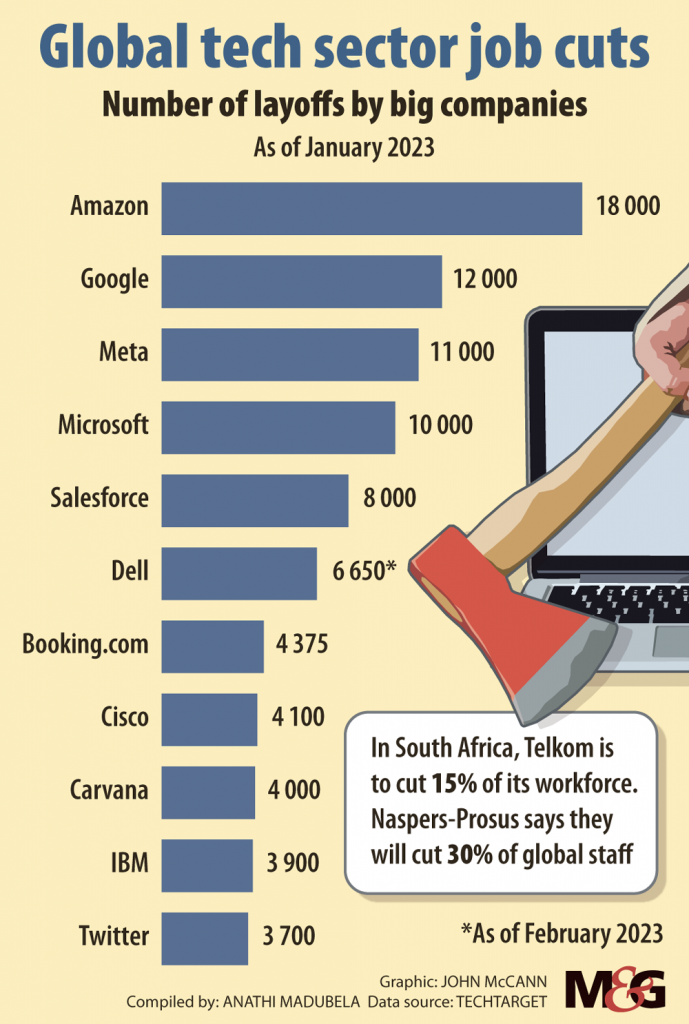 (John McCann/M&G)
Telkom’s troubles
For Telkom, there was a double blow, Takaendesa said, the first being the cyclical economy-related concerns seen globally, and the second, the company’s own structural challenges.
“That is what’s making life difficult for Telkom, (which) is almost a business in decline and you will see that the cost reduction is not starting now,” he said.
“It started decades back and that’s when the fixed-line business started to decline.
“When Sipho Maseko was appointed in 2013 his retrenchments were even more aggressive than what Telkom is proposing to do now.
“The economic picture that other global businesses are facing, is making matters worse for Telkom.”
Under Maseko, there were 15 800 job cuts in seven years, according to MyBroadband.
Until this year, the most recent retrenchments at Telkom were in February 2020. Then, 2 364 employees opted for voluntary severance and voluntary early retirement packages, an alternative to forced retrenchment.
Lay-offs at Telkom have been happening for decades as a result of the shift from a fixed line-based business to a mobile-based business, Goldstuck said.
“Telkom used to have more than 5 million fixed-line customers at the beginning of the century, and their entire business was built around that fixed-line business, but once the mobile revolution took off in earnest, and especially after the advent of smartphones from 2008 onwards, the move from landlines to mobile was inexorable and inevitable.”
This meant a telco could be run with far fewer people and Telkom was top-heavy, Goldstuck added.
“The lay-offs that you see now are really part of a trend that has been going on for 15 years at Telkom. It’s not surprising and it’s not as big as one would have expected,” he said.
“But what is significant as a landmark is that, for the first time in many decades, Telkom will have fewer than 10 000 employees.
“It gives you an indication of how much more efficiently the company can be run as a mobile-based business rather than a landline-based business,” he said.
[/membership]