Power-sharing: A DA billboard erected in Johannesburg in February suggests an adversarial political relationship, but in reality coalitions may be on the cards. Photo: Mduduzi Ndzingi/ Sowetan/Gallo Images
In the early days of Cyril Ramaphosa’s presidency, Democratic Alliance (DA) MPs were not too secretive about their readiness to work with the “good” ANC, as personified by him, in an eventual coalition.
At the time, then ANC secretary general Ace Magashule was going toe-to-toe with Ramaphosa and there was a belief, however naive, that the ANC might see an existential shift, if the president won the battle.
Predictably, that did not happen and the penny has dropped, as one DA insider put it, that what makes the ANC unpalatable as a coalition partner cannot be pinned on one faction alone.
Two sets of events in particular have made the DA wary of a coalition with a Ramaphosa-led ANC.
The first is the Phala Phala scandal, which saw the DA vote en bloc for Ramaphosa to face an impeachment process, the second is the president’s continued protection of ANC leaders who the opposition believe have no place at the ruling party’s Luthuli House or around the cabinet table.
Neither is likely to stop the DA from entering a coalition with the ANC next year, should the need arise, but it means the party will stick to the old wisdom of never floating coalition plans to supporters until after the votes are cast and counted.
“It is a very hard sell for our voters,” one senior DA member commented this week.
In 2021, months before the local government elections, DA leader John Steenhuisen admitted to the Sunday Times that he was keen to work with the reformists in the ANC, led by Ramaphosa.
He was adamant that the door was open for talks with the incumbent ANC president but was opposed to working with David Mabuza who was deputy president.
Many in the DA say while the scandal surrounding Ramaphosa over his farm in Limpopo has somewhat reduced chances of the blue party finding common ground with the ANC, it is still up for debate whether the DA under Steenhuisen and Helen Zille would consider coalescing with the governing party.
The party is ready to govern, according to its leadership.
This week, during a debate with Mpho Phalatse, his challenger for the post of leader at the party’s elective conference this weekend, Steenhuisen said the DA needed to be far more prepared to go into government.
He said the official opposition had made mistakes in the past when taking over previous ANC administrations by keeping the ruling party’s models instead of “governing in our own image”.
“I think that, when we get into governments and municipalities in future, one of the first tasks we should be doing is getting rid of corrupt officials. Secondly, redesigning that government in the form that we know works,” Steenhuisen said.
This would be a sticking point in any coalition talks between the ANC and the DA, should the parties find themselves in horse-trading discussions.
The DA believes it has recovered from its 2019 electoral losses and has closed the gap between itself and the ANC. According to Steenhuisen, the party is just 10 percentage points behind the ANC.
This is despite polling by market research group Ipsos last year which indicated the DA would incur further losses next year, with its electoral support dropping to 16% from 20%.
Some leaders in the ANC have also not ruled out a political marriage with the DA.
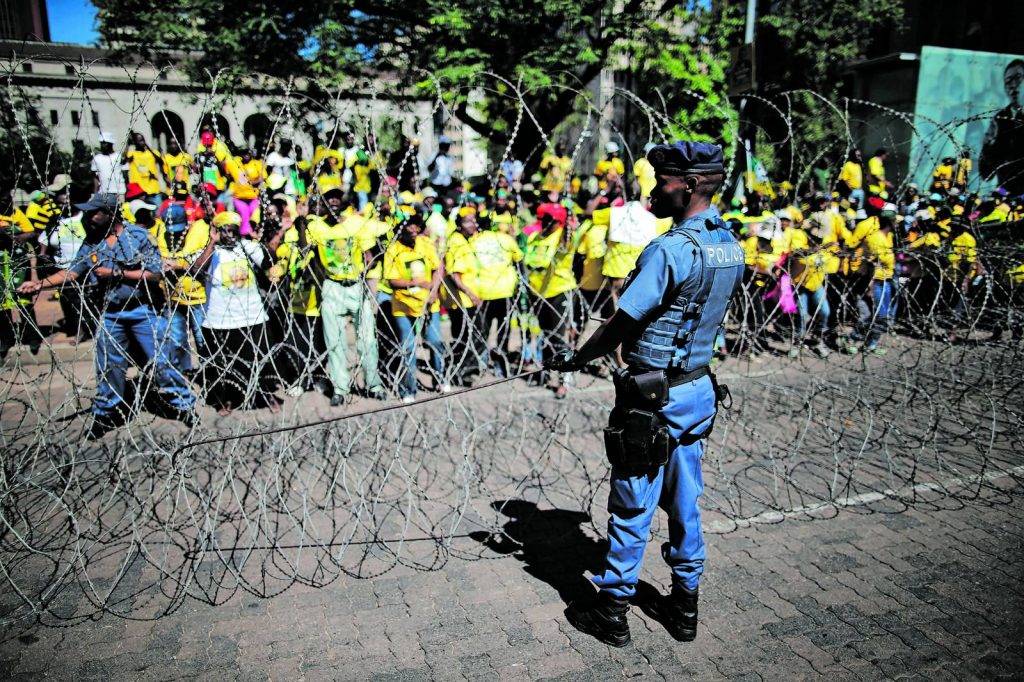 Protest: Police and razor wire prevent clashes during a DA march to the ANC’s Johannesburg headquarters. Despite traditional enmity, the parties might be forced into bed together in the future. Photo: Marco Longari/AFP
In 2021, Ramaphosa’s allies, including the Eastern Cape’s Oscar Mabuyane, were putting out feelers in their own provinces for a possible alliance with the DA.
During a meeting with provincial leaders in November 2021 Mabuyane, who is also premier of the province, said the ANC must rise above party politics to lead the people of South Africa in light of the quagmire of several hung municipalities after local government elections.
He said the ANC could look at possible areas of convergence, politically and ideologically, if it were to entertain a coalition with the DA.
Mabuyane, a staunch ally of Ramaphosa, could not have made the statement with confidence had it not been in the realms of possibility.
According to the ANC’s internal polling — the most recent in August — the party would only manage 40% of the vote in the next year’s elections without Ramaphosa at its helm, and 48% with the president.
However, this poll was conducted before the release of parliament’s independent panel findings on the Phala Phala scandal, and the revelations by former Eskom CEO Andre de Ruyter that ANC leaders were complicit in the corruption at the power utility, which has been forced to implement unprecedented levels of load-shedding.
There are other factors influencing which parties the DA could end up coalescing with next year.
The Economic Freedom Fighters (EFF) have already indicated their availability to the ANC as a potential coalition partner by helping the governing party take back control of the Gauteng metros, the eThekwini metro and rural councils in KwaZulu-Natal since November 2021.
Many in the ANC see this as the formula for next year, should the ruling party continue its recent trend and drop below 50% of the vote in the national and provincial elections. However, its internal discussions on coalition partners, which are far from concluded, will determine whether it works with the DA or EFF post-elections.
Supporters of deputy president Paul Mashatile have driven the council-level agreements with the EFF and believe they could be the necessary forerunners of a national coalition which would see EFF president Julius Malema serve as deputy president under Mashatile after Ramaphosa’s possible recall by the ANC.
The DA will also have been chastened by its experience in the minority coalitions it has led with the EFF, ActionSA and others since 2016, which have seen it take — and lose — power in Johannesburg and Tshwane several times due to their unstable nature.
The party has tabled two bills before parliament which it believes are necessary to stabilise coalitions at national, provincial and local government level by limiting the number of no-confidence votes which can be brought against a president, premier or mayor each year.
The party believes this will prevent the “revolving door” syndrome, that has plagued municipal governments, from spreading into provincial and national government should there be no clear majority in polls from next year onwards.