Possible partner: Economic Freedom Fighters leader Julius Malema protests at the state of the nation address in Cape Town in February. (Esa Alexander/AFP)
A contentious debate over the ANC’s coalition arrangements is looming in the party, with some expecting plans to partner with the Economic Freedom Fighters (EFF) after next year’s national elections to become a major proxy battle.
The ANC has already appointed former Gauteng premier David Makhura to look at coalition arrangements going into next year’s vote. It is understood that Makhura has already made his first presentation to the ANC’s national working committee.
According to insiders, factions forming in the national executive committee (NEC) are already lobbying for their preferred coalition partners for next year’s elections, primarily in relation to Gauteng.
The ANC’s electoral support is expected to dip below 50% in the province — and nationally.
ANC insiders who are against a coalition with the EFF say there is a strong push for it by those in the Gauteng provincial leadership but there are plans to prevent this arrangement. The Gauteng ANC has entered into agreements with the EFF in several municipalities, including Johannesburg, Tshwane, Ekurhuleni and West Rand in a bid to oust Democratic Alliance (DA) governments.
One NEC member, who declined to be named, said the majority believed the ANC could not partner with the EFF. They said although a coalition in Gauteng was highly likely, the party was aiming not to lose more than 10 seats in the legislature. The ANC would then use the smaller parties it is already working with to make the majority in the province.
“It’s something that is causing a lot of problems. Internally, this Gauteng issue and our relationship with the EFF is a problem. The EFF is not an option because they are the most disruptive; they have deep-rooted bitterness. In the EFF, they want control. They want to even control the ANC to dance to their music,” they said.
“Between DA and EFF you are between a hard place and a rock — that is why, if the ANC goes below 50%, it must not need more than 5%. You need lesser numbers to collect from smaller parties rather than relying on the EFF.”
The NEC member said they were not ruling out the possibility of a coalition with the DA, should the need arise, arguing that the ANC in the Eastern Cape was already exploring this option in Nelson Mandela Bay metro.
DA leader John Steenhuisen said during his closing speech at the party’s recent conference that he would be lobbying smaller parties in his “moonshot” pact to close out the ANC and the EFF.
Steenhuisen — who focused his speech on the EFF, declaring the Red Berets the number one enemy of the blue party — said he would do all in his power to ensure an EFF-ANC alliance was not realised next year.
In February, DA heavyweight and Cape Town’s mayor, Geordin Hill-Lewis, said the party could go into a coalition with the ANC to keep the EFF out of power.
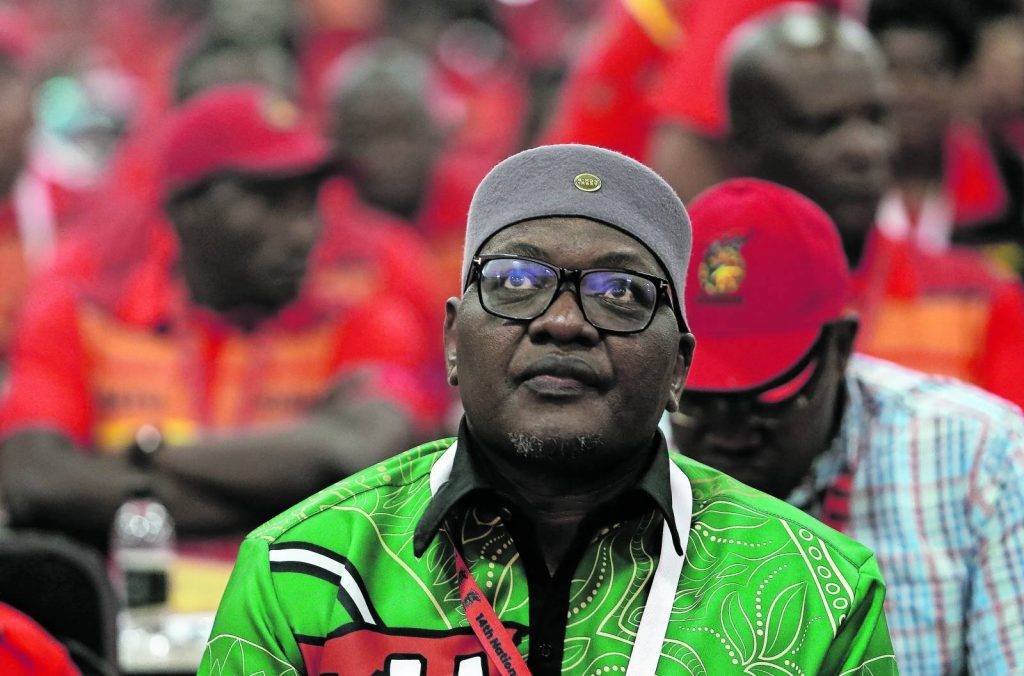 Gauteng premier David Makhura has apparently been tasked with looking into the issue of a coalition with the EFF at next year’s elections. (Felix Dlangamandla/Daily Maverick/Gallo Images)
A second NEC member told the Mail & Guardian: “What you like about the two is that they have their distinct constituency that they serve. The problem with all these smaller parties — they are being recreated to eat into the ANC [support]. The EFF is eating into the ANC more than it is the DA.
“If you form a coalition with EFF, you are building the EFF unintentionally. It’s what strategy and tactics teaches us — leave emotions and all other ideological issues aside but focus on practical issues.”
They added that a coalition with the DA would also remove the smaller parties from government and that, with an ANC-DA coalition, there would be more stability and development in government.
“We are going to argue this in the NEC at the right time. The NEC will discuss coalitions — that debate is going to come — but I can tell you the majority of those NEC members will never agree with that approach that we can rely on the EFF,” they said.
A third NEC member said the ANC still had hopes of retaining its 2019 electoral vote of 57.50% but was also preparing for a worst-case scenario. They said although they were aware that some NEC members would push for an ANC-DA coalition, the two parties had serious differences that could not be ignored.
“We disagree on a number of issues, fundamentally, foreign policy issues like the Israel-Palestine issue — we are not together there.
“We are not together on our attitudes towards the West and East. We are not together in terms of our attitude towards the African continent. Internally in the country there are serious differences around economic policy.”
They said while an arrangement with the DA would be a convenient way of doing away with the smaller parties and ensuring relative stability, the major differences between the two parties “may also impact negatively in that coalition in a sense that, as you move along in that kind of a setup, either the ANC or DA may decide that, because of this, I’m pulling out — I’d rather work with smaller parties”.
“It would take a huge effort on [the part of] both or either parties to make fundamental compromises to remain together for a five-year term in case of that situation,” the NEC member added.
The ANC’s predicted electoral decline and the apparent plateauing by the EFF will render the role of the smaller parties currently in coalitions with the ANC at municipal level — Al Jamah-ah and the African Independent Congress (AIC) in Gauteng and the National Freedom Party (NFP) in KwaZulu-Natal — all the more important going forward.
The NFP faces liquidation over a R25 million debt and has had its funding by the Electoral Commission of South Africa (IEC) withdrawn over an internal leadership dispute that has been running since 2019.
It is also facing an internal revolt in some KwaZulu-Natal municipalities, where its councillors are backing an Inkatha Freedom Party and DA coalition, rather than that of the ANC, EFF, NFP. All of this could affect the NFP’s ability to make up the numbers after next year’s poll.
Al Jamah-ah president Ganief Hendricks said the party — which turns 16 this month — would hold a meeting with the ANC in the coming weeks to assess the parties’ nine-year relationship and its future.
Hendricks said both Al Jamah-ah and the ANC viewed the meeting as “very important” and that it would take place “very soon”, convened by one of the governing party’s deputy secretaries general.
“We are going to analyse the relationship between us and the ANC over the last nine years and how it has matured. We are also going to discuss the 2024 elections and the 2026 elections,” Hendricks said, adding that Al Jamah-ah would not enter into any pre-election agreements.
“We are going into elections now and it is every man for himself. Once the voting is over, then we can talk. We don’t support the corruption and looting on the part of the ANC. We are wary of them because of that,” he said. “We do support most of their policies because they benefit our constituency as well as the ANC’s constituency.”
Hendricks said the model in the City of Johannesburg, where Al Jamah-ah had been given the mayorship, was “a model where we are reimagining politics”.
“We want to use that model for 2024,” he added, while conceding that it did have its down sides in that the ANC and EFF in Johannesburg were “sitting and laughing”, while “we are taking all the flak”, and “are on the receiving end” over the appointment of mayor Thapelo Ahmed.
Hendricks said both his party and the ANC understood that the governing party would need its votes to make up a 50% plus one coalition and govern nationally and provincially after the next elections — and in the 2026 local government elections.
Al Jamah-ah was working on increasing its reach and presence ahead of the elections, to take it into other provinces, aiming at former ANC voters who had lost faith in the party over corruption.
“About a third of the ANC’s people dumped the party and are looking for another party. They still have loyalty to the old values of the ANC and we believe some will see it in our party and that is why people are embracing our party,” he said.
“ANC policies lead to government programmes that our constituents benefit from. Our difficulty is with corruption. We will have to decide what is the lesser of the evils and continue to speak out against corruption in parliament.”
Hendricks said Al Jamah-ah was talking to United Democratic Movement leader Bantu Holomisa about the parties’ common concerns around the electoral commission before next year’s elections.