Gauteng ANC: (Left) TK Nciza and Panyaza Lesufi brief the media in Johannesburg. (Papi Morake/Gallo Images)
With just a year to go until the national general elections, the ANC’s newly appointed national working committee (NWC) is facing its toughest conundrum yet — whether to place KwaZulu-Natal and Gauteng, its two biggest provinces by voter share, under administration.
After reports of governance issues and political turmoil in both provinces, sources inside the ruling party say the KwaZulu-Natal leadership is flirting with possible disbandment in the face of rising instability.
While this might not be the case for its leadership in Gauteng, there is a strong view within the NWC — the structure tasked with the day-to-day administration of the party — that the province will need national intervention if it wants to weather the storm of tumultuous coalitions, as well as the impending elections.
To assess the enormity of its challenges in KwaZulu-Natal, the NWC is headed to the province next weekend, where a decision will be made on whether it would be prudent to disband the province’s leadership or opt for a less drastic intervention.
Any intervention in KwaZulu-Natal has its dangers, including the risk of alienating ANC members and voters in a province where the Inkatha Freedom Party (IFP) made a comeback in 2021 and has been taking wards in by-elections ever since.
Likewise, a heavy-handed approach in Gauteng could keep ANC voters away from the polls next year. A backlash in the two provinces could cost the ANC support, and power, in both provinces and beyond.
KwaZulu-Natal and Gauteng account for the lion’s share of the ANC’s voters. A Paternoster Group study indicates that, in 2021, the ANC received 5.25 million votes, over two million of them coming from the two provinces. This translates to 37.7% of the ANC’s national vote.
In 2019, the ANC received a little over 10 million votes, of which 4.44 million came from Gauteng and KwaZulu-Natal, the equivalent of 44.3% of the voter share.
“The ANC’s drop in those two provinces between 2019 and 2021 alone was very significant and caused it to get a mere 45% of the national vote in 2021 [local government elections],” Paternoster Group’s senior researcher Mike Law said.
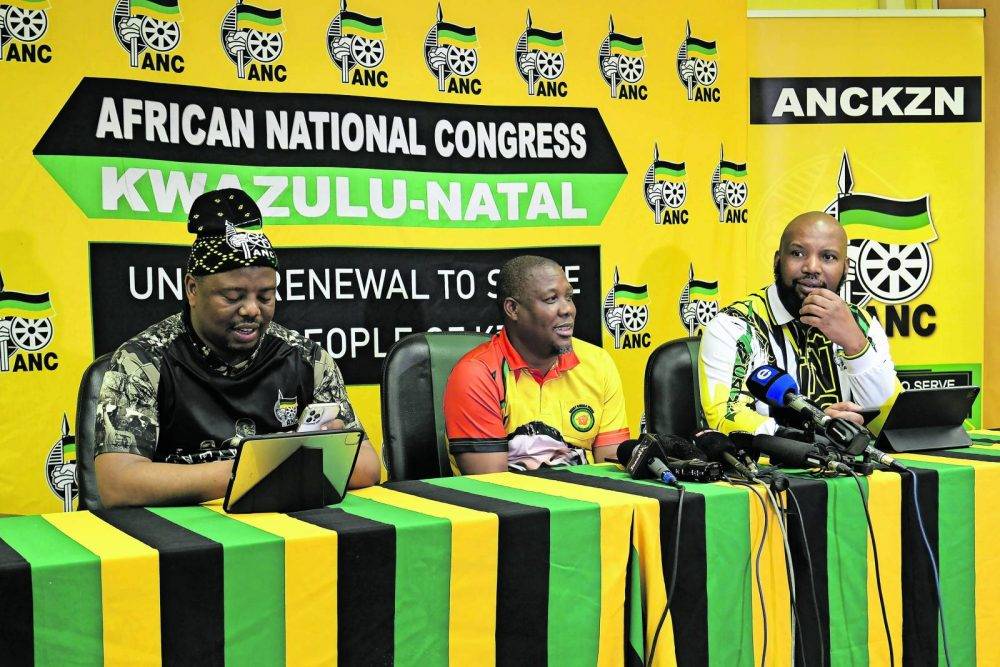 KZN ANC: (left to right) Sipho Hlomuka, Bheki Mtolo and Siboniso Duma in Durban. (Darren Stewart/Gallo Images)
‘Monumental drop’
“The effect was particularly obvious in Gauteng, where the ANC went from 2.4 million in 2019 to just 958 000 in 2021. Even adjusting for the local government elections, that’s a monumental drop.”
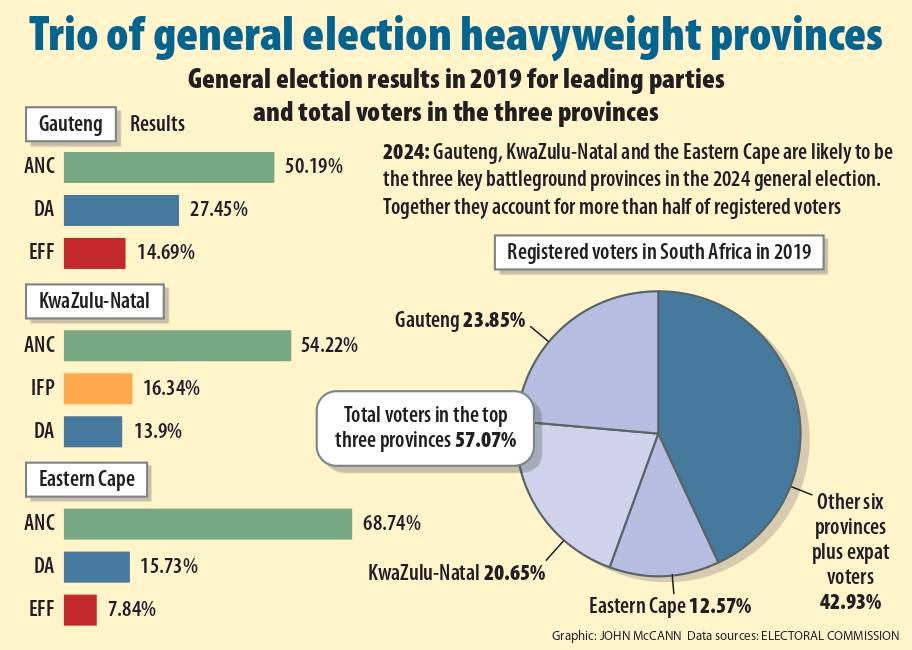
According to the Electoral Commission of South Africa, Gauteng has the largest registered voter block, with 23.45%, while KwaZulu-Natal comes a close second with 20.79%. The Eastern Cape has the third-largest voter registration numbers with 12.42%.
“If you do badly in those two provinces and, of course, traditionally badly in Western Cape, you’re really going to struggle to get over 50%,” political analyst Richard Calland said.
“If the ANC can’t get its act together in Gauteng and KwaZulu-Natal, if there’s a hung parliament in KwaZulu-Natal, what that does is it gives the IFP quite a bit of leverage in terms of negotiations.”
KwaZulu-Natal’s disastrous decision to appoint a single company to run its school nutrition programme — which left millions of pupils hungry — has blown up in the face of the provincial executive committee, placing it under pressure from the ANC nationally.
The fallout from the award of the R2.1 billion tender to Pacina Retail has placed the actions of the provincial leadership — under which the ANC has won only four of 12 by-elections — under the microscope.
A source in the NWC said the tender had been processed without going to cabinet.
“When the premier asked the MEC Mbali Fraser, ‘How do you run a process up to its end when my office is not involved?’ she said, ‘But the leadership decided it that way,’” the source said.
The KwaZulu-Natal leadership had also lobbied for the eThekwini metro to be placed under Section 139 administration, which the NWC had not agreed to.
“We did not support it. They are saying the city manager is the wrong person, but we can’t fire him, we have to place the city under administration. How were you not aware of this five months ago?
“This [eThekwini] is the pinnacle of KwaZulu-Natal. You can’t make that kind of mistake there,” the NWC member said. “Politically, it doesn’t help the ANC to put the biggest metro you are governing under administration on the eve of elections.
“What have they done to introduce interventions before you go to Section 139. When do you take responsibility?”
The source said the province now wants a treasury intervention, which cannot be finalised without the NWC’s permission.
The Mail & Guardian spoke to three NWC members and two national executive committee members stationed at the ANC’s Luthuli House headquarters in Johannesburg, who said this was the prevailing concern facing the party.
“A mistake that was committed was to elect a leadership that does not have the experience to lead at that level,” one NWC member said.
KwaZulu-Natal provincial secretary Bheki Mtolo’s leadership was also proving to be a problem.
“We are going there as NWC because there is a major concern at a national level. We are losing ground in KwaZulu-Natal.
“Whether in terms of messaging or action, we are unable to see anything coming out of that leadership that is cohesive and will allow us to regain the ground,” they said.
A second NWC member said if the ANC lost KwaZulu-Natal, it would lose the country.
The source, a national leader, added regional leaders had voiced concerns that the disjointed state of the provincial leadership had resulted in the lack of a uniform approach to organising resources for the party.
“The KwaZulu-Natal leadership have burnt bridges with former president Jacob Zuma. They have lost any favour with the IFP. It’s quite a lot that has gone wrong in KwaZulu-Natal in a very short period.”
The third NWC leader said they did not foresee a disbandment of the provincial leadership this close to an election, but that if it were to happen, it should be now.
“We need a team that will work in KwaZulu-Natal and [act] as if it’s under administration. Then you can decide what to do with them after elections because, if they don’t co-operate, you may be forced to decide now and live with the consequences but, without a very strong team, we are in big trouble in that province.
“Governance is in tatters, everybody runs their own departments. The premier is weakened. She can’t reprimand and hold the provincial chair accountable. She is frustrated.”
Trouble in Gauteng
Gauteng is not in danger of disbandment yet but internal strife and the partnership with the Economic Freedom Fighters (EFF) has worried national ANC leadership.
The ANC caucus in Johannesburg defied the province this week, refusing to vote for the Al Jamah-ah candidate for city mayor agreed upon by the ANC provincial leadership and Julius Malema’s EFF.
This led to an intervention by the ANC’s top officials on Wednesday.
The ANC in the province has been flirting with the red berets for a coalition as a litmus test for next year’s elections but this has raised red flags in the national leadership.
According to the national leaders, Luthuli House is being pushed to intervene in Gauteng.
An NEC member and deployee in Gauteng said a recommendation would be made to the NWC for additional intervention in the province in coming months to help undo the damage from the ANC-EFF coalition.
“It was a big mistake, this EFF thing. The dynamics are just too tricky to disband,” they said, adding that part of the risk from working with the EFF was the divide it was causing at national level.