Up in smoke: The open display of tobacco and e-cigarettes, as well as the sale of ‘loosies’, will not be allowed under the new legislation if it is passed. (Michele Spatari/Getty Images)
Tobacco manufacturers and processors have bemoaned the government’s pending implementation of the Control of Tobacco Products and Electronic Delivery Systems Bill, describing it as “draconian”.
“We believe that this bill is not well researched and what the government wants to do is to hand over the legal market to the illicit traders,” said Zacharia Motsumi, spokesperson for the South Africa Tobacco Transformation Alliance.
“The growers will also be affected if the manufacturers are affected. Manufacturers won’t produce as many cigarettes as they produced before because people buy cheap cigarettes from illicit traders and that will be because of this draconian bill. The government should not implement these draconian laws. This is going to cause havoc to an industry that is struggling at this stage,” Motsumi added.
The bill, which aims to “reduce the incidence of tobacco-related illness, disability and death”, proposes to institute a 100% smoke-free rule for indoor and certain outdoor places, ban the sale of cigarettes in vending machines and the sale of single cigarettes.
It also prohibits the display of tobacco and e-cigarettes at points of sale. Retailers can only provide products — on request — to people over the age of 18.
The law will also enforce standardised uniform, plain colour and texture packaging and labelling for tobacco and e-cigarette products with graphic health warnings, among other restrictions.
Penalties include up to 10 years’ imprisonment, a fine or both.
The bill is sitting with parliament and has been released for public comment from 25 June to 4 August. Public hearings will then be held.
“Public hearings are coming and that is where we will raise our voice. We are pleading with the parliamentarians to take us into consideration more especially when we speak from the growers point of view, the processors and manufacturers point of view,” Motsumi said.
François van der Merwe, of Limpopo Tobacco Processors, said the current Act is not enforced by the department of health, “yet they want to bring draconian measures, which are further going to increase illicit trade and we will receive the shorter end of the stick. At that point we will give up but that won’t stop smoking because the illicit trade market will still be there.”
The bill repeals the Tobacco Products Control Act of 1993 and includes the imposition of an excise tax on vapour products.
Van der Merwe said that if the bill goes through as is, it could be the death knell for the legal tobacco industry in South Africa.
He said the bill had not been adequately researched. “How does the government want to ban the display of tobacco products when more than 80% of cigarettes are sold in the informal sector by thousands of small businesses? They clearly don’t know what the market is like, because small businesses display their products on table tops and in street cafes and spaza shops and now they want to ban that.”
The sale of loose cigarettes has been banned in South Africa for more than a decade. The Mail & Guardian reported in 2004 that service stations such as Total and Engen stopped the sale of loose cigarettes.
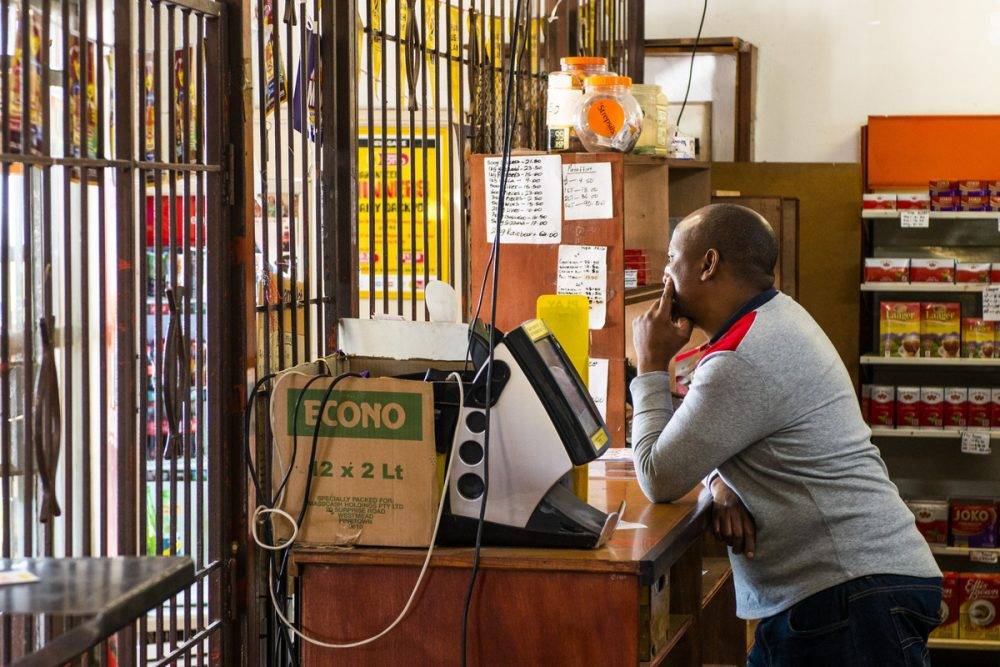 Tobacco manufacturers and processors have bemoaned the government’s pending implementation of the Control of Tobacco Products and Electronic Delivery Systems Bill, describing it as “draconian”. (Waldo Swiegers/Getty Images)
But “loosies” are still available from street vendors and cafés.
British American Tobacco South Africa (Batsa) general manager Johnny Moloto said the bill would not only negatively affect the company’s profits, but all its operations.
“Already we’ve made so many changes. We’ve had to reduce our staff. We’ve had to buy less from our farmers. Only time will tell if this bill comes in place in the same form as it is, but if it does we will need to rethink our operations. We will not be viable, we will not be able to operate in this current model because we’ll just be too small and too expensive to operate in this market.”
Moloto cautioned that if the legal market shrinks, the entire value chain suffers. Batsa would buy less tobacco from farmers and processors, but smoking would not end. The volume shift would simply move from the legal to the illicit market, he said.
For years tobacco manufacturers have bemoaned the effects of the illicit cigarette trade on the legal market. They say the government is handing the country’s tobacco industry to illicit traders on a silver platter.
“From 2019 we have lost 40% of our volume. That is quite significant in such a short space of time and that number is not improving, it keeps on declining. Yet, in terms of what this bill wants to address, which is reducing smoking … actually smoking [is increasing]. Right now our smoking incidents sits at 23% of the adult population,” Moloto said.
According to the South African Medical Research Council, 29.4% of the adult population uses tobacco (smoke and smokeless products). This is 12.7 million adults. Of that number, 41.7% are men and 17.9% are women.
Moloto claims the illegal tobacco trade in South Africa makes up 70% of the market, but a 2019 study by Business Leadership South Africa estimated that in June 2018, the illicit tobacco trade was 33.4%, while in September 2018, it was found to be 41.8%.
Van der Merwe noted that if 70% of the market is illicit that means that the legal value chain occupies only 30% of the market.
“It’s getting smaller and smaller while total consumption is not declining. The only winners are illicit players or criminal players who don’t pay tax and who don’t comply with regulations. And the losers here are farmers, the processors and manufacturers — and the government is a loser because of the tax,” he said.
Batsa has previously claimed that the government loses R20 billion in excise tax a year to the illicit cigarette trade. The Business Leadership South Africa study found that the illegal trade contributes an R8 billion loss in government revenue, as well as job losses.
In January this year, Batsa said it had started a section 189 retrenchment process, which could affect 200 jobs at its local operations. The company has, since 2020, retrenched more than 30% of its workforce, equating to about 500 jobs.
The company said it had embarked on the retrenchment process because of further losses in cigarette volumes, which it claims are a result of the continued effect of the growth in the country’s illicit cigarette trade.
“We have dipped to below a thousand jobs. In comparison, in 2018, we had over 2 000 employees. It shows you how significantly we have declined in terms of the number of jobs we have lost,” Moloto said.
To illustrate the severity of job losses, Motsumi said: “If we look at farmers, if you lose just one hectare of land that is not farmed because of low volumes, that is 10 people that will be faced with unemployment, and then you translate that to the processors.”
The key tobacco-growing areas are in Limpopo, North West, Mpumalanga, the Eastern Cape and the Western Cape.
“For the past three years on the processing side we have been retrenching people and manufacturers have been retrenching people. The industry is bleeding at this stage and we are pleading with the government not to continue with this draconian bill as it will definitely increase unemployment in the country.”
*disclaimer: A previous version of this article said R20 million instead of R20 billion