Drop: Joburg Water cannot ensure residents have a regular supply. (Delwyn Verasamy/M&G)
A complex set of problems are behind the ongoing problem of taps running dry in Gauteng’s metros, which has left thousands of households struggling without water for days and weeks on end.
Parts of Johannesburg, Ekurhuleni and Tshwane have been battling severe water cuts since August, with the blame being pinned on ageing infrastructure, water leaks, rolling blackouts, high demand and governance issues, among others.
Water supply has been an issue since the discovery of gold on the Witwatersrand in the 19th century, said Gillian Maree, a senior researcher at the Gauteng City-Region Observatory (GCRO).
“Towns, and later cities, were developed in an area without a sufficient supply of water,” Maree said.
“As Gauteng developed, so did the demand for water and we now have a complex infrastructure network, where raw water is supplied via the Integrated Vaal River System [IVRS], Rand Water purifies bulk water, and municipalities distribute it for urban, industrial and other uses.”
The IVRS, a network of 14 interconnected dams, is the country’s most important bulk water supply system, providing water to 46% of the economy and 33% of the population.
To determine how much water can safely be used from the IVRS, Maree explained that a planning model is used to predict how river flows and dam storage levels may change under different weather and water use conditions.
The department of water and sanitation, which regulates the use of water resources and manages the IVRS, has licensed Rand Water to abstract no more than 1 600 million cubic metres a year from the system for its users. But, in the last five years Rand Water has exceeded the allowable limit of the resource.
 A tanker delivers water to Hammanskraal in Tshwane. (Felix Dlangamandla/Daily Maverick/Gallo Images via Getty Images)
This increasing demand for water is because of population growth in Gauteng, but is also caused by rising water wastage as a result of poorly maintained infrastructure that leads to leaks. Additionally,
economic water losses are high.
“Many urban users are not paying for water and water utilities are increasingly not recovering the costs of supplying water.
“For example, non-revenue water in Johannesburg is at a staggering 44%,” Maree said.
It becomes increasingly difficult to invest in infrastructure maintenance “if you aren’t recovering enough money to pay for it”, she said. “Then there is a tension between the more conservative estimates used to protect longer term water supply and the pressure of increasing water supplies in the short term.”
Multi-year droughts are a feature here, Maree added, and the global climate system is entering an El Niño cycle. “We’ve had a couple years of good rainfall, but that isn’t guaranteed going forward.”
At the moment, there is enough water in the IVRS to supply users. “The problems are largely related to Rand Water reaching the limits of its allowable withdrawals from the IRVS, infrastructure failures, water leaks and governance issues.”
Additionally, load-shedding and power failures at pumping stations have also led to further large outages. All these issues “point to organisational failures and a lack of prioritising water issues in the past”.
None of this is a new problem. “The work we did a couple years ago on a Water Perspective for Gauteng highlighted much of what we see playing out now. And even then, the issues were well known.”
 The South Hills tower system in Joburg is consistently under strain. (Delwyn Verasamy/M&G)
Maree cited data from the GCRO’s Quality of Life survey in 2020-21, which showed that from 2017-18 to 2020-21, the number of households reporting monthly water interruptions rose by 3% to 33%, or a third of all households reporting water interruptions.
Johannesburg reported the highest increase in water interruptions with 37% of households reporting monthly water interruptions, a 10% increase from 2017-18. This, Maree said, translated to two in five households having water interruptions on a monthly basis.
“While we don’t ask how long the interruption lasts for, we do know that water interruptions are very disruptive and households are having to spend additional unplanned money to shield themselves from the impacts.” This rate of water interruptions is “likely to increase even further in the next survey”, Maree said, noting that the trend is moving in the wrong direction.
Rembu Magoba, the manager of the Council for Scientific and Industrial Research’s Water Research Centre, said load-shedding, ageing water infrastructure and surging demand, are to blame.
“As a result of load-shedding, it means that we are now purifying less water than we used to … We have got a little water available and with this, there’s higher consumption, which is also another bigger problem. Whenever you have a breakdown, the breakdown will have a major impact than when you have got a stable system.”
Pipe bursts and water leaks mean that more water gets lost, causing “very low pressure because of the same water leaks that are prevalent throughout the distribution network. You need some sort of good water pressure to get those reservoirs filled quickly, so that slows down and while it’s still very slow, load-shedding also comes in,” Magoba said.
Load-shedding is not being applied in a way that the water distribution network is being spared. “You might find a particular network, a particular water purification system sitting in an area where it’s exempted from load-shedding, but if you’re not exempting the reservoirs or the pump stations, it’s not helping because you will have water treated but that water is not being pumped into the system,” he added.
Johannesburg’s water crisis is characteristic of any complex system “where instability within the system starts to oscillate” and eventually becomes more amplified over time, according to water specialist Anthony Turton, of the Centre for Environmental Management at the University of the Free State.
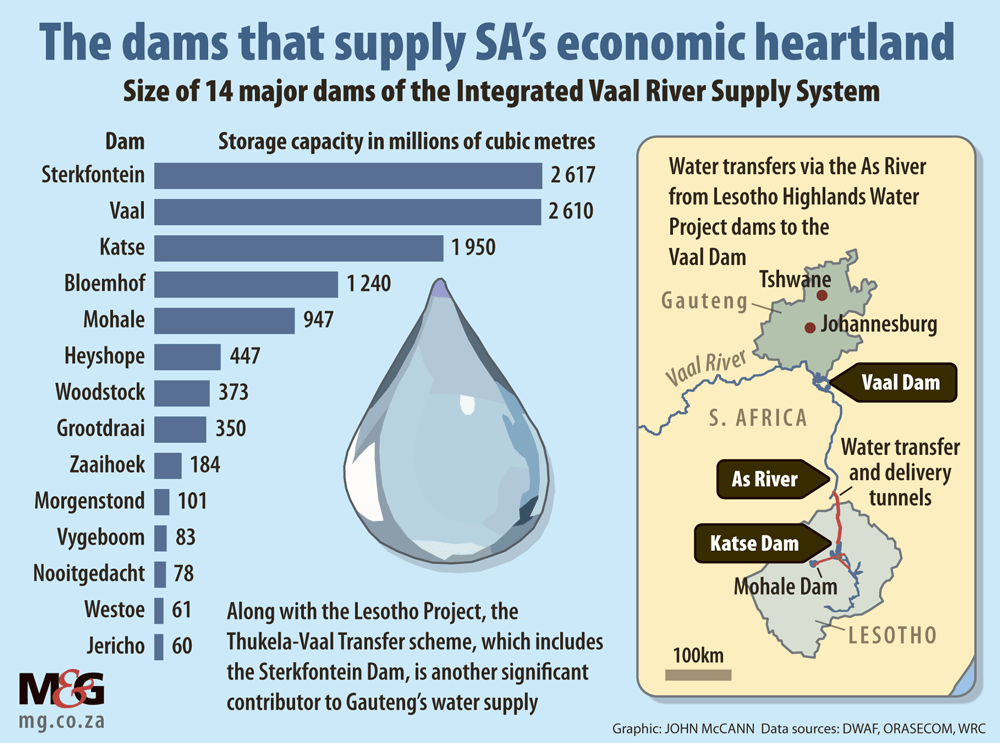 (John McCann/M&G)
This oscillation is what provides signals to the management that a crisis is starting to build, “so self-correction is needed”.
When these signals are misinterpreted, Turton said, “no self-correction happens, and the oscillations become more pronounced eventually leading to catastrophic failure. This is a characteristic of complex systems where feedback loops are discreet but powerful. At a theoretical level, this is what we saw play out in SAA, in Eskom and now in places like Johannesburg Water.”
“How can Johannesburg Water be stable when the mayoral team is mired in dogfighting about who is actually in charge? To date, the mayor has shown no interest in the water issue, is technically incompetent and therefore unable to understand what it’s about, and therefore unable to give direction in times of crisis.”
He said Rand Water has a water use licence, and its infrastructure is designed to deliver what the licence empowers them to deliver. “Half of the water they deliver to any of the many municipalities they service is simply lost to leakage and unaccounted for water.”
Even if Rand Water doubled its production, it would still not be able to keep the reservoirs full because half of all water supplied is lost by municipalities.
The water crisis in Gauteng is emblematic of a broader national water crisis. “It manifests in all major metros, as well as in many small towns. The same conditions prevail — incompetent leadership that is unable to grasp the complexity of water supply systems, so the system is run into the ground,” Turton said.
Lester Goldman, chief executive of the Water Institute of Southern Africa, said: “It’s accepted that local government is a problem and that aligns very closely with the Green Drop and the forthcoming Blue Drop report.” There is no quick or simple solution other than local government in Gauteng “needs to up its game”. “Water shortages will always exist in a water scarce country and Lesotho Highlands Phase 2 is going to assist with bulk water but that’s not where the problem lies,” Goldman said, referring to the long-delayed commissioning of the Polihali Dam in Lesotho, by 2028 to augment the Vaal River System for greater Gauteng. “The problem lies at the domestic level and it’s a local government challenge.”