Investor confidence is low as citizens and domestic private companies stash their cash abroad to protect it from the volatility of the weakened rand. (Getty)
The rand started off on a weak footing in the new year — and the threat of more volatility in 2024 has reared its head.
Although certain inflationary pressures have subsided, the rand’s ructions could keep prices higher — encouraging hawkishness by the South African Reserve Bank and postponing long-awaited interest rate cuts.
As it stands, two key developments stand in the way of the rand regaining sustained strength: a view that the United States Federal Reserve may hold off on cutting rates for much longer than was expected at the end of last year and that South Africa faces a particularly tough election year, which will drive uncertainty until the country’s political future is decided.
Late last year, the rand rallied on market expectations that the Fed would start cutting interest rates as early as this month.
But data out of the US last week showed that inflation rose 3.4% year-on-year, slightly above market expectations of a 3.2% rise. The Federal Reserve targets a 2% inflation rate.
Recent remarks by Fed governor Christopher Waller added to speculation that an early 2024 cut is no longer on the table. Last week, during a conversation organised by the Brookings Institute, Waller noted that although interest rates should come down in 2024, changes in the path of policy should be “carefully calibrated and not rushed”.
“In the end,” he added, “I am feeling more confident that the economy can continue along its current trajectory.”
Markets have pushed out their expectations for a US rate cut to mid-2024, said Shannon Bold, a senior economist at the Stellenbosch-based Bureau for Economic Research (BER).
A number of economists anticipate that the Reserve Bank will start its cuts near the mid-year mark. But the longer the Federal Reserve delays its easing, the longer South African borrowers may have to wait before they get some relief.
Investec chief economist Annabel Bishop noted this week that the probability of a January cut has been fully factored out.
The chance of a March Fed cut has now fallen below 50% as financial markets become less dovish, according to Bishop.
Meanwhile, the perceived probability of a May cut has fallen from more than 100% mid-month to about 75%.
As odds of an early Fed cut have started to recede, the dollar has clawed back some strength, sending the rand to a multi-month low. So long as US interest rates remain at their current highs, the dollar will continue to outshine other, riskier currencies.
At the time of writing, the rand was trading at just over R19 to the US dollar.
Late last week, Nedbank’s economists projected that the first 25 basis point rate cut could happen in May, with a cumulative 100 basis point reduction over the rest of the year.
But they noted that there is still uncertainty about the timing and pace of the anticipated easing, suggesting the Reserve Bank could only start cutting in July “if the rand tumbles ahead of elections and the US starts its monetary easing later than we expect”.
If this scenario materialises, interest rates will probably be cut by only 75 basis points over the year, the Nedbank economists said.
Last week the BER forecast that the Reserve Bank would only start cutting interest rates in the third quarter of this year.
The BER said that although inflation is set to ease over the year, it should only reach the Reserve Bank’s 4.5% target towards the fourth quarter of 2024. A recent uptick in inflation expectations will also have a bearing on the central bank’s willingness to ease interest rates.
The rand, which performed poorly in 2023 in the wake of load-shedding and other structural constraints on growth, has continued to lag other emerging market currencies, Bold pointed out.
Towards the end of last week, the local unit had depreciated 4.2% in the first few weeks of the year. Other currencies were down about 2%.
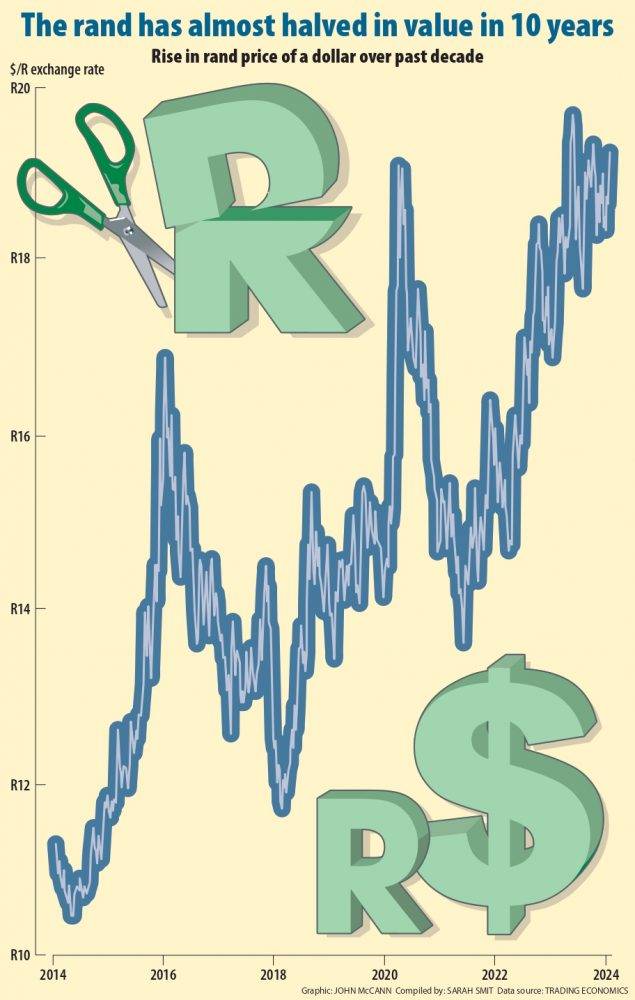 (Graphic: John McCann/M&G)
“I think we also have to be cognisant of the election year and a lot of the uncertainty around that. I think that is probably going to be a theme for the rand throughout the year,” Bold said, adding that the rand would be volatile and trade in a wide band throughout the year.
Bold noted that the BER’s expectation is that the elections will see coalitions leading some of the provinces, with the ANC narrowly winning the national vote. “If anything outside of that happens, that could be bad for the rand,” she said.
“Although, if there are some radical policies coming out of the ANC just to scrape through that vote, that could also be bad. But so far, everything seems to be status quo. Analysts point to 2029 being the more worrisome election year.”
In the worst-case scenario, the local currency could head to R19.50 to the US dollar, Bold said.
Investec’s most severe scenario for South Africa’s economy, to which it assigns only an 8% probability, the rand would depreciate to R21.50 to the US dollar.
This scenario would be brought on by a lengthy global recession and financial crisis. Under this scenario, a coalition of the ANC and Economic Freedom Fighters (EFF) would have won the national elections and the economy would be hit by severe load-shedding, as well as social and political unrest.
An ANC-EFF coalition appears to be the worst case for investors, with currency strategist Andre Cilliers also suggesting that this outcome would be bad news for the rand. “That would scare investors. But I don’t think that is something that would be realised,” he noted, adding that the more likely scenario is that the ANC will end up choosing a smaller partner.
Cilliers said there is a good chance the rand will claw back some strength over the course of the year — as long as certain pressures, including the ructions in the Middle East, start to recede.
Investec’s expected scenario is significantly more benign, with the rand averaging R17.95 to the US dollar in the first quarter of 2024 before evening out to R17.50 by the end of the year.
In this base case, global financial market risk sentiment is neutral to positive and South Africa holds on to a BB credit rating on the back of fiscal consolidation, Russia’s war on Ukraine starts to ease and the country’s greylisting is only temporary.
In a research note published last week, Bishop dug into some of the uneasiness surrounding the election, and its effect on business confidence.
“Government’s attention is diverted away from the pressing need to stimulate economic growth and improve the operating environment for private sector businesses, instead of constraining it, as politics take centre stage due to the upcoming election.”
She also suggested the timing of the election could have some bearing on the rand’s volatility.
With the election date not yet set in stone, the expectation is voters will head to the polls sometime from May to August.
With a later date still on the cards, “markets will continue to be dragged down by uncertainty and political noise, with the latter escalating in the run up to the election itself”, Bishop said.