Former president Jacob Zuma. (Photo by Gallo Images/Darren Stewart)
Only former president Jacob Zuma, the leader of the Umkhonto weSizwe (MK) party — and not its founder, Jabulani Khumalo, who was expelled last week — can deregister the party, the Electoral Commission of South Africa (IEC) says.
Khumalo registered the party on behalf of Zuma and there has been speculation he could deregister it in retaliation for his expulsion.
IEC deputy chief electoral officer Masego Sheburi said this week that the deregistration process, which is governed by the Electoral Act, involves the party first having to pass a resolution to dissolve itself.
“Notice of deregistration of a party may be given by the registered leader of the party following a resolution of the party to dissolve,” Sheburi said. “For the purposes of the MK party, Mr JG Zuma is registered with the IEC as the leader.”
MK party spokesperson Nhlamulo Ndhlela said Khumalo had “no chance” to deregister the party because he had signed a letter to transfer all his powers to Zuma.
“Section 15 of the Electoral Act is very clear on that. No one person has the power to do that. He [Khumalo] doesn’t have the power for that,” Ndhlela said.
He added that the allegations by Khumalo that he was expelled without being given reasons were not true because he was in a meeting with more than 25 people when the decision was taken to remove him.
“In fact , walking out with a letter and without a protest after being told the reasons of why you are being expelled is a clear indication that is an acceptance of a reason and acceptance of the decisions to be expelled.”
In addition to the expulsion of Khumalo and other senior members, the party has recently also been rocked by allegations of fraud in the process of collecting signatures for registration to participate in the 29 May national and provincial elections.
It has defended itself on both fronts, with Ndhlela arguing this week that if it were to be removed from the ballot, then all the other new parties that had to collect signatures to participate should be investigated as well.
In response to accusations by former party member Lennox Ntsodo that signatures were forged so that it would qualify to appear on the ballot, the MK party has presented itself as a victim of forgery rather than a perpetrator.
National police commissioner Fannie Masemola said in Durban this week that an inquiry had been opened at the Cape Town central police station to investigate the alleged fraudulent signatures.
“It is at the initial stage to verify as to whether there is a case that happened. If indeed it’s found that [there are] elements of crime, then the case will then proceed to the National Prosecuting Authority for the decision [to prosecute or not],” Masemola said.
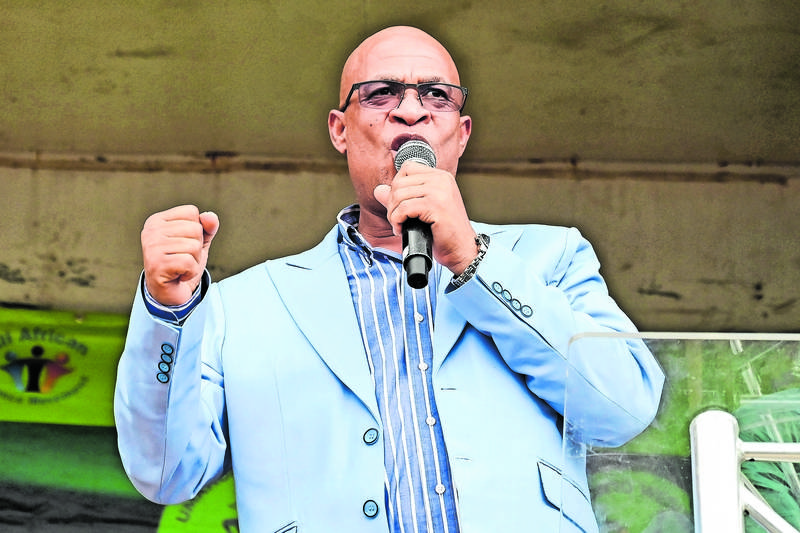 nternal strife: Jabulani Khumalo (above), who registered the uMkhonto weSizwe party on behalf of Jacob Zuma, has been expelled from the newly formed party and cannot deregister it. (Photo by Gallo Images/Darren Stewart)
Ndhlela accused Ntsodo of being a fraudster masquerading as a volunteer for the party and using fraudulent methods to collect signatures in the Western Cape, putting the party in disrepute.
He said that when Ntsodo realised that he was not on the party’s candidates’ lists submitted to the IEC, he then went to open the case at the police station.
“When we realised that he had been involved in fraudulent tenders and house scams, we were not going to put him on the list,” Ndhlela said. “When that happened, he goes and puts an affidavit.”
Ndhlela added that the MK party would in turn open a case against Ntsodo.
He reiterated that the party was not worried about being removed from the ballot.
“How will they remove a victim? We will ask them to go and check every single political party, every single volunteer of that political party, and every single signature before they can tell us [they are removing us].”
The IEC’s Sheburi said the law requires an unrepresented party to submit the identity numbers of voters equivalent to a predetermined quota for an election and then submit the signatures of the voters to the IEC.
The electoral body has created an online system to facilitate this and the MK party has complied with both requirements.
He said the IEC would cooperate with whatever lawful investigation arose over the signature fraud allegations.
At a media briefing two weeks ago, the electoral body said it did not have any way of verifying whether the signatures submitted by new parties and independent candidates belonged to the people with the ID numbers submitted.
Sheburi said all the commission did was to check whether the number of captured signatures supported the requisite number of signatures for a candidate to qualify. The IEC deputy chief electoral officer in charge of outreach, Mawethu Mosery, said the commission accepted what was given to it by political parties and independent candidates without suspicion.
Asked about the scenario of an individual realising after the election that their signature had been forged and whether this was not a cause for concern for the integrity of the vote, Mosery said it instead had a bearing on the integrity of the person elected on the basis of the forgery.
“It will then be up to parliament to deal with that person. Seven days after the elections, we hand over the outcome of the election to parliament. Once we hand it over, it is no longer within our mandate,” he said. “If you discover that a person was elected having used your name and signature incorrectly, you then have to deal with parliament.”
Economic Freedom Fighters leader Julius Malema told journalists two weeks ago that he had raised the issue of signatures with the IEC and was told that it did not have the systems to check whether these were valid signatures.
“I can register the same people, just take them from the voters’ roll, register them to be supporting me and then get different people to do signatures. There have to be systems in place to verify the authenticity of the signatures,” he said.
Tessa Dooms, the director of programmes at the nonprofit group Rivonia Circle, said the credibility of the elections should not be minimised and that the forgery issue should be resolved before the 29 May elections.
“The question is, if the elections continue as is now with all these questions unanswered, does it risk the credibility of the elections? Instead of focusing on the time, we should focus on the credibility,” she said.
“We have a lot of time to have this election; we have until August to have this election. Time is not the issue. We haven’t run out of time in terms of what the law provides for. What we don’t have is a clear sense that the IEC is sure that all these things can be resolved to have credible elections.