The poor condition of the water in Kamfers Dam. (Ester van der Westhuizen-Coetzer)
An ecological disaster is unfolding at Kamfers Dam — South Africa’s only lesser flamingo breeding site — where more than 160 waterbirds have died in the latest outbreak of avian botulism, linked to municipal sewage contamination.
The recent deaths and paralysis of waterfowl at the dam, near Kimberley, have raised serious concerns among conservationists, BirdLife South Africa said in a statement.
Historically, the pan hosted Southern Africa’s largest permanent Lesser flamingo population, with more than 80 000 recorded in 2006.
“It is shocking to see the extent to which the water quality has been permitted to deteriorate in Kamfers Dam,” said Mark Anderson, the chief executive of BirdLife South Africa. “Birds are dying unnecessarily and in such numbers.”
Pathology lab findings from the University of Pretoria suggest botulism as the cause, which was “likely worsened by bacterial imbalance from sewage” from the Homevale wastewater treatment works, according to the non-profit.
“The discovery of Clostridium septicum in affected birds’ intestines indicates exposure to untreated sewage.”
Anderson called on the Sol Plaatje local municipality to “intervene without delay” and to take the required steps to improve conditions at Kamfers Dam “for the sake of the birds, and the people of Kimberley”.
As one of only four African breeding sites for lesser flamingos, supported by an artificial breeding island built in 2006, Kamfers Dam earned recognition as a natural heritage site and key biodiversity area.
“It is unacceptable to witness hundreds of birds die in their natural habitat due to negligence from pumping untreated sewage into a natural area,” said Ester van der Westhuizen-Coetzer, an environmental specialist at Ekapa Minerals in Kimberley.
“Kamfers Dam was once a pristine bird area … where different species could flourish.”
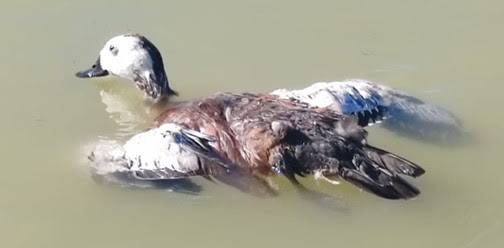 A sick South African Shelduck struggling to swim in Kamfers Dam. Photo credit: Ester van der Westhuizen-Coetzer.
Dead, dying birds
In late November, she reported numerous dead and dying birds to BirdLife South Africa. Affected species include lesser flamingo, fulvous whistling duck, South African shelduck, red-knobbed coot, blacksmith lapwing and Egyptian goose.
The botulism outbreak is a “biodiversity nightmare”, Van der Westhuizen-Coetzer told the Mail & Guardian. “It’s the only breeding site in South Africa for lesser flamingos and it’s going down the drain because nobody cares. Somewhere along the line, somebody must care.”
Once a week since November, she has gone to Kamfers Dam to retrieve the carcasses of the birds washed to shore and to retrieve dying birds to be euthanised. An unknown number of further dead birds remains inaccessible to collection efforts.
“There’s no lab that tests just for botulism so the pathology report from the University of Pretoria ruled out all other diseases,” she said.
“They found Clostridium in the intestines of the birds that we sent away and then the water results that we received in December also confirmed that there’s Clostridium in the water. Clostridium is the main bacteria that causes botulism.”
When Van der Westhuizen-Coetzer took the paralysed birds to be euthanised, a local vet agreed that all the symptoms showed that it was botulism. “From the university, to the vet, to the water results, we can come to the conclusion that it actually is botulism.”
It causes the birds to suffer agonising deaths.
“First of all, their legs get paralysed and then their wings get paralysed. They can’t keep their heads up anymore because this obviously attacks your muscles.
“This paralyses the muscles and then eventually the intercostal muscles in the ribs also get paralysed and the birds can’t breathe anymore. If they haven’t drowned when they couldn’t keep their heads up, they definitely will suffocate.”
Nor can the afflicted birds forage. “Every bird that we send away for tests at Pretoria University, if you read the report, it states that the bird’s stomachs were mostly empty so they can’t eat during this process.
“They are also hungry, they don’t have energy and they can’t move because their muscles are all paralysed … For me to pick up a duck and carry it 2km to get it to my car to get it to the vet, to be euthanised is terrible. It’s really a devastating thing.”
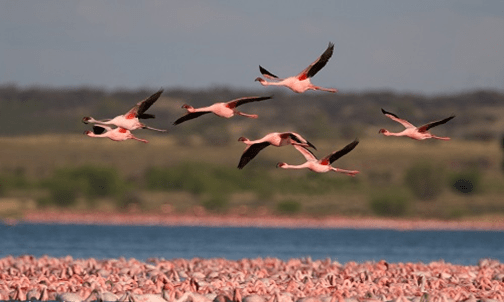 Flamingos flying above and breeding in Kamfers Dam, over five years ago. (Mark Anderson)
‘Cooking pot’
A combination of factors are at play, she said. “They [Sol Plaatje local municipality] are pumping raw sewage into Kamfers Dam. It’s supposed to be water that has been cleaned to a state where it can be released but it hasn’t been clean for years so it’s raw sewage at this stage … And then we had extremely high temperatures over the last two months of up to 41°C.”
These conditions have turned Kamfers Dam into a “cooking pot”, she said.
“There’s no oxygen coming in, there’s no movement on the water. It’s high temperatures, so the biomaterial from the sewage actually is busy breaking down, and then it’s like a pot cooking.
“It takes out all the oxygen and then, when it takes out all the oxygen, the botulism can flourish because they don’t need oxygen. It’s the high temperatures; it’s the high volumes of raw sewage going into the pan and that just creates chaos.”
Wisane Mavasa, spokesperson for the department of water and sanitation, told the M&G that it had initiated “administrative enforcement action” instructing the Sol Plaatje local municipality to correct its failure to maintain the required standard of effluent discharges into the Kamfers Dam in its Homevale wastewater treatment works.
“Due to non-compliance with the administrative enforcement, the department has opened a criminal case against the municipality for pollution. The case is currently under investigation,” she said.
BirdLife South Africa noted that, for the past four or five years, flamingos have been unable to breed at Kamfers Dam because of artificially high water levels submerging the breeding island.
“Water quality has deteriorated as the Sol Plaatje municipality failed to maintain the Homevale wastewater treatment works. The once-abundant flamingo population is sadly now only visible on local business signage.”
Citing botulism experts, it said that controlling botulism requires stabilising the wetland ecosystem to prevent decaying animal protein accumulation, particularly during favourable temperatures for toxin production.
“Water level manipulation and frequent carcass removal are essential measures. The municipality has not implemented either action.”
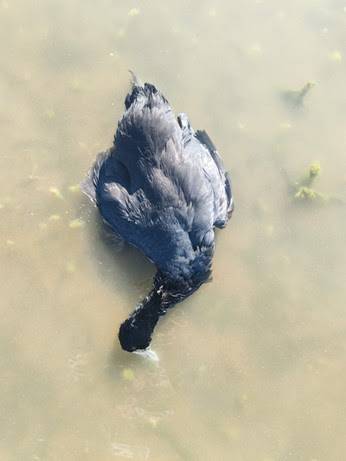 One of the many dead birds on Kamfers Dam, a Red-knobbed Coot. (Ester van der Westhuizen-Coetzer)
Unique habitat
Thabo Mothibi, spokesperson for the municipality, told the M&G that the “municipality acknowledges the contamination and pollution that is taking place at the Kamfers Dam linked to the Homevale wastewater treatment works”.
“In addition to its much-needed upgrade and refurbishment, the plant has been besieged by a series of acts of vandalism and theft of electrical and mechanical components, impacting on it operating optimally.”
It is steadfastly lobbying for funds.
“The upgrade and refurbishment of the Homevale wastewater treatment works requires at least R156 million to permanently eliminate the discharge of raw sewage to Kamfers Dam,” he said.
Mothibi said the municipality had submitted a business plan to the treasury seeking funding to address the bulk sewer infrastructure to the tune of R1.6 billion.
The funds would also cover the construction of a new treatment plant with a treating capacity of 40 megalitres daily to “address the 20-year horizon sanitation demand”.
He added that the newly installed executive mayor Martha Bartlett “will be championing all efforts” to secure funding.
“Apart from the waterbird die-off, the increased levels at Kamfers Dam tend to submerge Transnet’s railway line, hampering operation and causing economic loss. Transnet committed R10 million for the purchasing of three mobile pumps and other equipment.
“The municipality is committed to upholding environmental sustainability.”
Van der Westhuizen-Coetzer said more tests would be conducted at the end of the month.
“I’m not going to test for botulism because I know it’s there now but I’m going to test to see what the chemical oxygen demand is. The last time we tested, the chemical oxygen demand was 1 150 milligrams per litre, which is much higher than the legal limit of 75 milligrams per litre.
“If that starts going down, and if we have rain, then most probably it [the botulism outbreak] would start ending because the rain puts oxygen back in and if there’s movement in the water, then we have oxygen that can actually work against the botulism.”
She added that failing to save this unique habitat means that it would be lost to future generations.
“Losing South Africa’s only lesser flamingo breeding site to such a catastrophe must be stopped. We urge all stakeholders to engage and do something to save those that cannot speak for themselves.”