Roedean school
I am writing this letter because what has unsettled me most about the recent controversy involving Roedean School cancelling a fixture with King David School, Linksfield has become a window into something far bigger than sport. What troubles me is the deeper pattern it reveals about how elite institutions respond when young people express ethical discomfort about injustice, and how quickly the language of “apoliticism” is deployed to shut that discomfort down. The leaked conversation between Roedean and King David sharpens this concern: it shows how quickly a political objection is reframed as an issue of Jewishness, when what is being contested is the normalising of sport with an institution that promotes Zionism as part of its identity and formation of learners.
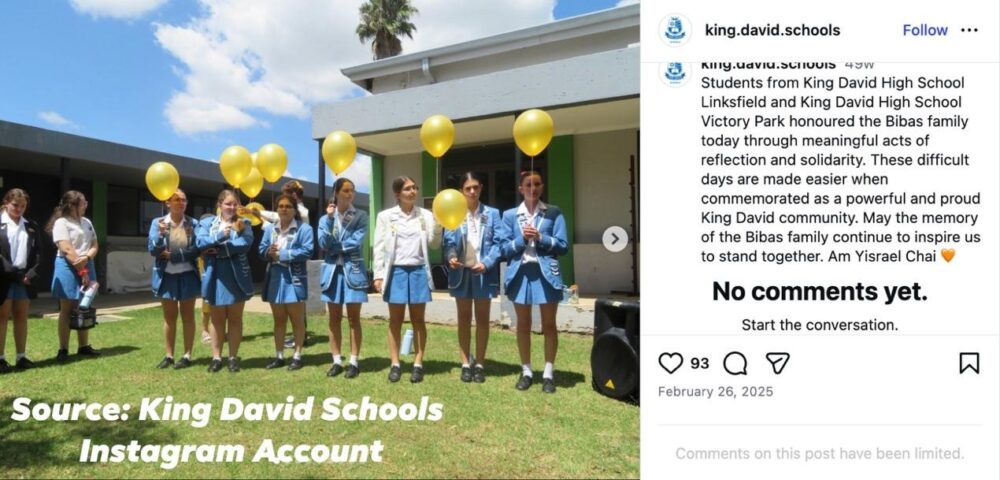 Post from the official King David Schools Instagram account expressing institutional solidarity with Israel.
In South Africa, “apolitical” is not a neutral position. It is a posture made possible by privilege. It is the luxury of those who are insulated from the consequences of political violence, racialised inequality, and global power. In a society still structured by the long shadow of apartheid, neutrality functions not as innocence but as preservation.
Roedean is among the most expensive schools in the country. It serves families with extraordinary economic and social capital. To present such a space as detached from politics is disingenuous. Elite schooling is not an escape from society; it is one of the sites where society reproduces itself.
Let me be clear from the outset: this is not about antisemitism. No Jewish learner should ever be targeted, excluded, or made unsafe because of their identity. That principle is non-negotiable. The issue at stake is not Jewishness, but how institutions respond when students raise moral questions about ideology, militarism, power, and injustice in the world they are inheriting.
The leaked voicemail between a Roedean staff member and a representative of King David School is instructive, not because it proves malice, but because it reveals a framework. In that call, the Roedean caller explains that the school is “facing a bit of pressure from our community and our constituents regarding just not playing against King David,” adding that “what’s happening out in society is now affecting us at a school level.” The problem, as she frames it, is not ethical disagreement but inconvenience — the intrusion of politics into the smooth functioning of elite school sport.
Rather than sitting with students, asking what they are grappling with, or guiding them through complexity, the instinct was to turn outward, seeking advice from the very institution the students were objecting to, effectively asking how to manage dissent.
That is not leadership but narrative control. It reflects a familiar pattern in elite white institutions: when confronted with discomfort, authority manages upward, protecting reputation and calm rather than engaging young people as moral agents.
The caller repeatedly emphasises that she must “remind them that schools are apolitical.” What is also deeply revealing is how quickly she frames the objection as a matter of Jewish identity rather than political critique. She states, “at the moment, it’s presenting itself as a Jewish day school issue,” and later asks, “so what are your parents objecting to us playing you?” In doing so, she collapses a political and ethical objection into a question of Jewishness. This suggests little reflection on what students are actually saying and why. In a country like South Africa — and in a school that claims to cultivate critical, ethically aware young people — it is alarming that a senior educator appears unable, or unwilling, to hold a basic distinction between Jewishness as identity and faith, and Zionism as a political ideology and institutional allegiance.
Roedean is not an abstract space. It is one of the most elite schools in the country. The conditions that allow a school to claim neutrality — safety, wealth, insulation from violence — are themselves political outcomes. To refuse a stance is, in practice, to take one: prioritising calm and reputation over ethical engagement. At a school where annual fees run into hundreds of thousands of rand, parents are not paying for reputational management but for moral and intellectual leadership. When questions of justice are outsourced to public relations firms instead of being held by educators, something has gone wrong. Moral formation is the work of teachers, not spin doctors.
This matters because the students’ discomfort did not arise in a vacuum. King David Schools do not claim neutrality. Their own institutional documents describe Jewish education as inseparable from Zionist education and affirm the centrality of the State of Israel. Parents and learners are required to sign acceptance of this framework. One may defend this position, but it cannot honestly be described as apolitical.
King David’s own Code of Conduct states this explicitly
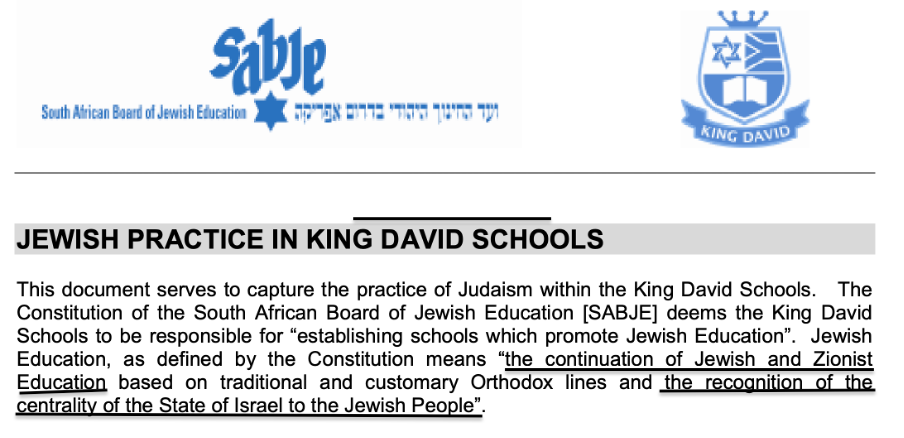 Extract from the King David Schools Code of Conduct defining Jewish education as inseparable from Zionist education and affirming the centrality of the State of Israel.
This alignment is not merely textual or administrative; it is embedded in school life and learner formation from primary level
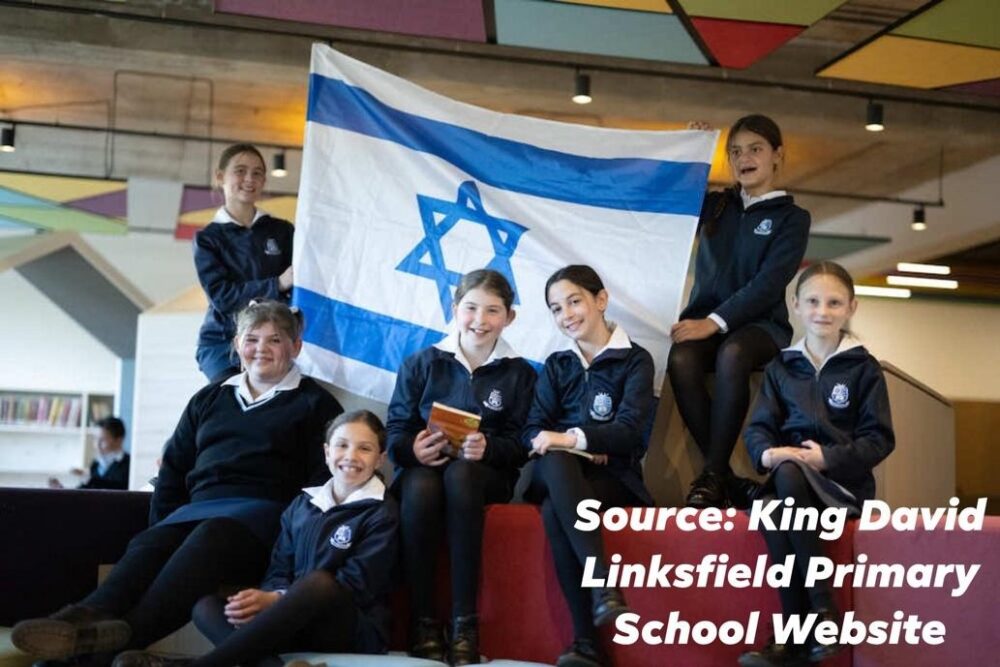 Image from the King David Linksfield Primary School website showing learners posed with the Israeli flag.
Nor is the connection between South African Zionist education and the Israeli military merely theoretical. A November 2024 fact sheet compiled by Palestine solidarity researchers collates publicly available material identifying a number of South Africans described as “lone soldiers” in the Israel Defense Forces, and links several of these individuals explicitly to King David Linksfield. For ease of reference, the examples listed in the fact sheet are summarised in the table below.
These examples are drawn from publicly available material collated in the November 2024 fact sheet
None of this means that every learner at King David will serve in the IDF. That would be an irresponsible claim. But it does mean that South African students are being educated within an explicitly Zionist framework that, in documented cases, has intersected with participation in a foreign military widely accused of committing genocide
Against this backdrop, it is not irrational, hateful, or antisemitic for students at another school to say: we do not want to participate as if this is morally neutral. We do not want to normalise institutions tied to militarism. We refuse to play along.
We live in an abnormal society. There is no such thing as normal sport in an abnormal society. This framing comes from a long tradition of moral refusal—seen in anti-apartheid boycotts, student uprisings, and other forms of conscientious objection—where ordinary social rituals are disrupted to expose what those rituals are helping to normalise.
It is therefore ethically coherent for learners to refuse participation in systems they believe are implicated in oppression, just as one might refuse to compete with institutions tied to white supremacy, homophobia, or apartheid violence. Refusal is often the first language of conscience, especially when the adult world insists on carrying on as if nothing is wrong.
Criticising Zionism is not the same as hating Jewish people. Judaism is not reducible to the political project of the modern Israeli state. Many Jewish people, including South Africans, reject Zionism precisely because of what it has produced. The insistence on collapsing these distinctions is itself a political strategy, one that forecloses ethical debate and shields power from scrutiny.
Instead of outsourcing the problem to public relations firms and issuing statements about being “apolitical,” school leadership should be doing the harder work: accompanying young people as they wrestle with racism, militarism, genocide, homophobia, xenophobia, and power. That is what moral education looks like in an unequal world. Schools are not meant to raise obedient children who avoid politics. They are meant to form ethical citizens capable of navigating a world fractured by injustice. The real question is not whether students are being political, but whether the adults around them are brave enough to listen.
I write this letter not to condemn Roedean, but to challenge it. The question before you is not whether students should have protested. The question is what kind of moral education you wish to offer when they do. In a society still haunted by the consequences of silence, that choice matters far more than any fixture ever could.
Nigel Branken
Social worker, activist, pastor and father
Nigel Branken is a South African social worker and community activist working at the intersection of faith, justice, and ethical public life. His work focuses on confronting xenophobia, racism, inequality and institutional harm, and on building forms of public life that are truthful, accountable and compassionate. He writes from the conviction that moral education cannot be separated from the political realities that shape human dignity and belonging.
*This article has been updated. It was brought to the Mail & Guardian’s attention that a graphic titled “King David Linksfielfd Alumni Serving in the Israel Defence Forces” was not accurate. The graphic has since been removed.