Migrating Homes — Gateways of Our Conventional World by Kibera Arts District. Photo: Anthea Pokroy
I first saw Atlas of Uncertainty on a crisp winter morning at the Wits Origins Centre, the gallery quiet in the moments between one school group leaving and another arriving.
It seemed fitting that the exhibition should be held there, in the middle of Braamfontein, with Johannesburg bustling outside the gallery windows.
The range of works represented in the exhibition is as sprawling and diverse as the three African cities that Atlas of Uncertainty explores.
Accra, Nairobi and Johannesburg are all booming with industry, culture and migration but they are also places characterised by flux and instability.
The exhibition challenges the viewer to consider what the African city encompasses. What makes Accra, Nairobi and Johannesburg the cities they are? Of course, speaking in this way implies that African cities are mirrors of one another, virtually indistinguishable.
However, the exhibition team was intentional about showcasing both the differences and the similarities of the three cities; at once recognising that there are certain realities which are largely universal, while also highlighting the idiosyncrasies of Accra, Nairobi and Johannesburg.
Atlas of Uncertainty opens with Ilanga Lishonile’s The Herd, a floor-to-ceiling tapestry featuring a blue-black piece of fabric with bright beaded tendrils snaking outward from its centre. It resembles a map of sorts but not in the traditional sense. Instead, like most of the works on show, it reimagines the concept of the atlas, offering viewers a counter-cartography of the African city.
The rest of the works are arranged in the temporary exhibition space, seeming to follow their own internal order and rhythm, despite the artists each using vastly different mediums.
Professor Loren Landau, part of the Atlas of Uncertainty project team, says the organisers weren’t entirely sure what to expect when they first put together the open call for visual artists in Accra, Nairobi and Johannesburg.
The exhibition was originally slated to open at The Point of Order, one block down from the Origins Centre but when the Atlas team surveyed the artworks they were given, they realised that they needed a much bigger space.
 Map of Dreams and Realities by Billie McTernan – Photo Credit Anthea Pokroy
Billie McTernan’s Map of Dreams and Realities is one such work. Originally outlined to be a small tapestry no bigger than 1m2, the work seemed to take on a life of its own, growing to become one of the largest works featured in the entire exhibition.
The delicate panels are stitched together in a haphazard weave, embroidered with what appears to be writing. The tapestry hangs in the space between two floors, stray threads reaching groundward. Its fragility is striking, particularly in contrast to its size. It resembles a curtain, a veil between worlds.
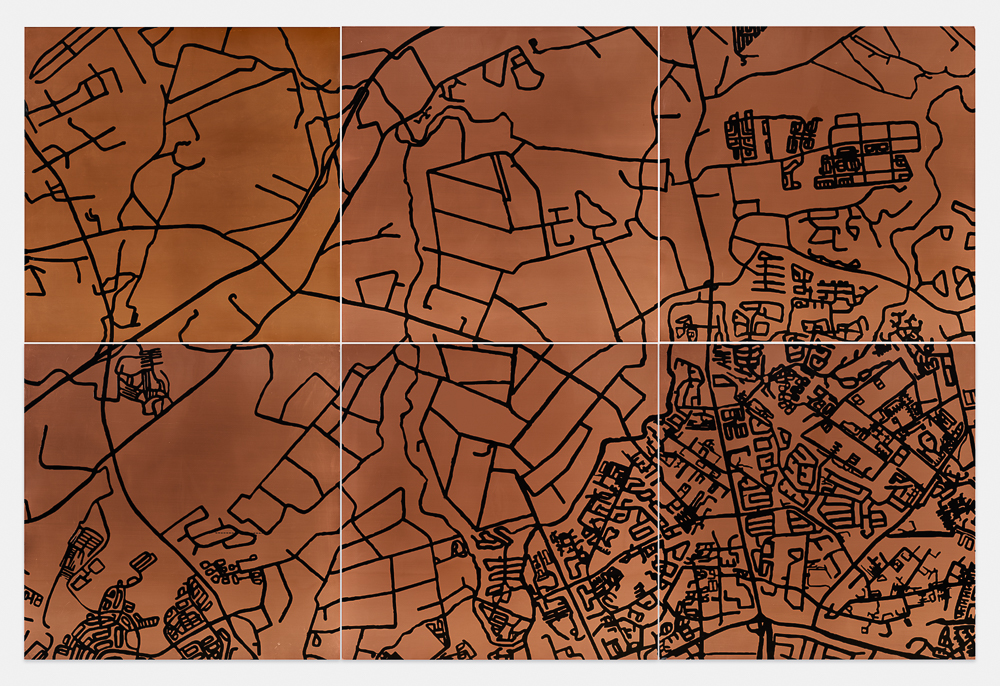 Unmapping Jozi by Candice Kramer – Photo Credit Anthea Pokroy
Another work that ended up being much larger than the team originally expected was Candice Kramer’s Unmapping Jozi, a polyptych featuring four bronze panels with a map of Johannesburg spidering across their surfaces. It, like many of the other works, turns our modern understanding of an atlas on its head.
The exhibition’s curatorial team was faced with the challenge of finding a space where all the artworks could be accommodated comfortably. “That’s actually what influenced the curation,” says Professor Landau.
“We arranged the works so that they could fit. If it had been in a traditional White Cube setting, then we probably could have arranged the works more thematically.”
In some way, this sudden change in curation meant the exhibition took on the same characteristics of the cities it aims to represent — ever-changing and expanding, consistently multilayered and multilateral.
In Daniel Muchina’s video work, Madini, a spectre haunts downtown Nairobi, travelling through light and shadow, from one dimension to the next. The viewer watches as the veils between two parallel versions of the city become blurred.
Stills from the video have been made into prints, freezing a moment in the spectre’s journey and showing the incredible interplay of light, colour and depth in Muchina’s work. The viewer is held in this moment of flux, watching as the city passes through this world and the next.
Atlas of Uncertainty poses and offers an answer to the question: Who gets to define what African cities should be?
The prevailing narrative that has often been endorsed and weaponised by the West is that African cities are, by nature, unsafe, unstable and unsustainable.
However, as stated in the accompanying exhibition text, “The Atlas of Uncertainty begins elsewhere. It starts from the proposition that African cities are not behind the curve but ahead of it”.
African cities are dynamic and unique, fast-paced and dense with industry, innovation and development. The dormant amateur economist in me sees the potentiality for growth, industry and enterprise.
But the artist in me sees the possibility for art to flourish in a place that is inherently uncertain, always in flux. Art is often born out of change — it is the spark, that sudden rip in the matrix, that spurs the artist on.
In this way, the project begins to offer a counter-argument to the current colonial mapping of African cities as dangerous places that are doomed to fail. Instead, the exhibition encourages viewers to recognise uncertainty as an indicator of potentiality, of the possibility for growth and expansion, both economically and socially.
Professor Landau notes that the project doesn’t seek to romanticise uncertainty.
“Uncertainty is nothing new,” he says. “It is many peoples’ way of life.” Rather, the purpose of the Atlas project is to provide a counter-mapping where the cities can be viewed more holistically.
What can we learn from places and spaces that are built to handle constant flux?
There is perhaps a widespread misconception that uncertainty almost always indicates scarcity and vulnerability. On some level, this can be true. But what Atlas of Uncertainty allows us to do as viewers is recognise flux as a precondition for resilience.
In an increasingly uncertain world, those cities that have reckoned with uncertainty for decades, centuries, will ultimately fare better in the long-term.
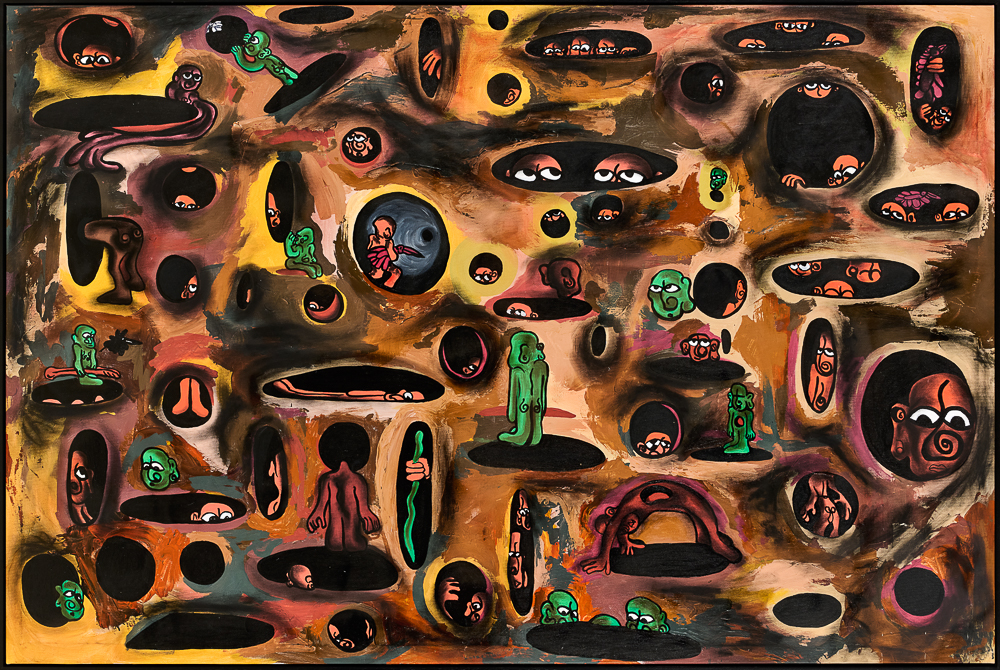 Po Ano Sika by Nana Danso – Photo Credit Anthea Pokroy
In Nana Danso’s speculative work, Po Ano Sika (Beach Gold), the artist wrestles with a future in which our cities become uninhabitable. Poisoned water and barren topsoil in this hypothetical future force Danso’s characters underground. Figures peek around the entrances to underground tunnels, constructing a new life out of an impossible situation.
This mirrors the real lives of the migrant communities that occupy Africa’s big cities. In the face of uncertainty, both economic and social, people resort to uprooting their previous lives in order to adapt.
In many ways, the sonic works, paintings, sculptures and video installations weave together to reflect the complex tapestried societies that make up Africa’s big cities, all of which are unique and distinct. The exhibition seeks to explore the African city as something that is constantly evolving and adapting with the changing socio-political climate.
Professor Landau and I spoke at length about the value inherent in African cities and the ways communities form and reform to shape the social fabric present in these places. In this way, the world becomes both bigger and smaller.