


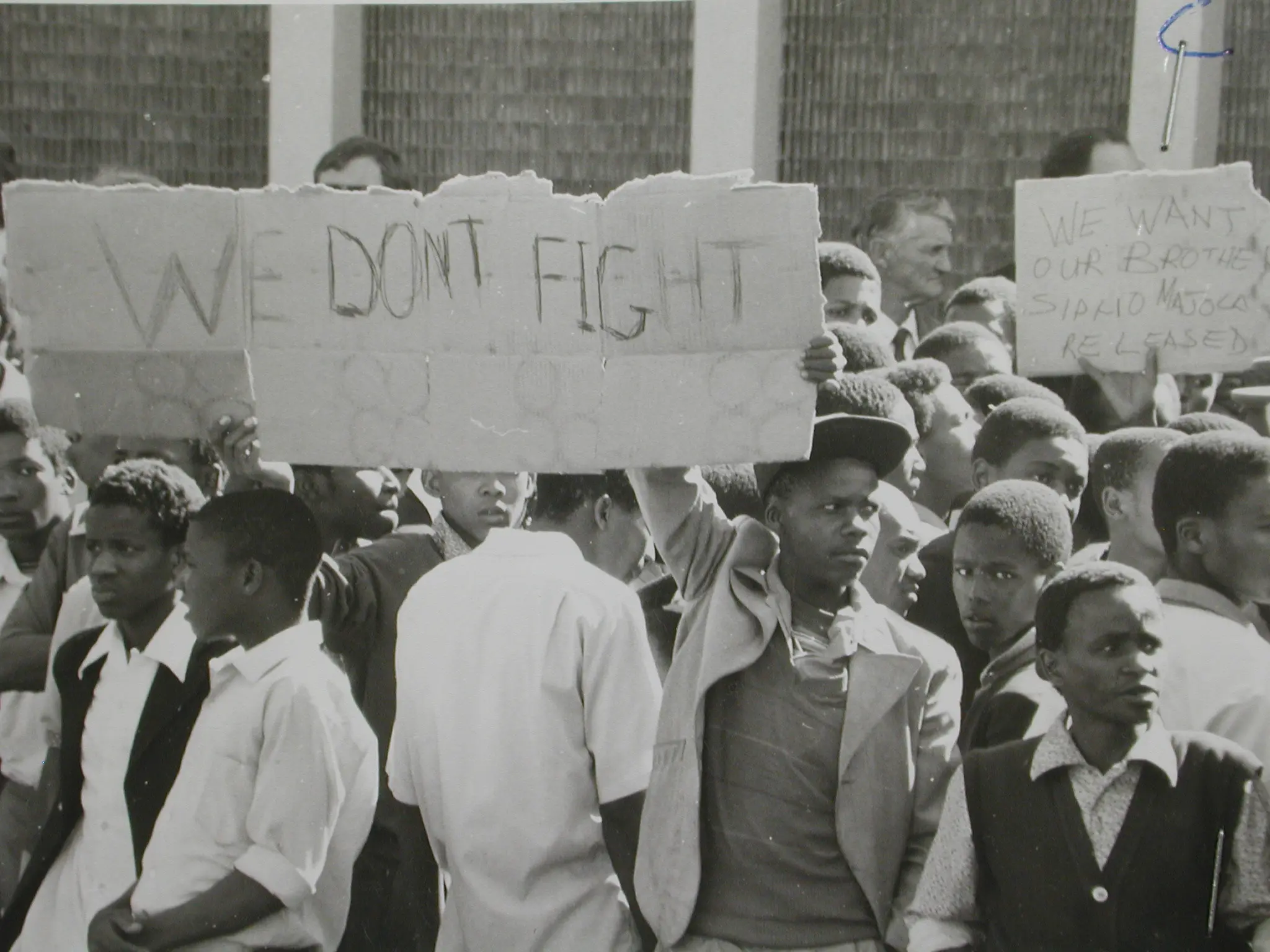
Every June 16th, South Africa holds a party. There’s music, dances and speeches from politicians.
Social media feeds are filled with the same photograph — Hector Pieterson’s body, carried through the streets of Soweto — reposted so many times it has begun to lose its power to disturb.
And then, by the end of June, we have all moved on.
This is what worries Noor Nieftagodien. “Those Youth Days have, by and large, become celebratory affairs,” he tells me, “with very little attention being given to the causes, the character, what happened on June 16th and the consequences of that historic day.”
Nieftagodien is a professor of history at the University of the Witwatersrand, head of the History Workshop and the author of The Soweto Uprising: A Jacana Pocket History, first published in 2014 and now reissued in a revised and updated edition to mark the 50th anniversary of the uprising.
He has spent much of his professional life thinking about 1976 — what it was, what it meant, and, increasingly, what is at risk of being lost as the years accumulate and the commemorations grow louder without necessarily growing deeper.
It is a concern that has sharpened with time. “I’ve been very worried,” he says, “as someone who operates in the field of teaching and researching history but also working in the field of heritage, how little attention has been given in the public domain about these events.”
The revised edition arrives at a particular moment. In 2015 and 2016, the Fees Must Fall movement swept through South African universities and with it came an explicit and conscious reckoning with the generation of 1976.
Students held up posters that referenced the uprising, connecting their own struggle against the cost and character of higher education to the struggles of the schoolchildren who had marched fifty years before. For Nieftagodien, that moment became both a prompt and a lens.
“It seemed to the students of Fees Must Fall that many of the ideals, the ambitions, the objectives of the 1976 movement had not been fully realised.”
The revised edition draws on that political moment and also on a wave of new scholarship — including research by his own PhD students — that has illuminated aspects of the uprising that the original book had only partially captured. Chief among these is the role of women.
“I had a couple of young female students who’ve done PhDs and MAs on the role of black women in Black Consciousness in the 1970s and 1980s,” he says. “I found that very inspiring.”
The revised text gives fuller attention to figures like Sibongile Mkhabela, who was, as Nieftagodien puts it, “really an instrumental figure in the 76 uprising” — one whose centrality to the events has been consistently underplayed in the dominant accounts.
One of the book’s most important arguments and one that runs against the grain of how June 16th is often publicly remembered, concerns how planned the uprising actually was. The popular image of the day is one of spontaneous eruption — a city of schoolchildren suddenly rising up. Nieftagodien pushes back firmly against this.
“Often when people think about 1976, they imagine that it was a sort of spontaneous eruption of protest,” he says.
“In fact, that moment of June ‘76 was preceded by the development, the evolution and the creation of small groups of political activists in schools and outside schools that over time developed into a set of overlapping networks.”
Those networks were fed by the ideas of Black Consciousness — the intellectual and psychological revolution initiated by Steve Biko and the South African Student Organisation in the early 1970s — and by a generation of young people who were reading voraciously, debating seriously and building organisations with real capacity.
“They read the African Writers series,” Nieftagodien says.
“They read speeches by Frantz Fanon, by Malcolm X, by Martin Luther King Jr.” By June 1976, structures like the South African Student Movement had drawn the key figures together and on June 13th — three days before the march — an action committee was formally constituted to coordinate it. “It is the agency of young people who made ’76 possible,” he says.
This matters not only as a point of historical accuracy but as a corrective to a more self-serving distortion. For years, certain political organisations — most notably the ANC — have implied or explicitly claimed a leading role in the uprising. Nieftagodien is direct about this.
“It is very clear from the interviews, as well as from the testimonies of leading figures of ‘76, that the main political parties such as the ANC and the PAC were at best marginal.”
The oral history methodology at the heart of his book — drawing on the voices of actual participants, from key organisers to young people who woke up on the morning of June 16th with no intention of becoming activists — is partly a scholarly choice and partly a political one. It allows the record to speak clearly, in ways that institutional narratives cannot easily muffle.
“What oral history helps us to understand,” he says, “is that it was the agency of young people who made ’76 possible. And that goes against the main narrative of political parties, especially of the ANC, making claims over having controlled or influenced the 1976 uprising.”
The urgency of that oral record is not abstract. Fifty years is a long time and the people who lived through June 16th are ageing. Some are already gone. The woman who organised the march, the student who ran from the police, the parent who sat in a community meeting the day after, counting missing children — their testimonies exist in archives and in books like Nieftagodien’s but also in living memory that is daily becoming less available.
“Are we in danger of losing something irreplaceable?” I ask him.
He doesn’t hesitate. What the book has always tried to do, he says, is foreground “the experiences, the ideas and the reflections of people who were actual participants in 1976, both leading figures but also young people who, on the morning of June 16th, did not see themselves as political activists.”
What makes the book’s anniversary edition feel particularly alive is the way it refuses to treat 1976 as settled history.
The conditions that produced the uprising — overcrowded classrooms, crumbling facilities, an education system that systematically underserves poor black communities — have not disappeared. They have, in many respects, persisted.
“The government itself today estimates it would take more than 30 billion rand to build more schools, upgrade schools and repair damaged schools,” Nieftagodien says, “and every year the backlog increases.”
The trigger of 1976 was Afrikaans as a medium of instruction. But the underlying grievances, he is careful to note, ran much deeper: “Overcrowding, poor teaching, poor education facilities, no sports facilities.” The parallels to the present are uncomfortable.
“The conditions for protest, for challenging inequality, remain in similar ways to what they did in the 1970s.”
What is different — and this is where the comparison becomes genuinely complicated — is the political clarity that made 1976 possible. “In the 1970s it was very easy to identify exactly where the problem rested,” he says.
“The problem rested with Bantu education and Bantu education was a central pillar of the entire apartheid system.”
Today’s young people face a system whose failures are real but whose causes are diffuse and more easily obscured.
Xenophobia and Afrophobia have filled the vacuum, offering convenient scapegoats — migrant children blamed for the decay of schools that have been crumbling for 15 years — while the structural causes go unaddressed.
“What one needs,” Nieftagodien says, “is the kind of development of political consciousness that we spoke about earlier, which occurred pre-1976, where young people like Bongi Mkhabela, Seth Mazibuko, Tsietsi Mashinini studied, debated and read about what the underlying causes were.” The absence of that kind of organised, ideologically grounded cohort is, for him, one of the defining challenges of this political moment.
And yet he is not despairing.
At the close of the revised edition, he gestures toward the Gen Z movements that have swept across Kenya, Mauritius and parts of Latin America. Young people who mobilised tens of thousands, toppled authoritarian governments and did so without the established political parties leading from the front.
It is, he suggests, a sign of what is still possible when young people claim their own agency.
“Hopefully young people can learn from that,” he says. “Not to emulate it exactly, 50 years later but it’s about how young people can and do have agency.”
This is, in the end, the central claim of both editions of the book. Not that 1976 was a miracle or an accident but that it was made by people — specific, organising, reading, debating, deciding people — whose example is still available to us if we are willing to take it seriously.
The Soweto Uprising: A Jacana Pocket History (Revised and Updated) is available now.