

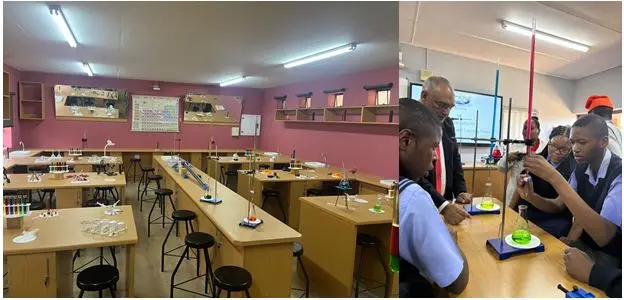
The partnership between the Garden Cities Archway Foundation (GCAF), the Western Cape Education Department (WCED), and Advancing Knowledge Non-Profit Company (AK NPC) has resulted in the establishment of five new Science Teaching and Learning Centres (Science TLCs), further strengthening opportunities for quality STEM (Science, Technology, Engineering and Mathematics) education in under-resourced schools across the Western Cape.
Three Science TLCs were officially opened on Tuesday, 27 October 2026, at St Andrews Primary School in Saldanha, Ilingelethu High School in Malmesbury, and Proteus High School in Atlantis. The remaining two centres were opened on Thursday, 29 October 2026, at Iingcinga Zethu High School in Ceres and Desmond Mphilo Tutu High School in Paarl.
The establishment of these five centres brings the total number of Science TLCs developed through the GCAF, WCED and AK NPC partnership during 2026 to eleven, with a further centre currently under construction. Since the inception of the Science TLC initiative in 2011, the total number of centres established across the Western Cape, including the five latest additions, has reached 136.
This continued expansion represents a significant investment in strengthening science education at school level. It also demonstrates the partnership's ongoing commitment to addressing inequalities in access to quality STEM education and ensuring that learners in under-resourced communities have opportunities to develop the knowledge, skills and confidence needed to participate meaningfully in an increasingly science- and technology-driven world.

Advancing Access to Inquiry-Based Science Education
The establishment of Science TLCs forms part of a broader, integrated programme of support provided by Advancing Knowledge NPC. This includes the professional development and ongoing support of science teachers, complemented by SACE-endorsed professional development courses offered throughout the year. These interventions prepare teachers to make effective use of the facilities and to integrate inquiry-based approaches into their everyday science teaching.
An important outcome of the partnership is the transformation of access to practical, inquiry-based science education. Schools that previously had limited or no access to functional science laboratories are now better equipped to provide learners with meaningful practical science experiences as an integral part of teaching and learning.

The purpose-designed facilities provide environments in which learners can engage directly with scientific concepts through experimentation, investigation, observation and hands-on activities. Rather than relying exclusively on theoretical explanations, learners are encouraged to explore scientific principles, ask questions, test ideas and develop their understanding through practical investigation.
This approach strengthens conceptual understanding while promoting curiosity, critical thinking, problem-solving and scientific reasoning. It also has the potential to increase learner engagement and stimulate greater interest in STEM subjects, further studies and careers.
Importantly, the Science TLC model recognises that infrastructure alone cannot transform science education. Its success depends on the effective integration of appropriate facilities, confident and well-prepared teachers, and meaningful opportunities for learners to engage with science.
Bringing Science to Life: New Opportunities Across Five Schools
The opening of the five new Science TLCs was met with considerable enthusiasm from school principals and science teachers, who recognised the opportunities the facilities would create to strengthen science teaching and learning at their respective schools.
The principals highlighted the importance of practical science experiences, the professional development of teachers and the potential of the new facilities to inspire learners and improve their engagement with STEM subjects.
St Andrews Primary School, Saldanha
At the opening of the Science TLC at St Andrews Primary School in Saldanha, Principal Mr Andre Swarts expressed his enthusiasm about the opportunities the new facility would create for both teachers and learners.

He indicated that the Natural Sciences teachers were eager to begin their new science journey with learners and welcomed the support and professional development provided by Advancing Knowledge NPC. This had given educators a better understanding of inquiry-based approaches to science teaching and how these could be translated into classroom practice.
The availability of a modern, purpose-equipped science laboratory would place teachers in a stronger position to implement these approaches and provide learners with opportunities to experience science through practical investigation and experimentation.
The facility is particularly significant at primary school level, where early exposure to practical science can help establish curiosity, build confidence and lay the foundations for continued engagement with STEM subjects in the higher grades.
Proteus High School, Atlantis
The Science TLC at Proteus High School in Atlantis was established through the refurbishment and conversion of an existing science laboratory that was in considerable need of upgrading.

Principal Mr Hilton Smith expressed confidence in the school's ability to make effective use of the new facility. Having previously served as the school's Senior Physical Sciences teacher, he was familiar with the importance of practical science in strengthening teaching and learning. He also highlighted the commitment of the school's science teaching team, which had already established a record of good performance in both Physical Sciences and Natural Sciences.
The teachers were looking forward to making full use of the upgraded facility and providing learners with more opportunities to engage with the practical aspects of the science curriculum. Mr Smith expressed confidence that the Science TLC would help inspire future generations of science enthusiasts and contribute to improved science results.
He emphasised that the value of the facility would ultimately depend on teachers making full use of the resources available to create meaningful, hands-on learning experiences for their learners.

Ilingelethu High School, Malmesbury
At Ilingelethu High School in Malmesbury, Principal Ms Vuyelwa Swelindawo welcomed the establishment of the school's new Science TLC and expressed her appreciation for the opportunities it would create for learners.
She highlighted the achievements of the school's young Physical Sciences teacher, Mr Esihle Kona, who had already been producing encouraging results at matric level. She was confident that access to the new facility would further strengthen his teaching and create opportunities for learners to improve their performance in Physical Sciences.
Ms Swelindawo also assured those attending the opening that every learner studying science at the school would have the opportunity to benefit from inquiry-based learning through practical, hands-on activities in the Science TLC.
Her remarks reflected the school's commitment to ensuring that the new facility becomes an integral part of science teaching and learning, rather than simply serving as an additional school resource.

Iingcinga Zethu High School, Ceres
Principal Mr Phidiso Lethunya of Iingcinga Zethu High School in Ceres expressed the excitement of the school's science teachers about beginning to use the new facility for both Physical Sciences and Natural Sciences.
He highlighted how the construction of the Science TLC had already generated renewed interest in science among both teachers and learners. The teaching team was eager to use the facility to introduce more inquiry-based, practical and hands-on approaches to science teaching.
Mr Lethunya emphasised that the centre would provide learners with meaningful opportunities to engage with scientific concepts through practical experiences, while helping to develop curiosity and an interest in STEM from an early age.
The new facility is expected to strengthen the school's capacity to move beyond predominantly theoretical approaches to science education and create a more engaging environment in which learners can explore, investigate and develop scientific understanding.
Desmond Mphilo Tutu High School, Paarl
At Desmond Mphilo Tutu High School in Paarl, Principal Mr Phumelele Tsewu highlighted the enthusiasm of the school's Senior Physical Sciences teacher, Ms Beatrice Mfundisi, and her colleagues about the opportunities presented by the new Science TLC.
He indicated that the facility would enable teachers to place greater emphasis on the practical dimensions of science teaching, allowing learners to engage directly with scientific concepts and principles through hands-on activities.

The new centre is expected to strengthen the teaching team's ability to integrate practical investigation into the curriculum and provide learners with opportunities to develop a deeper understanding of the scientific principles they encounter in the classroom.
A Shared Vision: Investing in Learners and the Future of STEM
Speaking at the Science TLC openings, Mr John Mathews, CEO of the Garden Cities Archway Foundation, emphasised the partnership's commitment to creating a more equitable STEM education landscape and expanding opportunities for learners in underserved communities.

He said:
"We do this work because we have seen firsthand how access to quality STEM education can change the trajectory of a young person's life. Too many learners, particularly in underserved communities, have the talent and potential to succeed in science and technology but lack access to the resources, opportunities, and support systems that can help them thrive. Our work is driven by a commitment to changing that reality.
"Through the establishment of Science Teaching and Learning Centres, we have focused on creating spaces where learners and educators can engage meaningfully with science, technology, engineering, and mathematics. Seeing learners develop confidence in their abilities, discover a passion for STEM, and begin to envision futures they may never have considered before is what makes this work so rewarding."
Prof Shaheed Hartley, Director and CEO of Advancing Knowledge NPC, highlighted the importance of combining infrastructure development with sustained teacher professional development and learner engagement to achieve meaningful and lasting improvements in STEM education.

He said:
"The work is important because meaningful improvement in STEM education requires both confident, well-equipped teachers and motivated, curious learners. By investing in educator development and creating inspiring spaces for scientific inquiry, we can transform schools into centres of opportunity, strengthening STEM outcomes and preparing young people with the knowledge, skills, and critical thinking abilities needed to participate in South Africa's future and economic development."
He further emphasised that the Science TLC model is based on the understanding that access to appropriate facilities must be accompanied by the professional capacity of teachers to use them effectively and the commitment to ensure that learners benefit from the opportunities they provide.
Beyond the Laboratory: Developing South Africa's Future STEM Talent
The contribution of the GCAF, WCED and AK NPC partnership extends well beyond the individual schools receiving Science TLCs. At a broader level, the initiative contributes to addressing one of South Africa's important long-term development priorities: building a strong pipeline of scientifically literate learners and developing the future generations of skilled technicians, engineers, researchers, scientists and innovators.
South Africa's economic growth, technological advancement and international competitiveness depend, in part, on the development of these skills. Strengthening STEM education at school level is therefore not only an educational priority but also an investment in the country's future human capital.

Improving the quality of science teaching, supporting educators through sustained professional development and creating environments in which learners can experience science in meaningful and practical ways are essential components of this process.
The Science TLC model also offers valuable lessons for potential wider implementation across South Africa and the African continent, particularly in addressing persistent inequalities in access to quality STEM education. By combining infrastructure, teacher development and learner engagement within an integrated programme, the model provides a practical approach to strengthening science education in schools that have historically been disadvantaged by limited resources.
As the partnership continues to expand the network of Science Teaching and Learning Centres, its focus remains on ensuring that infrastructure, teacher development and learner engagement work together as complementary elements of a sustainable approach to improving STEM education and expanding opportunities for young people.
Partnering for Greater Impact: Expanding Opportunities in STEM Education
The continued expansion of the Science TLC programme depends on partnerships with organisations that recognise the importance of investing in education and developing South Africa's future STEM talent.
Organisations interested in supporting the establishment of Science Teaching and Learning Centres and contributing to the expansion of STEM opportunities for learners in under-resourced schools are invited to contact:
Prof Shaheed Hartley
Director and CEO
Advancing Knowledge Non-Profit Company
Email: shartley@skatt.co.za
Cell: 083 793 0436