

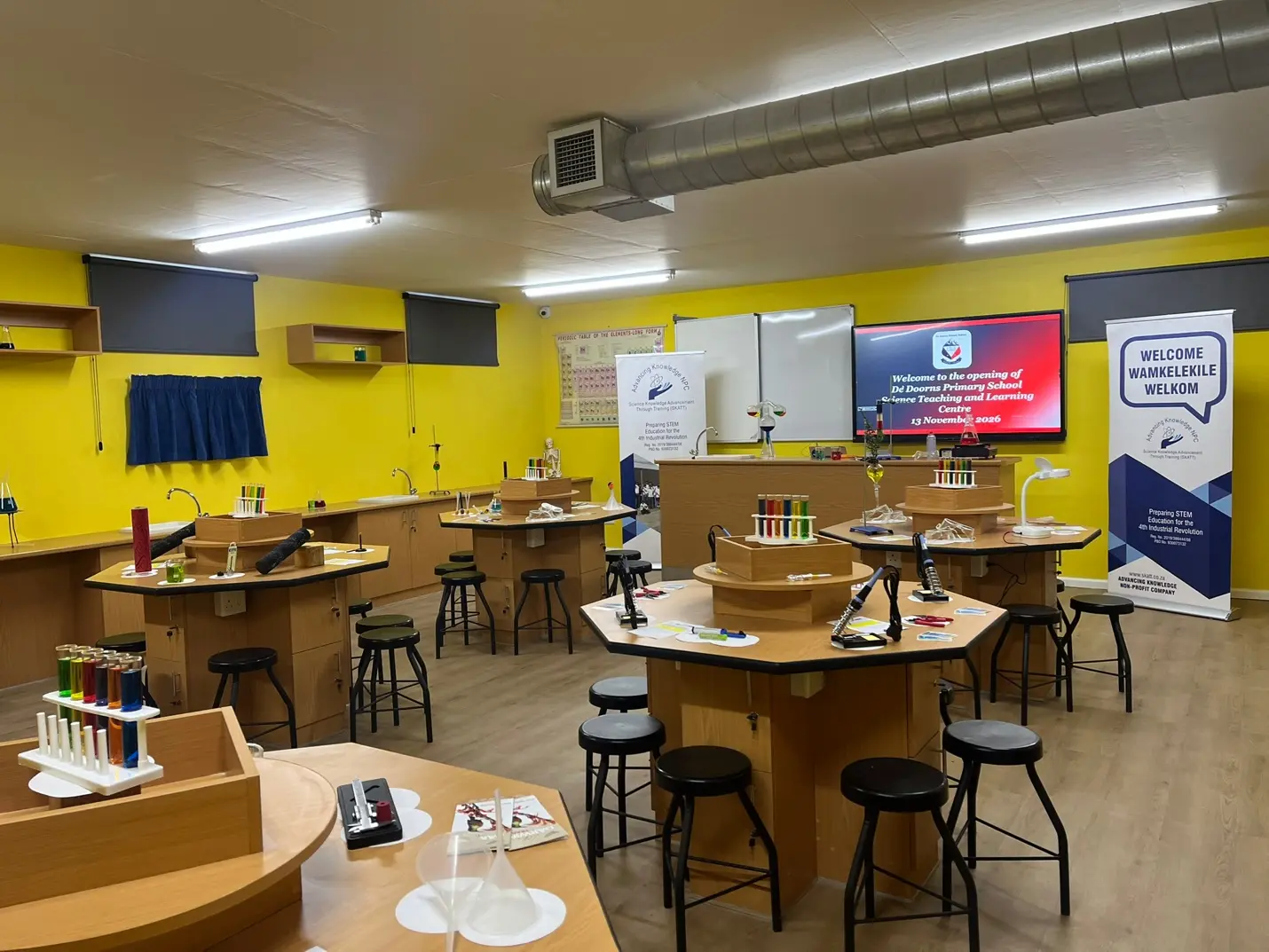
The ongoing partnership between the Garden Cities Archway Foundation (GCAF), the Western Cape Education Department (WCED) and Advancing Knowledge Non-Profit Company (AK NPC) has reached another significant milestone with the establishment of the twelfth and final Science Teaching and Learning Centre (Science TLC) for 2026. The latest addition is at De Doorns Primary School, a rural school serving learners in the De Doorns community. The official opening of the facility took place on Friday, 13 November 2026.
With this latest addition, the partnership has completed twelve Science TLCs during 2026, bringing the total number of centres established across the Western Cape since the initiative began in 2011 to 137.
The continued expansion of the programme reflects a sustained commitment to addressing inequalities in access to quality science education, particularly in under-resourced schools. It also demonstrates what can be achieved through collaboration between organisations that share a vision of creating meaningful and lasting educational opportunities for young people.
The partnership's contribution to STEM (Science, Technology, Engineering and Mathematics) education received national recognition at the 2026 National Science and Technology Forum (NSTF) Awards, widely regarded as the 'Science Oscars of South Africa'. Advancing Knowledge NPC was named the National Winner in the Non-Governmental Organisation (NGO) category for its contribution to STEM education, evaluated over the preceding five to ten years.
The award acknowledged AK NPC's integrated approach to improving access to quality STEM education, combining the establishment of Science Teaching and Learning Centres with sustained teacher professional development and opportunities for learner enrichment.

Beyond Infrastructure: Building a Culture of Inquiry-Based Science Education
An important distinguishing feature of the Science TLC initiative is that it extends well beyond the provision of laboratory infrastructure. The programme is founded on the understanding that meaningful improvements in science education require an integrated approach in which appropriate facilities, professionally supported teachers and active learner participation complement one another.

Through Advancing Knowledge NPC, participating schools receive ongoing support through teacher professional development, including SACE-endorsed courses offered throughout the year. These interventions equip science educators with the knowledge, practical skills and pedagogical approaches needed to make effective use of the facilities and incorporate inquiry-based science education into their everyday teaching.

For many of the schools participating in the initiative, the establishment of a Science TLC represents a significant improvement in the opportunities available to learners. Schools that previously had limited or no access to functional science laboratories can now offer practical science experiences as an integral part of the curriculum.
The purpose-designed facilities provide learners with opportunities to engage directly with scientific concepts through experimentation, observation, investigation and hands-on activities. Rather than relying exclusively on theoretical explanations, learners are encouraged to ask questions, explore scientific phenomena, test ideas and develop their understanding through practical investigation.
Such experiences are particularly important in developing scientific literacy, critical thinking, problem-solving and scientific reasoning. They also help stimulate curiosity, build confidence and encourage learners to consider further studies and careers in STEM-related fields.
The programme therefore seeks to establish more than functional science laboratories. Its broader ambition is to nurture a sustainable culture of scientific inquiry in schools, supported by educators who are confident in facilitating practical, learner-centred science experiences.
De Doorns Primary School: Creating New Possibilities for Young Scientists
The opening of the Science TLC at De Doorns Primary School marks an important development for the school and its learners. The new facility provides an environment in which Natural Sciences can be experienced through practical exploration and discovery, creating opportunities that were previously limited by the absence of appropriate laboratory infrastructure.

Principal Mr Anele Mqikela expressed his enthusiasm about the opportunities the new facility would create for both educators and learners. He indicated that the Natural Sciences teachers were eager to begin a new chapter in science teaching and learning at the school.
Ms Chantel Cupido, Science Subject Advisor in the Cape Winelands Education District, welcomed the professional development and support provided by Advancing Knowledge NPC. She noted that the training had helped educators develop a better understanding of inquiry-based approaches to science teaching and how these could be translated into classroom practice.
She also acknowledged the important role played by the school's Natural Sciences teacher, Ms Lee-Gay Davids, whose commitment was demonstrated through her attendance at all the training sessions offered by AK NPC and her active participation in strengthening her knowledge and skills in inquiry-based science education.
The commitment demonstrated by the school leadership and participating educator highlights an important aspect of the Science TLC model: the successful integration of new facilities into everyday teaching and learning depends on educators who are willing to invest in their own professional development and translate what they learn into meaningful classroom experiences.
A Shared Vision: Investing in Learners and the Future of STEM
Addressing the gathering at the opening, Mr Gregory Kannemeyer, Director of the Cape Winelands Education District, highlighted the significant opportunities that the new Science TLC would create for learners at De Doorns Primary School. He encouraged the principal, science teachers and learners to make full use of the new infrastructure and resources, emphasising the importance of introducing learners to practical science experiences from an early age.
In addressing the learners directly, he said:
"Make sure that you participate actively in learning science. The resources such as test tubes, measuring cylinders, etc. are there for you to use and to improve your understanding of science. You must be fully engaged in any hands-on science activity and use your imagination and motivation to learn science."

Mr John Matthews, CEO of the Garden Cities Archway Foundation, reaffirmed the Foundation's commitment to creating more equitable opportunities in STEM education, particularly for learners in underserved communities.
He emphasised the social responsibility underpinning the Foundation's involvement:
"We do this work because we need to level the playing fields between haves and have-nots. Too many learners, particularly in underserved communities, have the talent and potential to succeed in science and technology but lack access to the resources, opportunities, and support systems that can help them thrive. Our work is driven by a commitment to changing that reality."
Prof Shaheed Hartley, Director and CEO of Advancing Knowledge NPC, highlighted the importance of ensuring that infrastructure development is accompanied by sustained investment in teacher development and learner engagement.
He emphasised the educational philosophy underpinning the initiative:
"By providing the necessary training, knowledge and skills to teachers in inquiry-based science teaching, we want to inculcate practical hands-on involvement of learners so that their understanding stems from a position of I did this rather than I read this somewhere."
Prof Hartley further emphasised that the Science TLC model is based on the understanding that providing appropriate facilities is only one component of improving science education. Equally important is ensuring that educators have the professional capacity to use these facilities effectively and that learners are given meaningful opportunities to benefit from them.

Nurturing South Africa's Future STEM Talent
The significance of the partnership between GCAF, WCED and AK NPC extends beyond the individual schools benefiting from the establishment of Science TLCs. At a broader level, the initiative contributes to one of South Africa's important long-term development priorities: developing a scientifically literate population and building a strong pipeline of future scientists, engineers, technicians, researchers and innovators.
The country's economic growth, technological advancement and international competitiveness depend, in part, on the development of these skills. Strengthening the quality of STEM education at school level is therefore not merely an educational intervention; it is an investment in South Africa's future human capital and development.

By supporting educators, improving access to practical science facilities and encouraging learners to engage actively with scientific concepts, the Science TLC programme seeks to address some of the longstanding structural barriers that have limited opportunities for learners in disadvantaged communities.
Furthermore, the integrated model of infrastructure development, teacher professional development and learner engagement offers valuable lessons for wider implementation across South Africa and potentially the African continent. It demonstrates how sustained partnerships and coordinated interventions can contribute to improving the quality of science education in schools that have historically been disadvantaged by limited resources.
The completion of the twelve Science TLCs for 2026 is therefore more than the achievement of an annual infrastructure target. It represents another step in a longer-term commitment to transforming the teaching and learning of science and ensuring that a learner's educational opportunities are not determined by the circumstances of the community in which they attend school.
Partnering for Greater Impact: Expanding Opportunities in STEM Education
The continued growth and sustainability of the Science TLC initiative depend on partnerships with organisations that recognise the importance of investing in education and developing South Africa's future STEM talent.
Organisations interested in supporting the establishment of Science Teaching and Learning Centres and contributing to the expansion of STEM opportunities for learners in under-resourced schools are invited to contact:
Prof Shaheed Hartley
Director and CEO
Advancing Knowledge Non-Profit Company
Email: shartley@skatt.co.za
Cell: 083 793 0436