


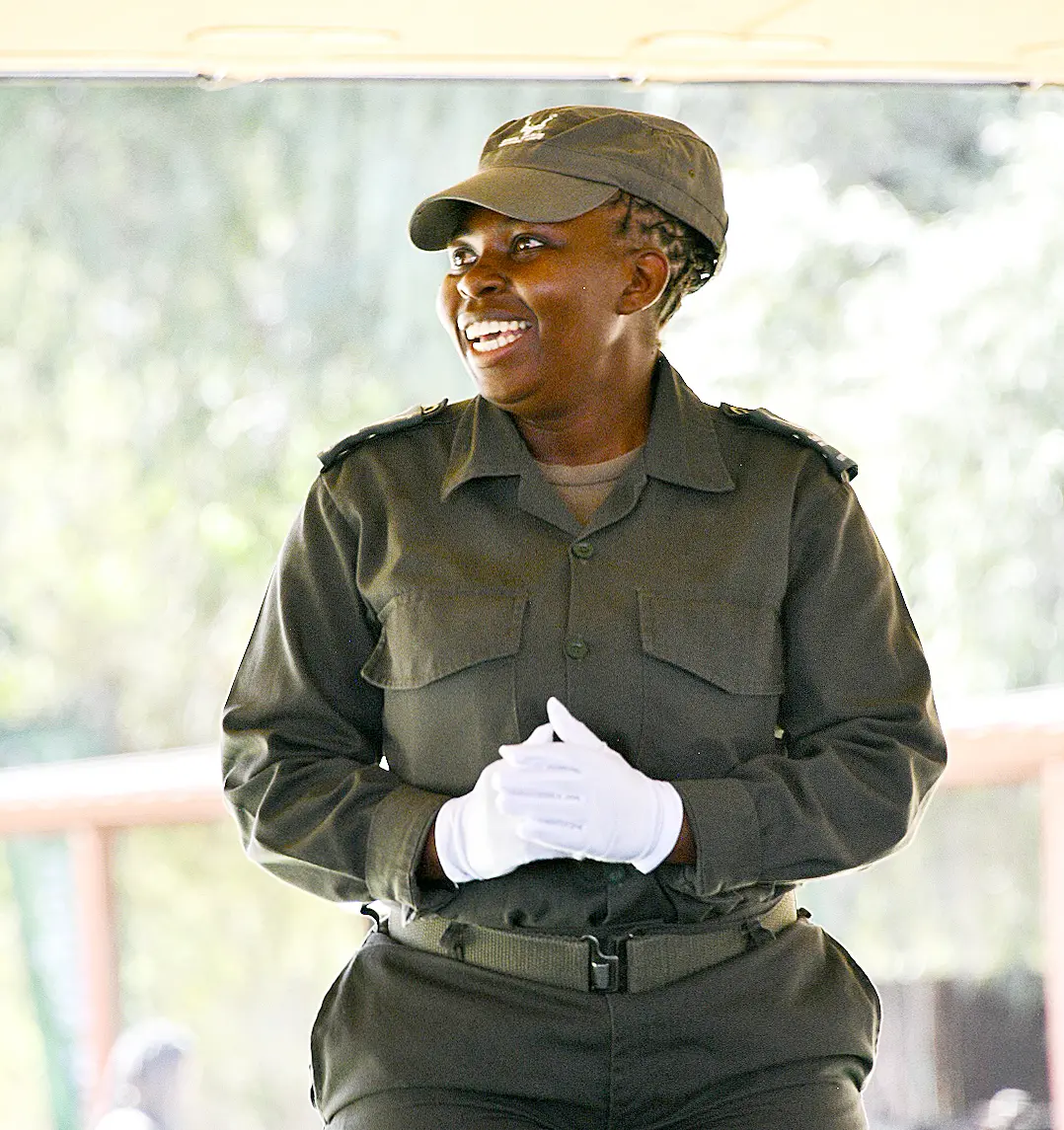
In a male-dominated world of men in camouflage, physically fit, heavily armed and alert to take on dangerous poachers guarding Kgalagadi Transfrontier Park, one of 21 SA National Parks (SANParks) - assistant searching ranger Nomcebo Tshabalala is undaunted.
Based at the Kgalagadi a vast wildlife enclave in the Kalahari Desert region of Botswana and South Africa, bordering Namibia to the west - Tshabalala has told the Mail & Guardian, about the passion for her challenging role.
Kgalagadi is characterised by red dunes and dry rivers, including migrating herds of wildebeest, springbok, with predators like raptors and black-maned Kalahari lions, roaming around.
Tshabalala's job entails reinforcement: conducting anti-poaching operations in protecting the country's wildlife from poachers.
To reinforce the SANParks conservation message of embracing all communities among key stakeholders, she also spends her time educating people, tourists and guests to Kgalagadi about wildlife.
"We talk about the importance of taking care of our biodiversity, our natural resources, as well as the ecosystem that we have inside the park.
"That education also extends out to our local community neighbouring the park, as well as to our farmers, whose depth conservation knowledge requires sharpening.
"Working with different stakeholders, including farmers - on the side of Namibia as well as Botswana, is crucial," maintained Tshabalala.
"Because Kgalagadi is a trans-frontier park, it commands all bordering countries to play an important role.
"We also work in collaboration with the SA Police Service, the SA National Defence Force and local communities who are part of the park's natural heritage sites," she added.
Tshabalala's work demands require her to "take care of our infrastructure inside the park maintenance of our boundaries and electric fence, making sure that we keep our wildlife within the space of the protected area of Kgalagadi".
Ensuring that poachers do not get access into the park is among her priorities.
She said: "Be it our wildlife, flora or fauna species within the park, it has to be protected.
"Another area of importance is that of maintaining our water points.
"We don't have any rivers or any source of water provision in the park, except using groundwater.
"In providing animals with artificial water points, we ensure that we maintain a sufficient daily supply.
"The congregation of animals at water points also serves as a tourist attraction, due to their gathering around water.
"We can see this in pictures posted by tourists on Facebook and on other online platforms."
Research, she said, was key in the role of rangers. "We are focused and assist when it comes to research.
"We have different researches, carrying out all kinds of research inside the park. These range from plants to animals and nutrition.
"In strengthening security, we make sure that the fence is in good condition always coming up with mitigation strategies in enhancing the full protection of the wild and surroundings.
"There are all kinds of research conducted in which we participate, including a survey on lions.
"In monitoring boreholes, we always need to know if there's still any underground water that is available for our wildlife," she said. Tshabalala's career began at the Golden Gate Highlands National Park as a conservation student, where she did her practicals.
This, after completing three years of studies in nature conservation.
Based at the Golden Gate from 2018 to 2021, she was later hired as the field ranger.
From October 2025 to December, she was appointed field ranger corporal, before being promoted to work in Kgalagadi as an assistant section ranger.
On whether she imagined being a ranger while at school, she said: "I wouldn't say that I had any kind of passion when I applied.
"I didn't know anything about conservation. It just happened to be one of those careers that I saw in a project determined to do more research about the field. "I actually fell in love with it when I was doing my first year at university, which was quite interesting.
"I never thought there were people who would go around identifying trees, types of grass knowing the names of all species: plants, birds, animals, marine and terrestrial. "I fell in love with the career and wanted to be part of this dedicated group of people making a difference championing our conservation, protecting biodiversity, ecosystem, as well as our natural and cultural heritage.
"I'm very fortunate to be here right now and be part of this amazing group of people."
On National Women's Month and strides made to empower women, Tshabalala said: "We are now in 2026, things have changed and anything is possible.
"I'm currently serving at supervisory level and leading a group of field rangers something amazing but unthinkable in the past. I never thought I could be where I am today. "I want women to take me as a role model - an example proving that it is possible and doable.
"We need more women voices and those who want to lead conservation. "Together, as women we can do absolutely way much more."
Reflecting on key challenges, Tshabalala said poaching presented the biggest hitch.
"One of the challenges is poaching. "We're trying our level best to make sure that we minimise that.
"Another challenge is that during the fire season, we experience a lot of outbreaks of fire within our protected areas.
"This threatens our biodiversity, fauna and flora, because of vast of areas that burning out.
"Other species die from such fires that we experience within our protected areas some animals that are very small living under rocks.
"We have lizards, snakes and other large antelopes burning from such fires. With limited staff, I fully commend our rangers for their daily work."
At a national ceremony attended by Forestry, Fisheries and Environment Minister David Maynier, SANParks board chairperson Beryl Ferguson, CEO Hapiloe Sello and other dignitaries to commemorate World Ranger Day, Tshabalala was among several rangers lauded for their work.