


A mountain of construction rubble beside the Jukskei River in Alexandra looks perilously close to collapsing into the waterway.
“If this happens, it could block the river and flood parts of Alexandra,” Deputy Water and Sanitation Minister Jack Bloom warned.
He reported seeing “unnatural foaming at various points, long stretches of murky water and widespread illegal dumping”, during a recent aerial survey of the interconnected waterways of the Kaalspruit, Jukskei, Hennops and Crocodile rivers feeding the polluted Hartbeespoort Dam.
The survey highlighted a problem extending well beyond the dam: pollution carried into it by the rivers that feed it, contributing to the spread of invasive water hyacinth and salvinia.
Bloom identified sewage, overflowing pump stations, agricultural fertiliser runoff and industrial pollutants as major sources of contamination. Excess nitrogen and phosphorus fuel the growth of invasive aquatic plants, while depleted oxygen levels threaten fish.
“My aerial oversight showed the importance of identifying hotspots where localised action can eat this giant elephant of a problem one bite at a time,” Bloom told the Mail & Guardian.
“It’s a mixture of failing wastewater treatment plants, pump stations, sewer networks and urban discharge points that need to be tackled. Scientific measurement of flows and nutrient concentrations can properly identify and target where interventions will have the most impact.”
Bloom cited the roughly 90-million-litre daily flow of untreated sewage into the dam from three malfunctioning Johannesburg wastewater treatment works.
The Limpopo-Olifants Catchment Management Agency said wastewater treatment works discharge treated effluent, although untreated sewage could enter rivers through manhole overflows.
Bloom also cited the 2025 Green Drop report, which found that 23 of Gauteng’s 61 wastewater systems were in a critical state. He identified the Zandspruit pump station in northern Johannesburg as a pollution hotspot requiring particular attention and called for municipalities to repair and properly operate failing wastewater treatment works.
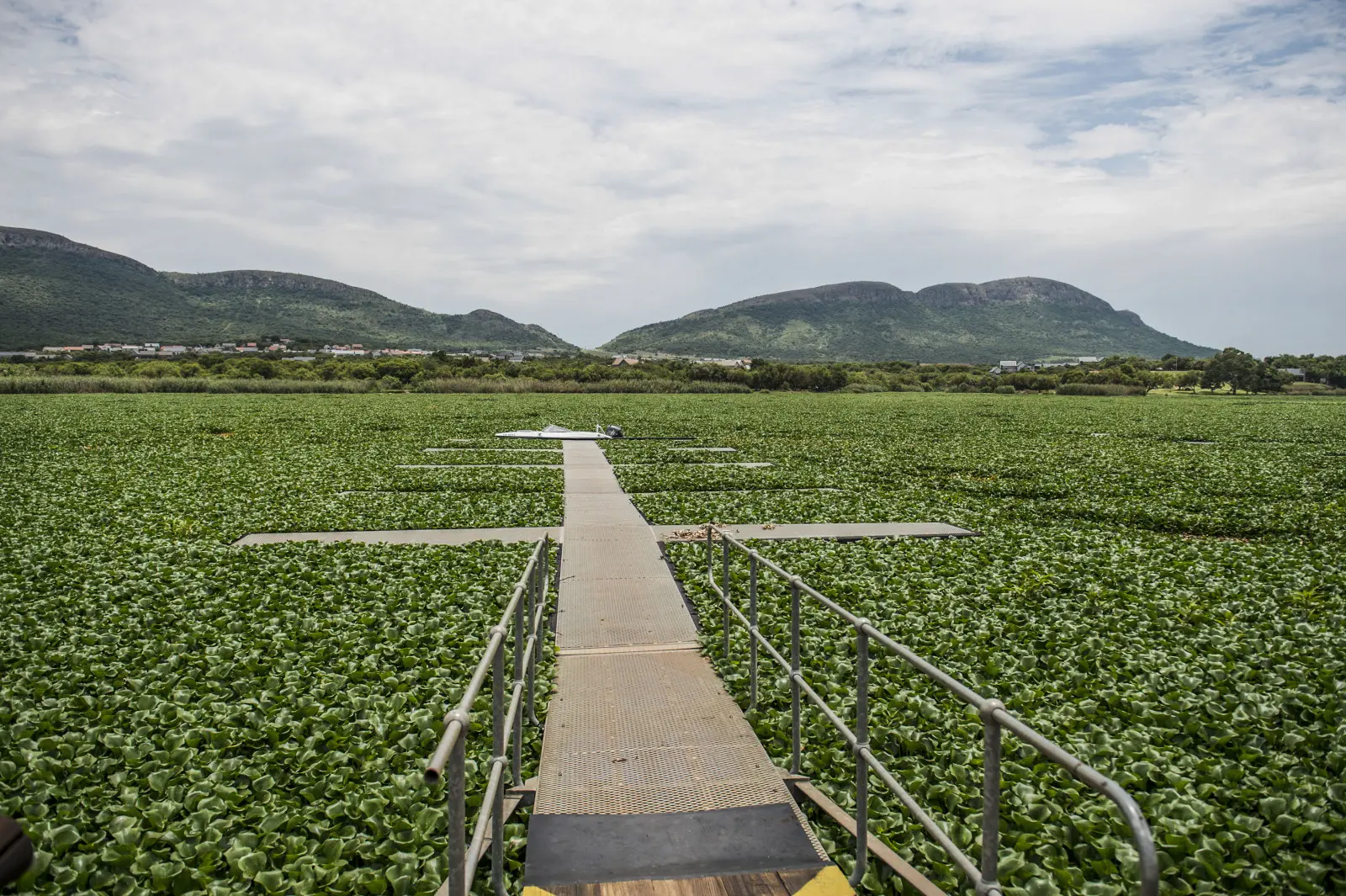
“I was shocked by the vast green blankets of water hyacinth and salvinia covering parts of the dam,” Bloom said.
Magalies Water uses biological control methods, including water hyacinth planthoppers, released under the guidance of Rhodes University’s Centre for Biological Control, to help manage the invasive plants.
“It would be even worse without Magalies Water’s innovative efforts to biologically control these invasive plants,” Bloom said. “But controlling the plants treats the symptom, not the cause, which is the devastating pollution from the inflowing rivers.”
The catchment management agency has called for coordinated action by municipalities and government authorities, citing deteriorating wastewater management, ageing infrastructure and inadequate maintenance.
“Municipalities are responsible for providing water and sanitation services to residents within their areas of jurisdiction,” the agency told the M&G.
Under the Water Services Act, municipalities must operate, maintain, rehabilitate and upgrade water and wastewater infrastructure to meet growing demand. But the agency said competing service delivery priorities often meant wastewater management received insufficient attention and investment.
The Hartbeespoort Dam catchment includes parts of the City of Johannesburg, City of Ekurhuleni, City of Tshwane, Mogale City and Madibeng municipalities.
“Over recent years, as reflected in Green Drop assessment reports, wastewater management performance within many municipalities has deteriorated,” the agency said, citing “ageing infrastructure, vandalism and theft of critical assets, inadequate maintenance, financial constraints, and declining technical capacity”.
The cumulative effect, it said, was the discharge of inadequately treated effluent and sewage into rivers and streams flowing into the dam.
The department of water and sanitation (DWS), together with its agencies, is responsible for regulating and protecting the country’s water resources under the National Water Act. Its regulatory measures include compliance monitoring and enforcement to ensure adherence to legal and licence requirements.
The department has initiated compliance monitoring and enforcement action against Johannesburg, Tshwane, Ekurhuleni and Mogale City over non-compliant effluent discharges and wastewater management failures.
“All these municipalities currently have criminal cases being investigated by DWS and Limpopo-Olifants Catchment Management Agency,” the agency said. It did not provide details of the cases or their status.
The department has also initiated a strategic audit and compliance assessment programme to identify other water users and activities contributing to deteriorating water quality in the catchment.
The agency said sustainable improvements would require investment in infrastructure rehabilitation and maintenance, stronger governance, greater technical capacity and consistent enforcement to ensure accountability and protect water resources.
Bloom has proposed turning the 4km inlet reach into a managed treatment delta incorporating litter capture, settling areas, modular floating wetlands, filtration and oxygenation.
“We have to move from symptom management at the dam to tackling the sources and engineering a recovery using a variety of technologies,” he said.
“The priority must be to stop pollution at source, enforce compliance and restore the health of the rivers that feed Hartbeespoort Dam. No amount of clearing invasive plants will solve the problem while sewage and industrial pollution continue to flow into the dam.”
On Tuesday, Bloom will join community volunteers in a Kaalspruit clean-up and open a set of river litter traps installed along the waterway.
The traps, which catch plastic and other waste before it moves downstream, were installed by the Fresh NGO on municipal land with the approval of the Ekurhuleni metropolitan municipality.
“The Kaalspruit is very bad,” said Willem Snyman, who runs Fresh. “Where we are, it’s above all the sewage works, so it’s only raw sewage coming down here from Tembisa but it’s massive.”
Snyman said much of the raw sewage and plastic waste came from informal homes without services.
“Most of the plastics also come from that source, where people don’t have waste removal services … so everything goes into the river,” he said. “[With the litter traps] we are basically trying to stop all the plastic and clean the sewage a little bit going down.”
Removing plastic upstream was important because of the volume of waste entering the river system, Snyman said.
“I think one can really make a big difference to the rivers by taking the plastic out here because the quantities are ginormous and further down you don’t really have the chance anymore.”